
Biblical Guidance for Teachers
Bible-based tools for teachers to reduce stress, build patience, manage heavy workloads, and cultivate grace-filled classrooms.
Teaching is demanding – balancing lesson plans, student needs, and administrative pressures can leave you feeling drained. But biblical wisdom offers practical tools to navigate these challenges with purpose and peace. Here’s what you’ll find in this guide:
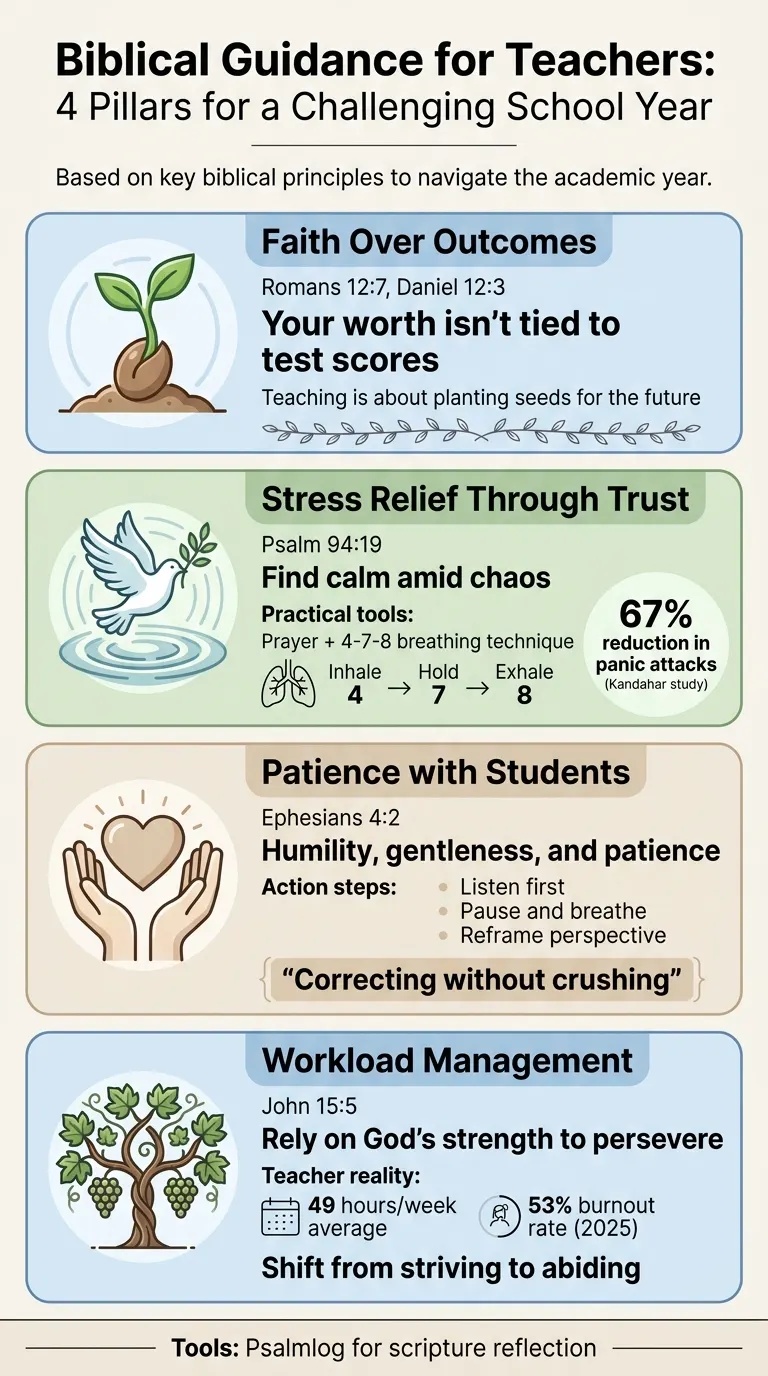
- Faith over outcomes: Your worth isn’t tied to test scores. Scripture reminds us teaching is about planting seeds for the future (Romans 12:7, Daniel 12:3).
- Stress relief through trust: Lean on verses like Psalm 94:19 to find calm amid chaos. Pair it with techniques like prayer and breathwork for immediate relief.
- Patience with students: Ephesians 4:2 teaches humility and grace, helping you handle disruptions with understanding rather than frustration.
- Workload management: John 15:5 reminds us to rely on God’s strength to persevere through long hours and heavy demands.
Practical tips include using prayer, reframing challenges, and leveraging tools like Psalmlog for scripture reflection. Teaching is more than just a job – it’s a calling. With faith as your foundation, you can face the toughest school year with renewed energy and purpose.
Biblical Strategies for Teachers: Faith-Based Classroom Management Guide
5 Bible Verses For Teachers: Encouragment and Inspiration for the Classroom Teacher
Reducing Stress Through Biblical Trust and Comfort
Teaching comes with a relentless to-do list – grading, lesson planning, responding to emails – it often feels like there’s no end in sight. But finding peace in the middle of the chaos is possible when you shift your focus. Instead of letting the workload consume you, leaning into trust in your Creator can bring calm to the storm.
Stephanie Sutherland, author of The Simple Classroom, puts it this way:
Jesus commands us to trust in the Lord and to keep our eyes on Him, but in the midst of a tough school year, it can be difficult to remember who we’re living for – God or The Stress?
This perspective doesn’t magically erase your responsibilities, but it can change how you approach them. Trusting in God’s steady presence reminds you that you’re not alone in navigating classroom challenges or administrative pressures. His comfort can reshape how you view your daily struggles.
Psalm 94:19: A Source of Calm Amid Overwhelm
Psalm 94:19 says: "When anxiety was great within me, your consolation brought me joy". This verse captures a transformative moment – moving from overwhelming worry to genuine joy through God’s comfort. It doesn’t dismiss the existence of stress; instead, it acknowledges how anxiety can sometimes feel all-encompassing.
Interestingly, science backs up this process. Research from Baylor and Duke universities shows that practices like meditative Scripture reading and prayer can reduce cortisol levels and stabilize heart rate variability, both linked to chronic stress. In one study, soldiers deployed in Kandahar who received cards with Psalm 94:19 reported a 67% reduction in panic attacks over six weeks. Even on a neurological level, the brain’s reward system responds to this kind of spiritual consolation.
The comfort described in this psalm goes beyond emotional reassurance. It’s a deeply personal promise from God, rooted in His covenant loyalty. He doesn’t offer peace from afar; He actively provides it. Whether you’re managing classroom disruptions or grappling with administrative demands, His support remains unwavering.
With this understanding of divine comfort, let’s look at ways to bring this hope into your daily teaching experience.
Practical Ways to Relieve Stress in Your Classroom
Psalm 94:19 can guide you in handling stress. Start by naming your specific anxieties. Whether it’s an upcoming observation or struggles with a particular student, identifying these worries and sharing them with God can help you address the root of your stress.
Pair this with the 4-7-8 breathing technique: inhale for 4 counts, hold for 7, and exhale for 8. As you practice this, meditate on Psalm 94:19 to calm your nervous system and internalize its promise of peace.
Memorizing this verse is another powerful tool. When stress hits – whether during a difficult parent meeting or a lesson that’s unraveling – recalling these words can provide immediate reassurance.
Stephanie Sutherland suggests the "acknowledge and pivot" approach:
The thing that the Psalms sets a good example of is letting yourself be stressed and anxious for a hot minute, and then gathering yourself together and saying ‘OK GOD, you’ve got me, right?’ Because He does.
Allow yourself to feel the stress briefly, then intentionally shift your focus back to God’s presence.
Keeping a stress journal can also help. Write down moments when you’ve experienced God’s comfort or seen prayers answered. These tangible reminders of His faithfulness can strengthen your trust during future challenges.
Finally, personalize Psalm 94:19 in your prayers. For example, say: "When my anxiety about [student’s name] was great within me, your consolation brought me joy." This makes an ancient promise feel directly applicable to your current situation.
These practices create a foundation for exploring other biblical principles, like building patience and managing your workload with faith.
Building Patience with Challenging Students
Every teacher has faced the tough moments when a student’s behavior pushes the limits – whether it’s constant disruptions, disengagement, or outright defiance. It’s easy to feel frustrated or even defeated in these situations, but Ephesians 4:2 offers a different perspective on how to respond.
Ephesians 4:2: A Guide for Humility and Tolerance
Ephesians 4:2 encourages believers to live "with all humility and gentleness, with patience, bearing with one another in love." For teachers, this verse serves as more than spiritual encouragement – it’s a practical guide for handling conflict in the classroom.
Humility means setting aside ego and remembering that your role as a teacher is a gift, not a platform for control. Gentleness involves using your authority to guide without crushing a student’s spirit. And patience? That’s the ability to endure difficult moments without losing hope or reacting harshly, trusting in the process of growth rather than expecting instant results.
As WatermarkWaves explains:
Gentleness does not mean silence in the face of truth. It means speaking truth with grace. It means correcting without crushing.
“Bearing with one another in love” calls on teachers to remain committed to their students’ growth, even when their behavior makes it hard. It’s not about tolerating disrespect or ignoring boundaries – it’s about addressing issues with grace and understanding. This approach keeps the focus on building relationships rather than tearing them down.
Practical Steps for Building Patience
Ephesians 4:2 lays the foundation, but how can you bring these principles to life in your classroom? Here are some practical ways to cultivate patience:
- Start with listening. When conflicts arise, take time to hear your students out before jumping to conclusions. This not only helps you understand their perspective but also shows them respect.
- Pause and breathe. When disruptions occur, resist the urge to react impulsively. A moment of calm can help you respond with empathy rather than frustration.
- Reframe your perspective. Philippians 1:6 reminds us that "God isn’t finished yet" – with your students or with you. Viewing challenges through this lens can make patience feel like an act of grace, not weakness.
Teacher, Be Still LLC puts it this way:
When you have the option to blow up on someone or put them in their place, but instead choose to step back and be patient, you are giving Grace. You are choosing Jesus.
Prayer can also be a powerful tool. Beginning each day by asking for wisdom (James 1:5) and patience can prepare your heart for the challenges ahead. Additionally, don’t shy away from admitting your own mistakes. As WatermarkWaves notes:
Humility builds bridges… Pride builds walls.
When you acknowledge your errors, you model the humility and accountability you want to see in your students. This creates a classroom atmosphere where growth feels safe and achievable for everyone.
Managing Heavy Workloads Through Faith and Perseverance
Teachers in the U.S. work an average of 49 hours per week – 10 hours beyond their contracted time – juggling up to 200 students and dedicating 15–20 extra minutes per assignment to verify essays. By 2025, 53% of teachers reported experiencing burnout.
John 15:5: Relying on Christ for Renewed Energy
John 15:5 reminds us: "I am the vine; you are the branches. If you remain in me and I in you, you will bear much fruit; apart from me you can do nothing." This verse offers more than spiritual encouragement; it’s a practical guide for navigating the overwhelming demands of teaching. When we rely solely on our own strength, burnout becomes inevitable. But when we lean into Christ, He renews our energy and equips us to teach effectively.
Linda Kardamis, the founder of Teach 4 the Heart, emphasizes this truth:
"Striving to do things through our own strength often leads to exhaustion, discouragement, and overwhelm. However, the good news is that we don’t have to live this way. God doesn’t want us to endure life on our own."
She further explains:
"The only way to be an effective teacher – to manage an orderly classroom, teach my subject well, and impact my students for eternity – is to abide in His presence."
Staying connected to God enables you to bear lasting fruit, positively influencing your students both in and beyond the classroom. This spiritual foundation naturally leads to practical ways to manage your workload.
Practical Tips for Managing Your Workload
Inspired by the message in John 15:5, here are some actionable strategies to help lighten the load while staying grounded in faith.
-
Shift from striving to abiding. When the workload feels overwhelming, pause and invite God into your day. Trust Him to help carry the weight of your responsibilities. This intentional act of surrender aligns with the biblical call to abide in Him.
-
Seek divine guidance in decision-making. Stephanie Sutherland, a writer and educator, advises:
"Set your sights on the job Jesus called you to do, not the one the world burdens you with."
Prayer can help you discern which tasks truly matter and which ones add unnecessary stress. By focusing on what brings peace and calm, you can prioritize your efforts more effectively. Praying for your students, coworkers, and yourself can also ease the emotional strain of teaching.
-
Reframe your perspective. Instead of viewing challenges as insurmountable, remember that everyone you interact with is a "Child of God." As Sutherland explains:
"When you’re spiritually where God wants you to be, you’re still working, but the work doesn’t weigh you down the same way."
-
Leverage technology to streamline tasks. Tools like AI detectors and batch upload features can reduce administrative burdens, freeing up mental space for deeper reflection and meaningful interactions with your students. The goal isn’t to avoid work but to approach it from a place of abiding in Christ, allowing His strength to sustain you.
Creating a Positive Classroom Using Biblical Principles
A classroom grounded in biblical values can become a space where respectful communication and humility not only influence behavior but also shape character. The way you communicate sets the tone for every interaction, and Scripture offers timeless guidance for fostering this type of environment.
Ephesians 4:29: Promoting Healthy Communication
Ephesians 4:29 says, "Let no unwholesome talk come out of your mouths, but only what is helpful for building up the one in need and bringing grace to those who listen." The word sapros in Greek, meaning "spoiled" or "harmful", emphasizes that speech can either build up or tear down a community. The focus here is on oikodome, or edification, which involves strengthening and uplifting others. In the classroom, this means using words as tools of encouragement, kindness, and love, even when a student may not seem to "deserve" it. Sensitivity to each moment is key.
To align with this principle, eliminate harmful language such as sarcasm, ridicule, or sweeping phrases like "you always" or "you never." Instead, focus on active listening – observe carefully, ask clarifying questions, and respond with patience. Pair constructive feedback with encouragement and specific praise to create a nurturing environment. William Penn’s advice captures this well:
"If you think twice before you speak once, you will speak twice the better for it. Better to say nothing than not to the purpose."
When correction is necessary, approach it calmly and with the intent to help students grow rather than instilling fear. Ephesians 4:29 can also serve as a guide for resolving conflicts – evaluate whether your words are harmful, fail to uplift, or lack grace. Remember, Scripture reminds us that we are accountable for every careless word we speak.
With this foundation of respectful communication in place, humility becomes the next key to transforming your classroom dynamics.
Matthew 18:3-4: Teaching with Humility
Humility plays a crucial role in how you connect with students. Matthew 18:3-4 teaches that those who take the lowly position of a child are considered greatest in the kingdom of heaven. For teachers, this means acknowledging personal limitations and recognizing that wisdom ultimately comes from God.
Humility encourages dialogue, mutual respect, and a willingness to learn from others – even from students. The Topical Bible: Humility in Teaching highlights this beautifully:
"A humble teacher remains teachable, open to learning from others, including their students… This attitude fosters a learning environment where dialogue and mutual respect thrive."
Pride and arrogance can block empathy and create barriers within the classroom. Instead, humility allows you to use your authority for the well-being of the class rather than for personal control. Teach 4 the Heart explains this well:
"We must not abuse our authority by being proud, controlling, or unkind. Pray about the gift of authority God has given you: to manage your classroom humbly for the good of learning and living together."
Lead through service by prioritizing your students’ growth over personal recognition or the need to always be right. Show students that their perspectives matter by listening attentively and responding thoughtfully. When you make mistakes, admit them openly to model humility and build trust. Embrace forgiveness and restoration when disruptions occur, creating a calm and ordered space guided by God’s principles.
These biblical approaches to communication and humility lay a strong foundation for other spiritual practices that can sustain and enrich your teaching journey.
Using Psalmlog for Scripture Reflection and Growth

Deep scripture reflection plays a key role in nurturing your spiritual growth. The biblical principles discussed earlier become even more impactful when paired with consistent, thoughtful engagement with Scripture. Psalm 119:99 highlights the value of this practice: "I have more insight than all my teachers, for I meditate on your statutes." This verse underscores how reflecting on God’s Word can guide daily decisions with wisdom that goes beyond formal education. For teachers juggling busy schedules, finding time for reflection can be tough. That’s where tools like Psalmlog come in, making scripture reflection more accessible and practical for spiritual development.
How Psalmlog Helps Teachers Grow Spiritually
Psalmlog is tailored for Christian teachers who want to integrate spiritual discipline into their hectic routines. Its voice-to-text journaling feature allows you to record prayers and reflections right after class, eliminating the need for typing. Plus, the app’s AI connects your entries to relevant Bible verses, offering immediate scriptural insights that align with your specific experiences.
Stefan, the founder of Automateed, shared his thoughts on using Psalmlog:
The app’s AI then connected my reflections with relevant Bible verses, adding depth to my entries.
He also noted:
I appreciated how seamless and personal the experience felt, almost like having a spiritual mentor in my pocket.
Beyond journaling, Psalmlog includes tools to track your growth. These features visualize your spiritual progress and suggest personalized action steps based on your entries. By combining reflection with these tools, the app helps foster qualities like patience and perseverance over time.
Using Psalmlog to Build Patience and Perseverance
When faced with challenges like managing difficult students or feeling overwhelmed by grading, Psalmlog’s voice feature can capture your immediate thoughts and emotions. The app then links your reflections to scriptures such as Ephesians 4:2 or John 15:5 – passages previously discussed in this guide – to provide renewed perspective and encouragement. Monthly growth reviews identify stress triggers and highlight areas where patience has improved. This intentional focus on Scripture helps transform biblical knowledge into deep, personal conviction. Many teachers report that this process enriches their prayer life, shifting it from routine obligation to an engaging and joyful connection with God.
Psalmlog offers both free and paid options. The free version includes basic tools for prayer and reflection, while the Faith Builder plan, priced at $19.99 per month, provides 300 minutes of recording time, personalized AI insights, and full access to all features. Keep in mind that an active internet connection is required to make full use of the app’s AI capabilities.
Conclusion: Moving Through the School Year with Faith
Stay Connected to Scripture
Scripture isn’t just a nice-to-have – it’s the steadying force that keeps you centered when things feel chaotic. When lesson plans crumble or your inbox overflows with emails, turning to Scripture offers clarity and peace. Think of it as your compass, helping you navigate everything from mid-year exhaustion to the stress of a new week. These verses serve as a source of renewal, reminding you of the bigger picture.
Start your day with a simple, heartfelt prayer before the school day begins. Ask for "eyes to see hidden needs" and "a heart that is slow to anger and quick to listen." When a student misbehaves, consider their actions as a form of communication – a story they may not yet know how to share. Grounding yourself in Scripture each morning equips you to respond with patience and grace, no matter what challenges arise.
Put Faith-Based Strategies into Practice
Let Scripture guide your actions, turning reflection into meaningful steps in the classroom. For example, when faced with a frustrating email or a disruptive student, take a moment to pause and pray for wisdom. A brief pause can shift you from a reactive mindset to one of calm, intentional leadership. Begin to see every student as an opportunity to make a difference, even in small ways.
Embrace the idea of planting seeds rather than expecting instant results. Galatians 6:9 reminds us that the rewards of your efforts may not be seen until long after your students leave your classroom. Use moments of quiet reflection to align your teaching with your faith, ensuring that both work hand in hand. Teaching isn’t just about delivering lessons – it’s about sharing your heart and values. To avoid burnout, follow the example of taking time for rest and spiritual renewal. Your faith isn’t something separate from your work – it’s what carries you through the highs and lows of every school year.
FAQs
How can I use these Bible verses in a public school setting?
In public schools, Bible verses can be shared as part of inspirational messages that emphasize universal values like patience, resilience, and strength. For instance, Philippians 4:13 can be presented as a motivational quote about perseverance. These messages work well in neutral, non-religious settings – like a bulletin board labeled "Inspirational Quotes" or within newsletters – highlighting encouragement while steering clear of promoting specific religious beliefs.
What can I do when I’m burned out but can’t reduce my workload?
When burnout takes hold and feels too much to bear, turning to spiritual renewal and drawing on God’s strength can make a difference. Reflecting on scriptures such as Matthew 11:28-30 – where Jesus calls out to the weary, offering rest – can bring peace to a tired heart.
Practical steps can also help you regain balance. Take time to remind yourself of your purpose, lean on trusted colleagues or mentors for support, and spend moments in prayer, asking for guidance and patience. The Bible offers encouraging examples, like Elijah in 1 Kings 19. When he was at his lowest, God provided him with comfort and the strength to keep going. Let this serve as a reminder that even in exhaustion, God’s care is ever-present.
How do I correct misbehavior with grace without losing authority?
Discipline, when viewed through a biblical lens, becomes more than just correction – it’s a chance to shape students’ character and guide them toward a life of holiness. Hebrews 12:4-11 reminds us that God’s discipline stems from His love and is always for our good. In the same way, our approach to discipline should reflect patience, love, and a desire to support growth.
By seeing discipline as an opportunity to align with God’s work in their lives, we can ensure that our corrections are purposeful and rooted in care. This doesn’t mean compromising authority but rather exercising it in a way that nurtures and uplifts, mirroring the loving discipline we receive from God.