
Peter's Spiritual Growth Patterns
Study Peter's shift from impulsive disciple to steady, Spirit-led leader—failure, restoration, suffering, and sustained obedience.
Peter’s story shows one clear point: spiritual growth is usually slow, messy, and shaped by failure as much as success. I see that pattern in his life from the Gospels to Acts to 1–2 Peter: he starts as bold but unstable, falls hard in denying Jesus, is restored, then becomes a steady leader who helps build the early church. One public sermon led to about 3,000 responses in Acts 2, but that moment came after fear, confusion, and correction.
If I had to sum up the whole article in a few lines, it would be this:
- Peter was called, but not finished
- He understood parts of Jesus’ identity, yet missed Jesus’ mission
- His denial became a turning point, not the end
- Jesus restored him and gave him work to do
- The Holy Spirit changed his boldness from impulse to grounded courage
- Correction from Jesus, Paul, and life in the church shaped him
- Suffering changed how he viewed faithfulness
- Repeated obedience formed steadier character over time
What stands out to me most is that Peter did not change in one moment. He changed across many moments. His life moves from calling, to confusion, to collapse, to restoration, to leadership, and then to the mature voice we hear in his letters.
Quick comparison
| Stage | What Peter was like | What changed |
|---|---|---|
| Calling | Eager, aware of his sin | He began following Jesus |
| Early discipleship | Bold, quick to speak, often mistaken | He saw who Jesus was, but not the path of suffering |
| Denial | Fearful under pressure | His self-trust broke down |
| Restoration | Forgiven and recommissioned | He was called to care for others |
| Pentecost and church leadership | Public, brave, Spirit-led | His courage had a new source |
| Later letters | Steady, pastoral, focused on suffering and holiness | His faith had depth and endurance |
For me, the main takeaway is simple: Peter’s growth followed a pattern many believers still know well – failure, correction, obedience, and slow change. That is what this article traces.
Peter’s Transformation
Peter’s Transformation Across the New Testament
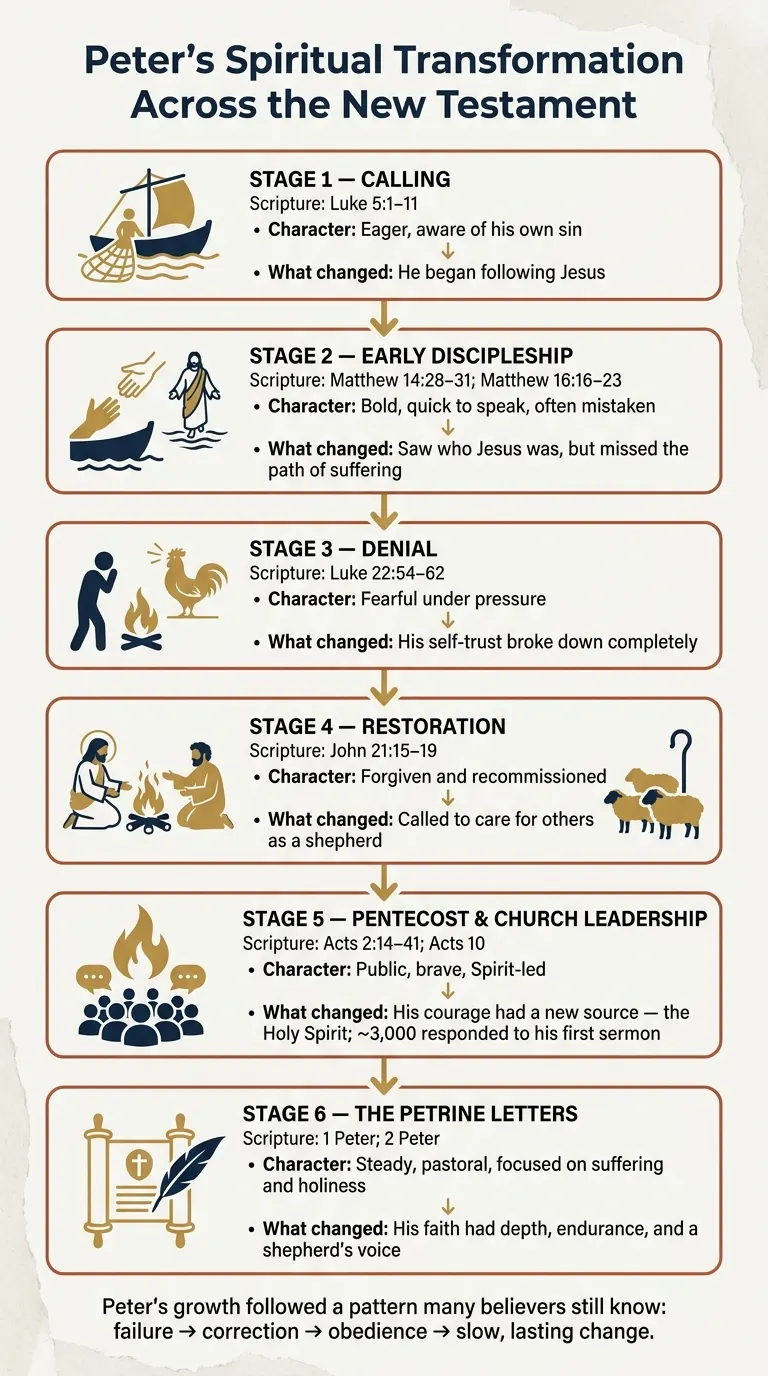
Peter’s Spiritual Transformation: From Fisherman to Church Leader
You can see the pattern clearly when you follow Peter through the New Testament. His story starts with eagerness, runs straight into failure, and then turns into Spirit-filled leadership and steady pastoral care. It doesn’t happen in the abstract. It happens in scenes you can point to – moments where something changes.
From His Calling to Misreading Jesus’ Mission
In Luke 5:1–11, Peter falls at Jesus’ knees and says, "Go away from me, Lord; I am a sinful man." Not long after that, he’s walking on water (Matthew 14:28–31), confessing Jesus as the Messiah (Matthew 16:16), and then – almost in the same breath – rebuking Jesus for saying that He would suffer and die (Matthew 16:21–23).
That stretch says a lot about this stage of Peter’s life. He sees something true about Jesus, but he still misses the shape of Jesus’ mission. His insight is real. So is his confusion. Peter wanted Messiahship without suffering.
That tension drives the story toward Peter’s lowest moment: denial.
Denial, Restoration, and a Renewed Calling
Luke 22:54–62 gives us Peter at his worst. The man who said he would never leave Jesus denied even knowing Him three times – not in front of rulers or soldiers, but in front of a servant girl.
Then John 21:15–19 answers that scene with careful symmetry. Jesus asked "Do you love me?" three times, once for each denial. Biblical scholars note that both scenes happened beside a charcoal fire, the only two times that specific Greek word (anthrakia) appears in the entire New Testament. That detail matters. It turns restoration into more than pardon. Jesus is reshaping Peter’s memory and, with it, his sense of who he is.
And the charge that follows – "Feed my lambs… Tend my sheep… Feed my sheep." – marks a shift in Peter’s identity. He’s no longer just the impulsive disciple who speaks first. He is now called to care for others as a shepherd.
Restored and sent again, Peter steps into public leadership.
Pentecost, Early Church Leadership, and the Petrine Letters
The man who once denied Jesus before a servant girl later stood up and preached in Jerusalem. About 3,000 people responded that day (Acts 2:14–41). Peter also opened the Gospel to Gentiles through his visit to Cornelius in Acts 10, a turning point that changed the direction of the early church.
His letters show the last stage of this arc. In 1 and 2 Peter, impulsiveness is no longer the main thing people notice. What comes through instead is the voice of a shepherd writing to believers scattered across the Roman Empire, teaching them about suffering, holiness, and perseverance through practical life application.
He warns them about the devil prowling "like a roaring lion" (1 Peter 5:8). Coming from Peter, that line carries extra force. This is a man who once brushed past Jesus’ warning about spiritual testing. Now he writes with the weight of someone who learned the hard way.
From Luke 5 and Matthew 16 to Luke 22, John 21, Acts 2, Acts 10, and 1–2 Peter, the movement is clear: Peter’s change reaches both what he does in public and who he becomes within.
5 Patterns That Explain Peter’s Spiritual Growth
The timeline shows what changed. These five patterns help explain how Peter changed: grace after failure, correction after resistance, and zeal shaped into steadier faithfulness.
Impulsive Zeal Became Spirit-Led Boldness
Early Peter often acted before he paused to think. He stepped out onto the water before grasping the moment’s weight (Matthew 14:28–31). He cut off Malchus’ ear in Gethsemane (John 18:10). He spoke up again and again – sometimes with sharp clarity, sometimes not.
After Pentecost, that same man spoke with fearless boldness under pressure. The difference matters. Peter’s confidence was no longer driven by temperament. It was rooted in power from the Spirit.
Failure as a Means of Formation
Peter’s denial is one of the hardest scenes in his story. It’s painful to read because it strips away every illusion of strength. But that failure also became a turning point.
It didn’t disqualify him. It exposed him. His denial brought his self-confidence into the open and replaced it with dependence on Christ. Sometimes growth doesn’t come through winning. It comes when a person sees, with painful clarity, that they can’t carry themselves.
Understanding, Community, and Calling Deepened Over Time
Peter grew through correction and through life with other believers. Jesus corrected him. Later, the Apostle Paul confronted him in Antioch over his hypocrisy toward Gentile believers (Galatians 2:11–14). That kind of accountability stings. Still, it helped keep Peter’s theology honest.
His place in the community changed too. At Pentecost, he stood "with the eleven" (Acts 2:14), which marks a quiet but meaningful shift from personal prominence to shared leadership. He wasn’t fading into the background. He was learning how to lead as part of a body, not just as the loudest voice in the room.
Suffering Reshaped Peter’s View of Faithfulness
The Peter who rebuked Jesus for speaking about the cross (Matthew 16:22) later wrote that "various trials" test the "genuineness of faith" (1 Peter 1:6–7). That’s a major shift, and it didn’t happen in a classroom.
Peter came to see suffering as refining, not pointless. In 1 Peter, hardship is not framed as proof that God has left His people. It is presented as a refining process. That view carries weight because Peter wrote it as someone who had lived through fear, loss, pressure, and endurance.
Repeated Practice Produced Steadier Character
Peter’s new name pointed to formation, not instant completion. His growth unfolded through repeated cycles of instruction, failure, correction, and renewed obedience.
Even later in life, Peter was still learning. His vision tied to Cornelius in Acts 10 shattered prior social and religious boundaries. That matters because it shows growth was not a one-time event. It came through repeated instruction, failure, correction, and obedience.
Learning how to find a Bible verse for your exact situation can help you identify these patterns in your own life. That slow formation is the pattern the next section turns into a method for study and reflection.
How to Study Peter’s Growth and Apply It Today
Reading Methods and Sources That Clarify the Pattern
To apply Peter’s story well, read it as a sequence, not a snapshot.
Read Peter as a person who changes over time, not as a fixed type. If you follow him in order – from the Gospels to Acts and then into his letters – you can actually watch that growth unfold. That makes it easier to see a pattern instead of a pile of disconnected scenes.
It also helps to track when the text says Simon, Peter, or Simon Peter. Those shifts can signal changes in setting, tone, or emphasis.
Pay attention to the text’s deliberate details. A word-level study can keep you from reading too much into Peter’s words in John 21. Then compare Peter’s early reactions with his later teaching. That’s where the change starts to stand out.
Using Journaling and Scripture Reflection to Track Growth
The same timeline that explains Peter’s growth can guide personal reflection too.
Journaling is one simple way to make growth easier to see over time. For example, you can track moments of fear-driven silence – times when connection with Christ leads to avoidance – alongside moments of Spirit-given boldness under pressure. That mirrors Peter’s denial in Luke 22 and his bold preaching at Pentecost in Acts 2. When you write those moments down over weeks or months, patterns start to show. You may spot areas where change is already happening, and areas where it still needs work.
The eight qualities Peter lists in 2 Peter 1:5–7 – faith, goodness, knowledge, self-control, perseverance, godliness, kindness, and love – give you a concrete grid for self-examination. Instead of asking, "Am I growing spiritually?" in a vague way, use that list to name where growth is strongest and where more work is needed.
Psalmlog lets readers speak a situation and receive Scripture, insight, and next steps. Looking back at those reflections can help you notice growth patterns that are easy to miss in the moment.
These observations lead into the article’s final takeaway.
Conclusion: What Peter’s Story Reveals About Spiritual Transformation
Peter’s change came through calling, failure, restoration, suffering, and steady obedience. That arc ties together the five themes traced above. The move from Simon to Peter was a process of formation, not reinvention. It grew out of life close to Jesus, honest exposure of failure, and a willingness to be shaped instead of merely sent in a new direction.
What makes Peter such a strong case study is how visible his growth was. He was corrected in front of others, denied Christ under pressure, and still needed correction years into his ministry. Yet he also became the one who preached at Pentecost and saw about 3,000 people respond after his first Spirit-empowered sermon. That matters. In Peter, the New Testament shows transformation as a long path of obedience, not a one-time reset. Impulsive zeal turned into boldness. Failure became formation. Suffering reshaped faithfulness. Repeated obedience gave his character steadiness.
Setbacks often become the place where formation happens. Peter’s story shows that spiritual transformation is gradual, costly, and real.
FAQs
Why did Peter deny Jesus?
Peter denied Jesus because fear got the better of him. In the high priest’s courtyard, the pressure was intense, and being linked to Jesus could have led to prison, violence, or death. In that moment, Peter chose self-protection and said he didn’t know Him.
What makes the scene hit so hard is that Peter had been so sure of himself earlier. He insisted he would stand by Jesus. But when the test came, he denied Him three times. Then Peter remembered Jesus’ warning, and he wept bitterly.
How did Jesus restore Peter?
Jesus restored Peter through deliberate, healing actions on the shore of the Sea of Galilee. At a charcoal fire, Jesus brought Peter back to the scene that echoed his denial. But He did it to give grace, not shame.
Jesus then asked Peter three times to affirm his love. That matched Peter’s three denials and gave him a public chance to reaffirm his devotion. And Jesus didn’t stop there. He recommissioned Peter to feed and shepherd His sheep.
What changed Peter after Pentecost?
After Pentecost, Peter was a different man. The Holy Spirit took the place of his old fear and impulsive swings, giving him steady courage.
Jesus’ forgiveness and Peter’s repentance started that restoration. But the Holy Spirit gave him the power to preach the gospel in public and face persecution with a deep fear of God instead of fear of people.