
Keep Going When No One Believes
Sustain your vision with faith, prayer, and practical tools like voice journaling and Scripture when others doubt your idea.
When no one supports your idea, it’s easy to feel isolated or discouraged. But the reality is, doubt from others doesn’t mean your vision is wrong – it often means it’s unique to you. This article highlights how faith, perseverance, and practical tools like journaling can help you move forward, even without external validation. Here’s what you’ll learn:
- Why discouragement is normal: Resistance often signals meaningful work.
- Faith as a foundation: Trust in God’s timing and guidance, even during delays.
- Lessons from Biblical figures: Stories of persistence and growth through challenges.
- Practical steps: Use tools like voice journaling to process doubts and track progress.
- Scripture for encouragement: Key verses to keep you grounded in your calling.
The journey may feel slow, but every step prepares you for what’s ahead. Stay faithful, keep praying, and trust that progress is unfolding, even when it’s not visible.
Perseverance: Why you can’t have faith without it (Bible Study)
Why Discouragement Is a Normal Part of the Process
Feeling discouraged? That’s actually a sign you’re doing meaningful work. It’s not proof that you’re on the wrong path – it’s often an indicator that you’re on an important one. When you’re pursuing something that truly matters, early resistance is almost inevitable. It’s part of the process.
Eduardo Quintana and Dr. Layne McDonald emphasize this idea perfectly:
"Opposition is not always a sign that we are moving in the wrong direction. Often, resistance appears precisely because something important is being rebuilt."
The journey from vision to fulfillment is rarely quick or smooth. Think about Abraham, who waited 25 years for Isaac. Moses spent 40 years in the wilderness before stepping into his calling. And Joseph? He endured 13 years of betrayal, slavery, and imprisonment before his dream came to life. These delays weren’t wasted time – they were seasons of preparation. Dr. Layne McDonald explains it well:
"His delays are not denials – they are developments."
In other words, while God is working on the outcome, He’s also working on you, shaping you to carry the vision He’s placed in your heart.
How Faith Carries You Through Uncertain Seasons
When the road gets tough, faith is what keeps you moving forward. Even when there’s no visible evidence of progress, faith becomes your anchor. Hebrews 11:1 reminds us, "Faith is the substance of things hoped for, the evidence of things not seen" (NKJV). The word "substance" here suggests a strong foundation – something solid to stand on. True faith isn’t tied to outcomes; it’s rooted in trust in God.
Biblical Figures Who Kept Going Despite Doubt
The Bible is full of examples of people who pressed on despite overwhelming doubt. Take Noah, for instance. He spent 100 years building the ark with no visible sign of the flood – his only motivation was obedience to God.
Joseph’s story is another powerful example. Betrayed by his brothers, sold into slavery, and wrongfully imprisoned, he faced trial after trial. Yet, through it all, his character was being shaped. As one source puts it:
"Discouragement isn’t just an enemy to overcome – it’s often God’s workshop where character is forged."
Then there’s Nehemiah, who faced public ridicule from figures like Sanballat and Tobiah, as well as discouragement within his own community. Instead of giving up, he turned to prayer, developed strategic plans, and kept moving forward. The resistance he faced only strengthened his determination and sharpened his mission.
These stories remind us of an important truth: you don’t need external validation to keep going. Resistance and waiting aren’t signs of failure – they’re part of the process. They prepare you, refine you, and equip you to fulfill the vision God has placed in your life. Keep moving forward, trusting that every challenge plays a role in shaping your faith and your future.
What Scripture Says About Staying Faithful to Your Calling
The Bible offers more than just comfort – it provides practical wisdom for those waiting for a dream or vision to come to life. It speaks to the realities of waiting, silence, and slow progress, offering encouragement for staying faithful even when the path feels uncertain.
Key Bible Verses for Encouragement
Certain scriptures stand out when doubt begins to creep in. Take Jeremiah 29:11, for instance. It’s often quoted, but its deeper context is worth noting. This verse was written to the Israelites during their Babylonian exile – a period of waiting that stretched for 70 years. The Hebrew word for hope in this passage, tiqvah, literally translates to "cord" or "thread" – a lifeline symbolizing divine restoration and hope.
Another powerful reminder comes from Galatians 6:9: "Let us not grow weary of doing good, for in due season we will reap, if we do not give up." The phrase "due season" is key here. Just like a harvest, progress depends on steady effort and the right conditions – it can’t be rushed by simply wishing for it.
Then there’s Proverbs 3:5-6, which shifts the focus from outcomes to attitude: "Trust in the Lord with all your heart, and do not lean on your own understanding. In all your ways acknowledge Him, and He will make straight your paths." This isn’t about sitting idly by. Taylor Welch, Founder of The Wealthy Consultant, explains it well:
"God rarely blesses paralysis. He blesses steps, and your steps will always require faith."
These verses remind us that God’s timing is deliberate, and trusting Him through slow progress is an act of faith.
How to Trust God’s Timing When Progress Is Slow
The Bible emphasizes that God’s timing is precise, not random. Habakkuk 2:3 highlights this with the Hebrew word moed, meaning "an appointed time" that’s fixed and set in advance. Pastor Joel Lowery of Crossroads Church sums it up perfectly:
"Precision always requires patience."
So, what can you do during those seasons of waiting? Use the time to grow. Instead of viewing it as wasted, see it as a period for building character, sharpening skills, and expanding your capacity for what’s ahead. As Chad A. Brodrick puts it:
"Faith is not built on immediate answers. It is sustained by trusting God’s character even when His timing and actions are unclear."
One practical way to stay grounded during these slow seasons is by writing things down. Record scriptures, prayers, and moments of clarity as they come. These notes become your stones of remembrance – tangible reminders of God’s faithfulness. When doubt creeps back in, those written moments serve as proof that God is still at work. Tools like voice journaling can also help you capture and reflect on His ongoing work in your life.
How Voice Journaling Helps When Doubt Is Loud
When doubt takes over, it can feel like your emotions are in a constant whirlwind. Voice journaling offers a quick and honest way to untangle those feelings and process them in real time.
What Is Voice Journaling?
Voice journaling is exactly what it sounds like: speaking your thoughts, prayers, or questions out loud into a recording device – most often your phone. Unlike traditional journaling, it captures the nuances of your voice – your tone, pauses, and emotions – things that often don’t come through in written words. It’s flexible too. You can record a quick entry while driving, walking in the morning, or during those quiet, late-night moments when doubt seems the loudest.
By verbalizing your fears, you’re forced to identify and name them. Research has shown that speaking feelings aloud can reduce fear and improve emotional regulation. You can take this one step further by pairing it with Scripture. For example, read a verse like Galatians 6:9 or Proverbs 3:5–6 out loud, then record your honest thoughts about how it applies to your situation, the doubts you’re wrestling with, and the direction you’re seeking from God.
This simple act of speaking and reflecting can open the door to deeper clarity, especially when combined with tools designed to enhance this practice.
How Psalmlog Supports Your Voice Journaling Practice

Psalmlog is a voice-first journaling app made specifically for Christians navigating moments of doubt, fear, or searching. You speak your reflections, and the app responds with a personalized six-point Scripture-based guide. This includes a key verse, a reflection, encouragement, a prayer, and an actionable next step. It’s perfect for those moments when typing feels like it would disrupt the flow of your prayer.
Here’s what makes Psalmlog stand out:
- Scripture tagging: You can link Bible verses to your voice entries, helping you track how specific passages have spoken to you over time.
- Personalized insights: The app identifies recurring themes and verses based on your entries, which can be especially helpful during ongoing struggles with doubt or discouragement.
- Privacy-focused design: Your voice is transcribed locally on your device, and the audio is discarded immediately. Only the encrypted text transcript is stored.
"During my cancer treatment, fear would hit me at 3 AM when no one was available. Psalmlog became my instant connection to God’s comfort." – Maria L., Cancer Survivor
Psalmlog offers a Faith Builder plan for $19.99/month (or $14.99/month when billed annually), which includes 300 minutes of voice recording time each month.
Practical Tips for Getting the Most Out of Voice Journaling
If you’re ready to make voice journaling part of your routine, here are some tips to get started:
- Find a quiet, private spot: Choose a place where you can speak freely without distractions.
- Ease into it with a simple opening: Start with something like, "Lord, today I want to talk to You about…" to help the words flow naturally.
- Keep it short and focused: A 5–10 minute session is often enough. You can read a Scripture passage aloud, share your thoughts or feelings as if talking to a trusted friend, and end with a question to God, leaving a moment of silence for reflection.
- Listen back weekly: Use Psalmlog to revisit one or two earlier recordings. You might notice a shift in your tone – from anxiety to calm – or see repeated themes where Scripture has brought clarity. Often, the most unpolished recordings capture the rawest and most meaningful parts of your journey.
Over time, this practice can turn moments of doubt into a powerful record of God’s guidance and faithfulness in your life.
How to Pray for Discernment and Next Steps
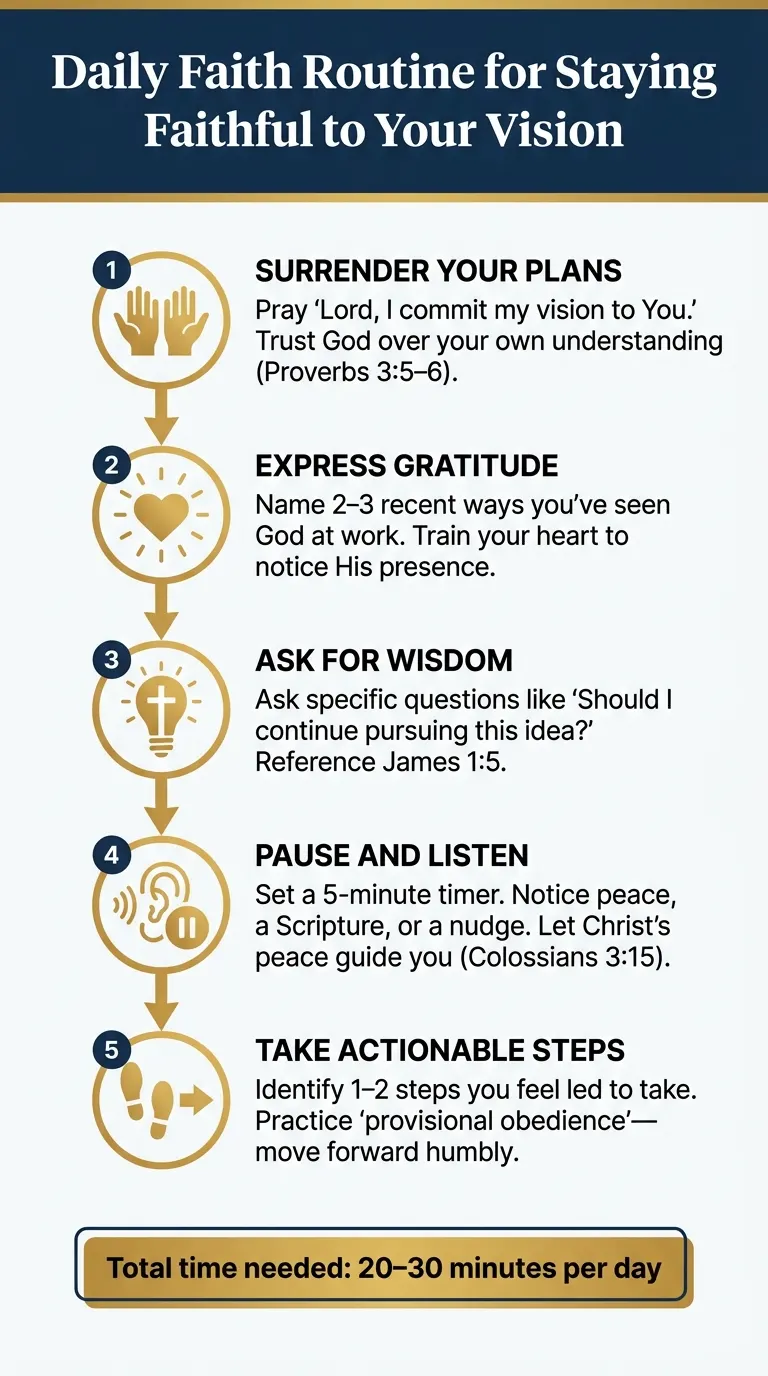
Daily Faith Routine for Staying Faithful to Your Vision
Voice journaling helps you process doubts, while prayer invites God’s guidance. Together, they pave the way for expressing your thoughts and receiving divine direction.
A Daily Prayer Routine for Clarity
Pairing Scripture with a consistent prayer routine can sharpen your ability to discern God’s will. The good news? This doesn’t require hours of your day. Dedicating 20–30 minutes is enough to create space for meaningful connection without feeling overwhelmed.
Start by surrendering your plans to God. A simple prayer like "Lord, I commit my vision to You" mirrors the wisdom of Proverbs 3:5–6, which encourages trust in God over relying solely on our own understanding.
Next, take a moment to express gratitude. Name two or three recent ways you’ve seen God at work in your life. This practice helps train your heart to notice His presence, even during times when outward encouragement feels scarce.
Afterward, ask for wisdom. James 1:5 assures us that God generously provides wisdom to those who seek it. Be specific about the decisions you’re facing – perhaps asking, "Should I continue pursuing this idea? Should I seek feedback from someone?" Once you’ve spoken, pause and listen. Set a timer for five minutes and invite the Holy Spirit to guide you. Pay attention to recurring feelings of peace, a Scripture that comes to mind, or a subtle nudge toward a particular action. Colossians 3:15 encourages us to let Christ’s peace guide our hearts, offering a real sense of direction.
Finally, identify one or two actionable steps you feel led to take. Offer these steps back to God, practicing what some call "provisional obedience" – moving forward humbly while staying open to adjustments. Often, clarity emerges as you take these small, faithful steps.
This routine complements your voice journaling by preserving the insights you gain for future reflection.
How to Capture What You Hear During Prayer
After praying, take time to record any insights or impressions while they’re still fresh. It’s easy for these moments to fade quickly, which is why many spiritual directors recommend writing them down immediately. Whether it’s a Scripture verse, a sense of direction, or a potential next step, jot it down or record a quick voice note.
Over time, tagging Scriptures and tracking personal insights can reveal patterns – recurring verses, themes, or a shift from confusion to clarity. This practice creates a long-term, searchable record of your spiritual journey, helping you reflect on how God has been guiding you all along.
How to Review Your Notes and Keep Moving Forward
Writing down your thoughts and insights is only the beginning. The real transformation happens when you take the time to review them.
Why Regular Reflection Matters
When life slows down, it can feel like you’re stuck in place. But often, the growth you can’t see day-to-day becomes clear when you look back over weeks or months. Reviewing your notes helps you spot answered prayers, identify your next steps, and confront recurring fears that might be holding you back.
Set aside 15–30 minutes each week for a quick check-in, and dedicate a longer session once a month to dive deeper. During your weekly review, skim through your entries, highlight key scriptures, and jot down one key takeaway and an actionable next step. The monthly review lets you zoom out: look for patterns, shifts in your confidence, and moments where your sense of purpose feels sharper. This process is about staying honest and attentive to how God is guiding you.
Ask yourself focused questions during these reviews: What progress have I made since my last review? Are there scriptures or themes that keep surfacing? What discouragements keep repeating, and what truths can counter them? These questions help turn your reflections into practical, forward-moving insights.
Using Psalmlog to Track Your Spiritual Progress
Journaling can quickly become overwhelming when you’re trying to track progress through a mountain of entries. That’s where Psalmlog’s personal insights dashboard can be a game-changer. It organizes your reflections by surfacing patterns – like recurring themes, scriptures, and shifts in your emotional and spiritual tone. Instead of endlessly scrolling through old entries, you can see clear evidence of growth, like moving from fear to trust or from confusion to clarity.
With tagged entries, you can easily revisit moments of encouragement or confront recurring doubts. For example, if you’re hit with doubt on a random Tuesday, you can pull up past entries that remind you of God’s faithfulness. It’s not just about staying organized – it’s about staying grounded when emotions try to derail you.
This structured approach to reviewing your notes doesn’t just highlight God’s guidance; it strengthens your resolve to keep moving forward.
Staying Patient and Trusting the Journey
Joseph spent years in prison before his purpose unfolded. David was anointed king long before he ever took the throne. Both waited without visible proof of progress, relying instead on faithfulness. Their stories remind us that delay doesn’t mean denial. Often, the quiet seasons are where the real preparation happens.
As you reflect, ask yourself: Am I waiting patiently, or am I stuck? Patience looks like continued prayer, small acts of obedience, and trust even when the results are slow. Stalling, on the other hand, often looks like circling the same doubts without taking new steps. If your notes show the same fear cropping up month after month without action, it’s a signal – not to push harder, but to bring that fear to prayer and ask for courage to take the next step.
Progress rarely feels dramatic or follows a straight path. But when you review your notes with an open heart, you’ll often see more movement than you realized. And that small glimpse of progress can be enough to keep going. By reflecting regularly and trusting God’s timing, you reinforce your commitment to the journey ahead.
Conclusion: Stay Faithful to Your God-Given Vision
The path from inspiration to meaningful impact is rarely straightforward. Feeling discouraged along the way doesn’t mean you’ve gone astray – it often signals that you’re pursuing something worthwhile. As Dr. Layne McDonald wisely says:
"Waiting on God is never wasted time. It’s working time – in His hands."
Scripture has a unique way of not just offering comfort but also sparking transformation. A study involving over 100,000 believers revealed that engaging with the Bible at least four times a week boosts personal confidence by 228% and reduces discouragement by 31%. This spiritual renewal equips you to embrace practical tools that fuel growth and resilience.
Practices like voice journaling and prayer provide clarity and reinforce your sense of purpose. When combined with reflection, they allow you to discern God’s guidance, even during quiet or seemingly stagnant periods. These stretches of waiting aren’t wasted – they’re where your character grows to match your calling.
So, keep writing your vision, praying over it, and revisiting the insights God has already shared with you. Even if your idea doesn’t receive immediate support, remember that it’s your faithfulness – not instant validation – that will carry it forward.
"Persistence is the sacred act of holding on when heaven is silent." – Dr. Layne McDonald
FAQs
How do I know my idea is from God?
To determine if your idea is truly from God, start by checking if it aligns with Scripture – God’s guidance will never contradict His Word or lead you toward sin. Take a moment to examine your motives. A genuine idea inspired by God often serves a greater purpose and encourages humility rather than self-promotion.
Seek confirmation through prayer, fasting, and advice from wise, trusted individuals. Finally, pay attention to the peace within you. Even when faced with uncertainty, God’s calling often brings a deep and steady sense of confidence that endures.
What if waiting turns into procrastination?
Waiting can sometimes feel like procrastination, but that feeling might be rooted in fear, perfectionism, or an aversion to uncertainty. However, biblical waiting is anything but passive – it’s active and purposeful. Think of it like a waiter at a restaurant, always attentive and ready to serve. It’s about being prepared and fulfilling responsibilities while seeking God’s guidance. Ask yourself: Are you hesitating out of avoidance, or are you genuinely seeking direction? Take a small step forward today, trusting that God will guide you through your actions rather than your inaction.
How can I hear God more clearly each day?
To hear God more clearly, start by creating moments of stillness. This means cutting back on internal noise and reducing distractions from digital devices. A helpful tool for this is Psalmlog, which lets you express your thoughts naturally while its AI links your emotions to relevant Scripture.
Pair this with practices like studying the Bible in its proper context, meditating on specific passages, and maintaining a steady prayer life. If you feel a prompting, take time to ensure it aligns with Scripture, consult with mature believers for guidance, and patiently wait for clarity.