
Daily Examen: 10-Minute Prayer Review
Use a 10-minute Examen to review your day with God—notice presence, name feelings, thank, confess, and ask for grace tomorrow.
If I have 10 minutes, I have enough time to review my day with God. That’s the core idea here.
I see this practice as a short daily check-in that helps me do five things:
- Pause and notice God’s presence
- Thank Him for specific moments
- Name my feelings with honesty
- Confess sin and resistance
- Ask for help for tomorrow
In plain terms: this is not a scorecard. It’s a simple way to look back over the day, spot grace, face failure, and end with prayer. For many Christians, a daily prayer planner like this can feel more doable than a long routine, and 10 minutes is short enough to fit into a lunch break, bedtime, or early morning start.
A few key points stand out:
- Gratitude works best when it is specific
- Emotions can point to what shaped my heart
- Confession should be direct, not vague
- One short prayer for tomorrow is enough
- Consistency matters more than length
I’d sum it up like this: the Examen turns an ordinary day into prayer by helping me walk through it with God, one moment at a time.
How to Pray the Daily Examen Prayer (St Ignatius of Loyola's Examen)
What the Prayer of Examen is
The Prayer of Examen is a short, structured prayer that helps you look back on your day with God. Think of it as a heart check, not a scorecard. You’re not rating your day or trying to prove anything. You’re slowing down long enough to notice how God is at work in the life of someone He has already rescued.
The five core steps in plain language
The Examen uses a simple pattern you can come back to each day. Each part leads into the next:
- Become aware of God's presence
- Give thanks for specific gifts from the day
- Notice your emotions honestly
- Confess failures and resistance
- Ask for grace for tomorrow
Here’s the basic idea: in about 10 minutes, you pause, pay attention, and walk back through your day with God instead of just rushing into the next thing.
What to look for during the review
The review is the center of the Examen. As you look back, pay attention to three things: gifts, emotions, and moments of resistance or grace.
Start with gifts. Look for specific moments that showed God’s care. Not just big wins or dramatic answers to prayer. It could be a kind word, a needed pause, a good conversation, or the strength to get through a hard hour.
Then turn to emotions. Your feelings matter here. They can point to patterns in your spiritual life, including anxiety, resentment, peace, or contentment. In plain terms, emotions are data. They often show what’s been shaping your heart beneath the surface.
Finally, notice failures to confess and moments of grace. Where did you push against God’s nudge? Where did you follow it, even if you did it clumsily? Those small moments can say a lot. The Examen helps bring them into view.
Next, you’ll turn these steps into a simple 10-minute prayer you can use tonight.
How to pray a 10-minute Examen step by step
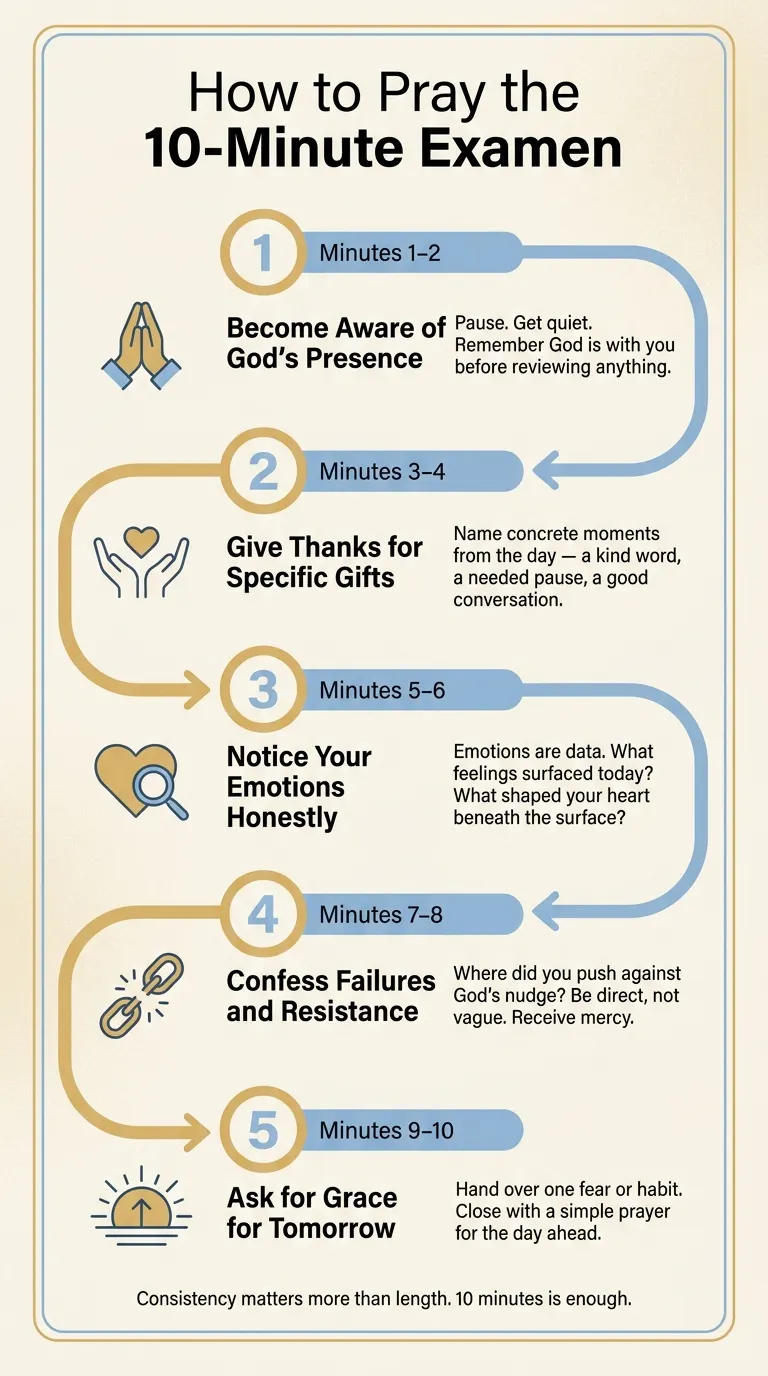
Minutes 1–2: Become aware of God's presence
Start by pausing. Before you look back on the day, turn your attention to God.
You don’t need fancy words here. Just get quiet for a moment and remember that God is with you.
Minutes 3–8: Review the day in order, using these questions to guide your prayer
Now walk through your day from beginning to end. Move through it slowly, and let these questions steer your prayer:
| Review Category | Reflection Question |
|---|---|
| Gratitude | What specific moments brought joy, and what should I thank God for? |
| Emotions | What am I feeling right now? |
| Failures | Where did I act dishonestly, angrily, or enviously today? |
| Grace | What do I need to surrender to God? What promise from Scripture do I need to hold onto? |
Keep the questions short. That helps the review stay honest and focused instead of drifting into overthinking.
Minutes 9–10: Ask for forgiveness and pray for tomorrow
To finish, thank God for what you noticed. Confess one failure. Then hand over one fear or habit that’s weighing on you.
Close with a simple prayer for tomorrow. Use this same rhythm in the sample prayer below.
A simple 10-minute Examen you can use tonight
A guided sample prayer
Use this prayer tonight and swap the brackets for your own details.
Minutes 1–2 (Presence): Lord, I am here. Help me see this day through Your eyes, not just my own.
Minutes 3–4 (Gratitude): Thank You for [specific moment, e.g., a kind word from a colleague]. Thank You for Your grace in this moment.
Minutes 5–8 (Review): Where was I restless? [struggle]. Where did I sense Your peace? [moment]. Forgive me for [failure].
Minutes 9–10 (Release): Thank You for meeting me here. I confess [specific failure], receive Your mercy, and ask for grace for tomorrow.
If something stands out, record one short voice note before moving on. That small step can help you remember what came up without turning this into a big project.
Simple tools to keep the habit going
If talking helps you stay on track, voice journaling is an easy way to repeat the Examen without much friction.
Want to keep it short? Record one voice note with:
- one gratitude
- one failure
- one prayer for tomorrow
That’s enough to keep the practice simple and steady.
Conclusion: Building a daily review habit with God
After the sample prayer, the main goal is consistency, not complexity. A focused daily review with God doesn't need to take long. Ten minutes is enough.
One of the easiest ways to stick with it is to tie it to a routine you already have. Add the Examen to something steady, like your morning coffee, lunch break, or bedtime. It also helps to keep your journal or prayer apps where you'll see them. That small visual cue can bring you back to the habit. Over time, steady practice matters much more than a perfect streak.
If the full practice feels like too much, make it smaller instead of walking away from it. There's no single right way to pray the Examen. Some nights, one moment of gratitude or one verse is enough.
Keep these five points in mind:
- Start with God's presence. Turn your attention toward God before you review anything else.
- Name specific gifts. Concrete moments of gratitude help you notice grace more clearly.
- Face emotions and failures honestly. Slow down enough to see what was hard instead of skimming past it.
- Notice where grace showed up. Over time, this helps you recognize God's work in ordinary moments.
- Ask for help tomorrow. End by bringing the next day to God in prayer.
Keep the Examen simple, and it can become a steady habit that helps you grow in awareness of grace and in your response to God.
FAQs
When is the best time to pray the Examen?
The best time to pray the Examen is the time when you can set aside 10 minutes and stick with it.
A lot of people like doing it in the evening because it gives them a chance to look back on the day. That said, morning can work just as well. A quiet lunch break can too. What matters most is picking a set time and place that fits easily into your routine and feels easy to return to day after day.
What if I do not feel anything during the review?
If you don’t feel much during your review, don’t beat yourself up or feel guilty. Spiritual practice is about showing up with steady care, not forcing a certain feeling.
If you feel stuck, keep it simple. Go over the facts of your day, or ask God for guidance. What matters most is honesty, not getting it “right.” A lot of the time, patterns only start to show after a while.
Can I do the Examen in under 10 minutes?
Yes. You can practice the Examen in less than 10 minutes.
What matters most is honest, focused reflection, not the length of the session. A few steady minutes each day can help more than pushing yourself through a longer routine that doesn’t fit your life. The best timing is the one you can stick with.