
Chronological Bible Reading: 1-Year Plan & Tips
Read the Bible in historical order with free chronological plans—1-year (12–15 min/day), 2-year, or 90-day options and practical tips to stay consistent.
If you want the Bible to feel more like one story, a chronological reading plan is a simple way to do it. I’d sum it up like this: you read Scripture in the order events happened, not just in the order the books appear, and that often makes the timeline easier to follow.
Here’s the short version:
- A 52-week bible reading plan usually takes about 12–15 minutes a day
- A 2-year plan can drop that to about 5–10 minutes a day
- A 90-day plan may take 45–60+ minutes a day
- You’ll read Psalms, prophets, and Paul’s letters near the events they connect to
- If I miss days, I don’t need to restart – I can catch up slowly or jump back in
This kind of plan helps me see:
- how Job may line up near Genesis
- how Psalms fit into David’s life
- how prophets fit beside kings
- how Paul’s letters fit into Acts
- why repeated scenes in Kings/Chronicles and the four Gospels are normal
Chronological Bible Reading? Here’s What Goes Wrong
Quick Comparison
| Plan style | How it reads | Daily time | Best fit |
|---|---|---|---|
| Chronological | By timeline of events | Often 12–15 min/day for 1 year | People who want the story flow |
| Canonical | By Bible book order | Varies | People who want the standard order |
What matters most is simple: pick a pace I can keep, use a basic tracker, and don’t quit after missed days—learning how to consistently read the Bible is a marathon, not a sprint. A printed checklist, phone app, or short voice note after each reading can help me stay with it over time.
What a Chronological Bible Reading Plan Is
A chronological Bible reading plan puts Scripture in the order the events happened. So instead of following the Bible from front to back by the table of contents, you read the story as it unfolds over time.
That shifts where some books show up. Job is often read alongside Genesis. In the New Testament, Paul’s letters are placed into Acts at the points when he likely wrote them during his missionary journeys. That’s what gives both the Old and New Testaments a timeline-based flow.
Canonical Order vs. Chronological Order
The Bible’s canonical order groups books by genre. Chronological order takes that same material and rearranges it by historical sequence. Side by side, the contrast is pretty easy to spot:
| Aspect | Canonical Order | Chronological Order |
|---|---|---|
| Organization Principle | Grouped by literary genre (Law, History, Poetry, Prophets, Gospels, Letters) | Arranged by historical timeline of events |
| Reading Experience | Like a library of individual books; the story can feel like it restarts or jumps | Like a single, continuous narrative |
| Placement of Prophets | Grouped together at the end of the Old Testament | Interwoven with the books of Kings and Chronicles during the eras they lived |
| New Testament Flow | Gospels first, then Acts, then all of Paul’s letters | Paul’s letters inserted into the narrative of Acts at the time they were written |
Why Many Readers Prefer the Timeline Approach
Reading in canonical order can feel a bit like walking through a library. Each book sits on its own shelf. Reading chronologically feels more like following one long story from scene to scene.
One big payoff is seeing how the prophets connect to the kings they were speaking to. In canonical order, Isaiah, Jeremiah, and the minor prophets sit near the back of the Old Testament, far from the events they address. In chronological order, they appear alongside the kings and moments they speak into, so their warnings hit with much more context.
The same pattern shows up in the New Testament. Most of Paul’s letters predate the final written form of the Gospels by roughly 10–20 years. Reading those letters alongside Acts helps you see the setting in which Paul wrote to the Thessalonians or the Corinthians. That extra context can change the way those letters read.
That connected storyline is the main reason many readers like this approach. Next, see how that timeline looks across the Old and New Testaments.
How the Bible Flows in a Chronological Plan
Here’s what that timeline looks like when you read it.
Old Testament: Narrative, Poetry, and Prophets in Historical Context
The Old Testament moves through six phases: Creation and the Patriarchs, Exodus and Wilderness, Conquest and Judges, the United Kingdom, the Divided Kingdom, and Exile and Return.
In a chronological plan, books show up where they fit in the story. So you read Psalms during David’s life, wisdom books during Solomon’s reign, and the prophets next to the kings and events they spoke into. That changes the feel of the reading quite a bit. The prophets start to sound like live messages sent into a crisis, not extra material tacked on later.
The Divided Kingdom is usually where this shift matters most. Things can feel scattered when you read the Old Testament in standard book order. In a timeline, the story holds together more clearly. The Exile and Return section does this well by bringing Ezra, Nehemiah, Esther, and the post-exilic prophets Haggai, Zechariah, and Malachi into one connected storyline.
The same basic pattern shows up in the New Testament, but the books are arranged around Jesus, Acts, and the early church.
New Testament: Gospels, Acts, Letters, and Revelation in Timeline Order
Most chronological plans blend Matthew, Mark, Luke, and John into one Gospel timeline. Instead of reading four separate accounts back to back, you follow Jesus’ ministry as one unfolding story.
After the Gospels, Acts becomes the main framework for the New Testament timeline. Paul’s letters are placed into Acts at the points where they were likely written. For example, 1 Thessalonians is often placed near the events of Acts 17. That setup helps the letters feel more grounded because you can see what was happening around them at the time.
The plan usually ends with Hebrews, 1–2 Peter, 1–3 John, Jude, and Revelation.
What to Expect as You Read Through the Plan
Some parts move fast, especially story-heavy sections like Genesis or Acts. Other days slow down with laws, genealogies, or prophetic imagery. That’s normal.
You’ll also notice repeated events. The same moments show up in both Kings and Chronicles, and Jesus’ life appears across all four Gospels. Far from being a problem, that repetition helps the bigger picture click into place.
A few details can vary from plan to plan. Job is a common example, and some prophets may be placed a bit differently depending on the reading schedule.
Once you see the flow, the next move is picking a free plan and a pace you can stick with.
How to Start a Free Chronological Bible Reading Plan
Chronological vs. Canonical Bible Reading Plans: Which Is Right for You?
Choose a Pace You Can Keep Up With
Pick a pace that fits your life now, not the version of you with extra hours and perfect discipline. If you’re honest about the time you can protect each day, you’re much more likely to stick with it.
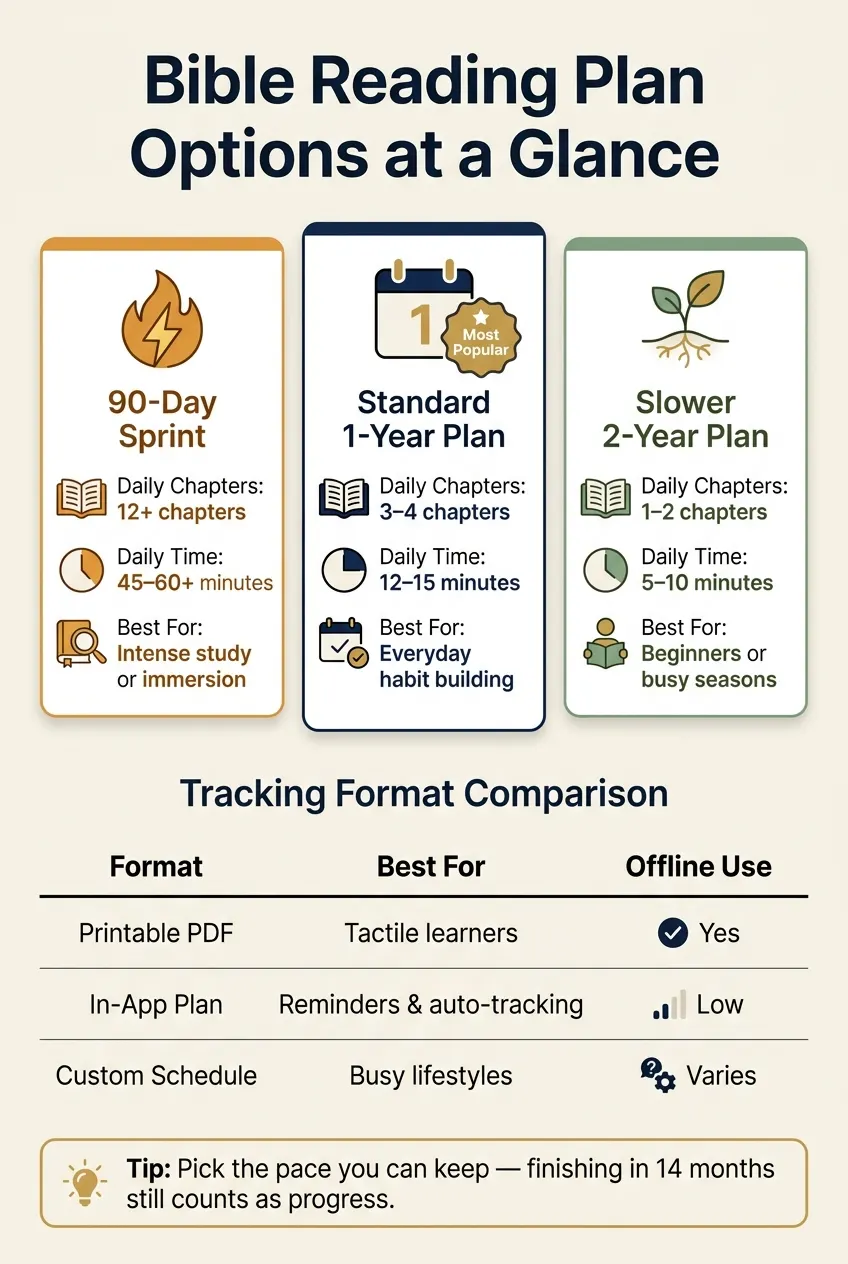
A standard one-year plan usually asks for 3–4 chapters a day. That comes out to about 12–15 minutes. A slower two-year plan cuts that down to 1–2 chapters daily, or about 5–10 minutes, which can be a good fit during busy seasons or if you’re new to daily Bible reading. At the other end, a 90-day sprint calls for 12+ chapters per day and 45–60+ minutes. That’s better for a focused study season than a long-term daily rhythm.
| Plan Type | Daily Chapters | Daily Time | Best For |
|---|---|---|---|
| 90-Day Sprint | 12+ chapters | 45–60+ minutes | Intense study or immersion |
| Standard 1-Year | 3–4 chapters | 12–15 minutes | Everyday habit building |
| Slower 2-Year | 1–2 chapters | 5–10 minutes | Beginners or busy seasons |
Start with the pace you can keep going. If a one-year plan feels like too much, you don’t have to force it. You might even consider starting with a New Testament reading plan to build momentum. You can split one day’s reading across two or three days and still keep moving.
After you choose a pace, pick the format that makes reading easier to start.
Get a Free Plan in Print or on Your Phone
Free plans usually come in two simple formats: printable PDFs and phone apps. Many include reminders and progress tracking, and most let you start on any day of the year.
The main goal here is simple: remove friction. If printing a checklist makes it easier to sit down and read, use that. If your phone helps you stay on track with prayer tracking apps and progress bars, go with the app.
Once you’ve picked a format, set up one simple way to track your reading and use it every day.
Set Up a Tracking System That Keeps You Consistent
Your tracking system doesn’t need to be fancy. A printed checklist, a note in your phone, a calendar streak, or an app’s built-in tracker can all help you stay steady.
| Format | Best For | Flexibility | Offline Use |
|---|---|---|---|
| Printable PDF | Tactile learners and those wanting a digital break | Low; fixed dates or check-boxes | Yes; no power/internet required |
| In-App Plan | Reminders and automatic tracking | High; syncs across devices | Low; usually requires data/sync |
| Custom Schedule | Busy lifestyles or specific study goals | High; set your own start/end dates | Varies by tool used |
A small trick can help here: tie your reading to something you already do. Read with your coffee, at breakfast, or during your commute. That kind of cue can make the habit feel less like one more task and more like part of the day.
How to Stick With the Plan Without Burning Out
Once your plan and tracker are set, the hard part is simple to name and hard to do: staying consistent.
Build a Daily Reading Habit That Repeats
Morning works well for a lot of people. But your lunch break or commute may fit your life better. The best time is the one you can keep.
Pick one set time and one set place, then guard it. Tie your reading to something you already do, like coffee, breakfast, or your commute. That way, it feels less like starting from scratch each day and more like part of your routine.
Catch-Up Methods That Keep You From Quitting
Missing a day or two does not ruin the plan. In most cases, what knocks people off track isn’t the missed reading. It’s the guilt that follows.
If you fall behind, don’t start the whole plan over. Just use the option that matches how far behind you are:
- Missed 1–2 days: Add the missed reading to your next two sessions.
- Missed a week or more: Jump to today’s reading and keep moving.
- Busy travel or a packed week: Use an audio Bible during a commute or walk. It still counts, and it helps the habit stay in place.
Once you’re back on pace, keep the passage with a short voice reflection.
Use Psalmlog to Reflect on What You Read
Reading through Scripture in chronological order gives you a lot to take in. Without reflection, it’s easy for passages to run together, especially when you’re deep in the Prophets or moving through the Epistles.
That’s where Psalmlog helps. After each reading session, record a short voice journal entry. The app connects each voice note to the passage you read, so your notes stay tied to specific verses. Over time, those notes can show repeating themes across Scripture and help you remember what God is showing you, not just get to the end of the plan.
For example, after Psalm 51 and David’s confession in 2 Samuel, record one thing that stood out.
Conclusion: Start Simple, Read in Order, and Keep Going
A chronological Bible reading plan puts Scripture in historical order, so the events and writings show up when they happened. That makes it easier to read Scripture in sequence and keep moving without losing track of the timeline.
This kind of reading does more than reshuffle books. It helps you see the Bible as one connected story. Old Testament prophecy, New Testament fulfillment, and Paul’s letters make more sense when you read them in context. And when you’re trying to stay consistent day after day, that kind of clarity helps a lot.
A one-year plan usually takes about 12–15 minutes a day. And if you finish in 14 months instead of 12, that still counts as steady progress.
Once the habit is there, a short voice reflection can help the passage stay with you. Keep the schedule realistic, use a forgiving catch-up plan, and record one insight in Psalmlog after each reading session. That mix turns the plan into a steady practice you can stick with.
FAQs
Which chronological plan should I start with?
If you’re reading the Bible for the first time, it usually makes sense to start with the standard canonical order. That gives you the basic storyline first and helps the bigger picture fall into place.
If you want a chronological plan instead, start with a 365-day reading schedule that places the 66 books in historical order. Most plans begin with Genesis, put Job near the start, and work Psalms and the prophets into the timeline where they fit.
Will different plans place some books differently?
Yes. Some events don’t have a clear date, and some books don’t have a clearly settled author. Because of that, scholars sometimes place them in different spots in history.
For example, Minor Prophets and some letters may show up in a different order from one plan to another. Those changes usually come from different views in historical research and academic study.
What should I do if I fall behind?
If you fall behind, don’t let it turn into pressure. The plan is there to help you stay engaged with Scripture, not make you feel behind.
Just pick up where you left off and keep going.
You can slow the pace, use catch-up days to get back on track, or move through it at your own speed. Aim for consistency, not perfection.