
Faith in College: Staying Christian on Campus
Stay rooted in Christ at a secular university through small daily habits, community, apologetics, healthy living, and voice journaling.
Navigating faith in a secular college can feel overwhelming, but it’s possible to stay spiritually grounded by being intentional. Here’s how:
- Build Daily Habits: Start small, like 15 minutes of prayer or Bible reading each morning. Use apps like YouVersion for structured plans.
- Make Faith-Based Decisions: Let Scripture guide choices, set boundaries, and avoid situations that compromise your values.
- Find a Community: Join Christian groups like Cru or InterVarsity, and connect with a local church for accountability and support.
- Defend Your Beliefs: Prepare for intellectual challenges by understanding common objections to Christianity and using resources like Tactics by Greg Koukl.
- Stay Healthy: Prioritize sleep, exercise, and limit screen time to maintain focus on spiritual growth.
- Use Tools Like Voice Journaling: Apps like Psalmlog can help you deepen your prayer life while balancing a busy schedule.
Staying connected to Christ during college isn’t just about surviving – it’s about growing. Start with small, consistent steps, and build a strong foundation for your faith.
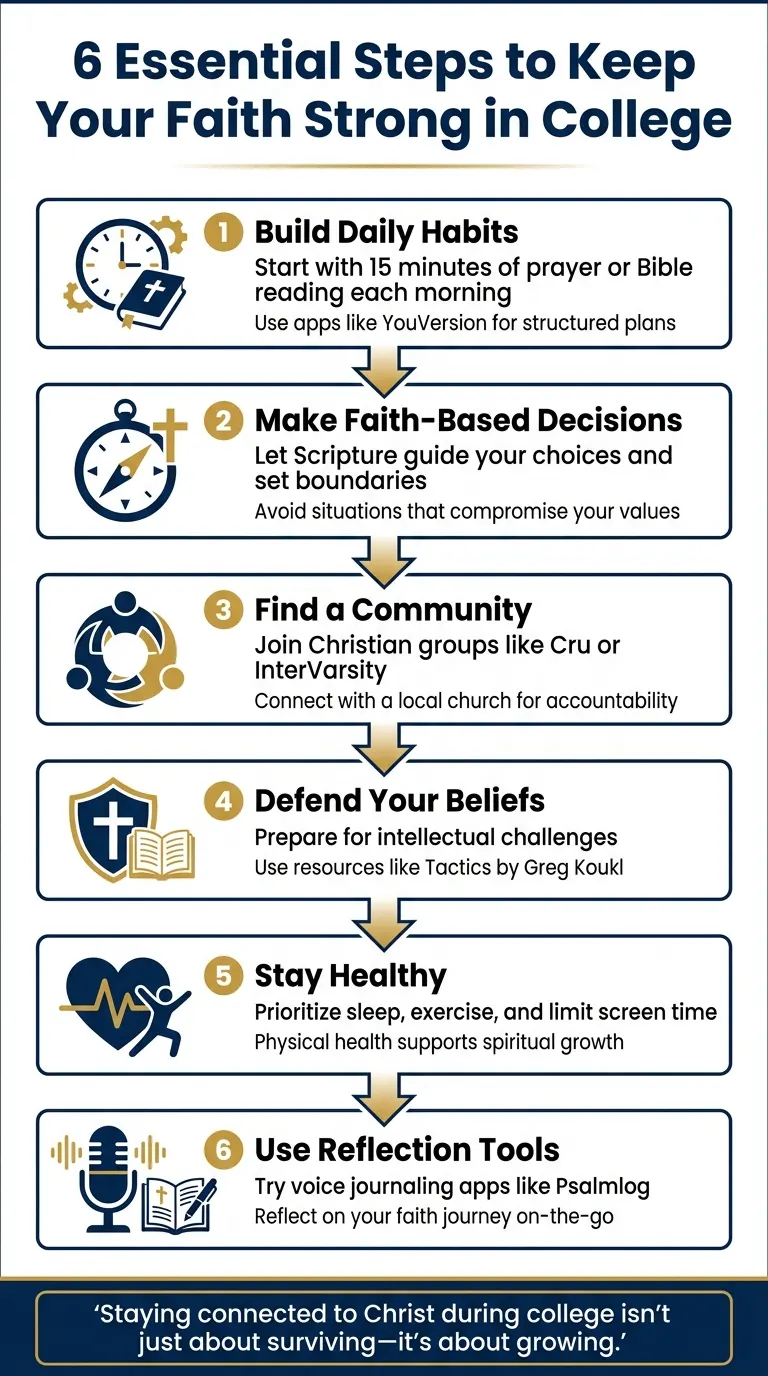
6 Essential Steps to Maintain Faith in Secular University
advice on growing your faith in college I tips, encouragement and challenges we face in this world
Building Your Personal Spiritual Foundation
Your faith thrives on personal effort, requiring a routine that extends beyond the practices you grew up with.
College life often makes it tough to prioritize faith. On average, students spend 4 to 8 hours a day on their phones, with some hitting 12 hours. Add to that just 3 or 4 hours of sleep per night, plus classes, assignments, social events, and part-time jobs, and carving out time for spiritual practices can feel overwhelming. The key is consistency, not intensity. Melissa Moore from Andrews University puts it well:
It is unrealistic to go from having no devotional life to reading the Bible for three hours daily… Start with reading a chapter of the Bible daily and then meditating on it. That is much more sustainable.
The goal isn’t to be perfect – it’s to stay consistent. Start small, with what you can handle, and grow from there.
Creating Daily Spiritual Habits
A simple way to begin is by following the 15-Minute Rule. Set your alarm just 15 minutes earlier than usual. Before reaching for your phone or checking social media, spend that time in prayer, reading a devotional, or studying a Bible chapter. Dallas Baptist University explains:
Establishing a rhythm of enjoying a quiet time with God and diving deeper into His word is foundational for a life well-lived.
Your phone can either distract you or help you. Use apps like YouVersion or Dwell for structured Bible reading plans, and set reminders to pray throughout the day. For example, when your phone buzzes at 2:00 PM, pause for a couple of minutes to pray for friends, family, or an upcoming exam.
You can also use everyday moments – like walking to class, waiting for the bus, or commuting – to pray or reflect on scripture. Putting Bible verses in visible spots, like your desk or mirror, can serve as daily reminders. As Psalms 119:105 says, "Your word is a lamp to my feet and a light to my path".
If you miss a day, don’t let it derail you. Follow the "Never Skip Twice" rule: if life gets in the way, say a quick prayer in the moment, but return to your routine the next day. Missing once is understandable; missing twice can lead to a habit that’s harder to break.
Once you’ve established these habits, let them guide how you make decisions in line with your faith.
Making Decisions Based on Biblical Principles
Every decision you make shapes your faith over time. From choosing whether to attend a party to responding to a professor’s critique, your choices matter.
In college, your decisions are no longer about meeting expectations set by parents or youth groups. As Shiao Chong says:
Students, you need to learn to make choices based on who you are, to be internally and not externally motivated.
When facing tough choices, let Scripture guide you. Lauren Anderson, an InterVarsity student, explains:
Theology affects the lens through which we view all areas of our life – including studies.
Before saying yes to a social event or taking an academic shortcut, ask yourself: Does this reflect biblical values? Does it honor God? Setting boundaries and practicing the word "no" can help protect your spiritual walk. Dallas Baptist University advises, "Don’t make compromises that are out of character or that chip away at your spiritual walk with God". This might mean skipping parties or avoiding situations that conflict with your values, and instead surrounding yourself with friends who encourage your faith.
Be mindful of the ideas shaping campus culture. Philosophies like naturalism, which assumes a godless world, or relativism, which denies objective moral truth, may surface in classroom discussions or dorm conversations. Recognizing these influences enables you to respond with a biblical perspective rather than simply going along with the crowd.
As you navigate these decisions, remember that caring for your overall well-being is essential to staying spiritually grounded.
Maintaining Your Faith Away from Home
Your physical health is tied to your spiritual health. First Corinthians 6:19–20 reminds us, "You are not your own; you were bought with a price. Therefore honor God with your bodies". Prioritizing sleep, eating well, and exercising aren’t just about self-care – they’re ways to honor God and strengthen your capacity for spiritual growth.
Limiting screen time can also free up space for God. Try cutting social media down to 1–2 hours a day, giving yourself more time for prayer and scripture.
Stay connected to your roots by practicing gratitude. Send a quick thank-you text or write a note to parents, former youth leaders, or mentors who helped shape your faith. This simple act keeps you grounded in the values you were raised with.
Find a mentor on campus, whether it’s an older student, a Christian professor, or a local pastor. Plan to meet with them monthly. They can provide the wisdom and accountability that your family once offered. Brad East, Associate Professor of Theology at Abilene Christian University, encourages:
Keeping faith in college isn’t an oxymoron. It’s what Christ calls you to. And he will always give you what you need to do his will.
Voice journaling can also help you reflect on your spiritual progress. Apps like Psalmlog allow you to record your thoughts, struggles, and prayers, offering personalized biblical guidance and scripture. With features like scripture tagging and sentiment analysis, you can track patterns and growth in your faith while keeping your reflections private.
Building a strong spiritual foundation isn’t something that happens overnight. It’s the result of small, consistent efforts. Start tomorrow with just 15 minutes – and let it grow from there.
Connecting with a Faith Community
You aren’t meant to navigate life’s challenges alone. Ecclesiastes 4:9–10 reminds us of the power of community: "Two are better than one, because they have a good reward for their toil. For if they fall, one will lift up his fellow. But woe to him who is alone when he falls and has not another to lift him up!" In the often secular environment of a university, Christian fellowship becomes an anchor for spiritual growth and resilience.
A strong faith community offers accountability, encouragement, and wisdom, especially when you’re under academic pressure, facing conflicting worldviews, or experiencing doubt. Lauren Anderson, a student involved with InterVarsity, shares: "Committing to spiritual disciplines and finding a Christian community can change your experience on campus and prepare you for a lifelong relationship with Jesus." Below, you’ll find practical ways to connect with groups that can support your faith journey and help you avoid isolation.
Locating Christian Groups on Campus
The first step to finding a faith community is exploring what’s available on campus. Attend activity fairs, where representatives from Christian organizations are eager to introduce you to their groups. National ministries like Cru, InterVarsity, Navigators, and Ratio Christi often have a presence on campuses and offer various focuses, from evangelism to discipleship and apologetics.
You can even start building connections before stepping foot on campus. Reach out to ministry leaders via email or social media to introduce yourself and inquire about events. On campus, check bulletin boards, ask other students for recommendations, and don’t hesitate to ask Christian professors if they know of active groups.
Finding a local church is just as important. Danny Myers, Associate Pastor at Smyrna Presbyterian Church, emphasizes this: "Finding a church might be the most important decision you make while in college." Use resources like 9marks.org or denominational websites to locate churches near your university. Visit a few services to find a congregation that aligns with the principles of biblical teaching, fellowship, prayer, and outreach, as described in Acts 2.
When evaluating a group or church, ask yourself two key questions: Does this group believe that Jesus Christ is the true Son of God and the only way to salvation? Does it uphold the Bible as the inerrant and authoritative Word of God?
Getting Support from Peers and Mentors
Once you’ve laid the foundation, seek out mentors and peers who can encourage and challenge your faith. Peer relationships are great for accountability, but mentors bring wisdom and guidance. While it’s valuable to connect with fellow students, don’t overlook older believers, Christian professors, and local church members who can provide deeper insights.
Sean McDowell, Ph.D., Professor of Christian Apologetics at Biola University, advises: "Most Christian professors would be thrilled to pray with you, guide you, and possibly even mentor you. Visit them in their office hours and get to know them on a personal level."
A simple way to approach a mentor is through what some call the "Coffee Strategy." Invite a campus minister, chaplain, professor, or mature church member for coffee, perhaps using a gift card as a gesture. Plan regular meetings – once a month, for instance – for prayer, advice, and accountability.
Keep in touch with mentors from home too. A quick text, call, or video chat with a youth pastor, teacher, or coach who shaped your faith can provide encouragement during tough times.
Joining a Bible study or prayer group is another excellent way to stay connected. These gatherings offer a safe space for spiritual growth and consistent accountability. Deepen these relationships by volunteering together for campus service projects or local charities, putting your faith into action.
Avoiding Spiritual Isolation
Spiritual isolation doesn’t happen overnight; it often starts with small steps, like skipping a Bible study or Sunday service. Before long, you might find yourself disconnected from the community that once kept you grounded. To prevent this, make corporate worship a non-negotiable part of your weekly routine, even when your schedule feels overwhelming.
When doubts arise or life feels chaotic, resist the urge to withdraw. Instead, lean on your faith community. Send a quick message to a friend from Bible study, call your mentor, or attend a campus ministry event – even if you don’t feel like it. A strong support system can help you stay rooted in your faith during challenging times.
Adopt a "missionary mindset" by viewing your campus as a mission field. Partner with other believers to serve your university town. This outward focus not only helps others but also keeps you engaged with your faith community and strengthens your spiritual walk.
If you’re struggling with feelings of isolation, look into programs like Summit Ministries, which offers a 12-day apologetics and worldview training for students aged 16–22.
Another helpful tool is voice journaling through platforms like Psalmlog. Recording your thoughts can help you identify patterns of withdrawal and prompt you to reach out before isolation takes hold.
Defending Your Faith Intellectually
As your faith deepens, both personally and within your community, it’s important to be ready to defend your beliefs thoughtfully. College classrooms often test Christian beliefs, with liberal professors outnumbering conservative ones by about 5 to 1. Additionally, the percentage of atheist professors in universities is roughly three times higher than in the general population. Learning how to engage with these challenges both respectfully and confidently is key to staying grounded in your faith.
You’re not expected to know every answer right away. A strong theological foundation is much more helpful than a surface-level understanding of Christianity when tough questions arise. If you don’t have an immediate answer, it’s perfectly fine to say, “I need to research that further.” This shows intellectual honesty rather than weakness.
Recognizing Common Objections to Christianity
Many secular classrooms operate on philosophical assumptions that are far from neutral. Ideas like naturalism (the belief that nature is all there is) and relativism (the notion that truth is subjective) frequently shape academic discussions. You might encounter claims such as, “Religion is just a social construct for comfort,” or, “Faith is belief without scientific evidence”.
Philosophy classes may introduce skepticism about whether life’s big questions can even be answered. Science courses might promote scientism, the idea that only material causes can explain the world. In literature or history classes, you could run into higher criticism, which treats the Bible as a purely human and political document rather than divine revelation.
Philosopher Michel Foucault, often cited in discussions on cultural relativism, has been referenced over 1.4 million times in academic literature. Understanding these philosophical frameworks helps you pinpoint where secular thought diverges from biblical truth. This knowledge lays the groundwork for engaging in meaningful, respectful conversations.
Discussing Faith Respectfully with Others
When engaging in classroom discussions, focus on asking questions rather than making bold statements. Sean McDowell, a professor of Christian Apologetics at Biola University, advises:
Instead of standing up to a professor in class and trying to win an informal debate, the best tactic is simply to ask questions… it keeps the burden of proof on the professor rather than on you.
For instance, if a professor claims that God is a social construct, you could ask, “If scientific evidence is the standard for truth, what scientific evidence supports the claim that God is a social construct?”. This approach shifts the focus back onto the professor and encourages a more thoughtful discussion.
Save deeper conversations for office hours, where there’s no audience and less pressure. Professors hold significant influence in the classroom, so public confrontations rarely lead to productive outcomes. However, when approached privately with kindness and genuine curiosity, many professors are open to discussing even controversial topics.
It can also help to research your professor’s worldview before the semester begins to anticipate potential areas of conflict. As Michael Kruger points out, “Disagreement is the same as disrespect in most people’s eyes”. Approach every conversation with humility and respect, even when you strongly disagree. Combining these conversational techniques with a solid understanding of apologetics can make a big difference.
Using Apologetics Resources
Prepare yourself with resources that address the challenges you’re likely to face in specific academic settings. Reading at least one Christian book on a subject before taking a related secular course can provide a helpful framework for integrating faith and academics.
| Academic Subject | Recommended Resource |
|---|---|
| General Philosophy | Thinking About God: First Steps in Philosophy by Greg Ganssle |
| Neuroscience/Mind | The Soul by J.P. Moreland |
| Biology/Origins | Understanding Intelligent Design by Sean McDowell and William Dembski |
| Conversational Tactics | Tactics by Greg Koukl |
| General Survival | Surviving Religion 101 by Michael Kruger |
Beyond books, explore organizations that specialize in addressing intellectual challenges. Groups like Stand to Reason, Reasonable Faith, Cold Case Christianity, Ratio Christi, and the Discovery Institute offer in-depth resources.
You can also seek guidance from Christian professors or campus ministries such as Cru, Navigators, or InterVarsity. Many Christian professors are eager to mentor students and help them navigate tough questions – take advantage of office hours to build these relationships.
If a particular question unsettles you, don’t shy away from finding an answer through research or mentorship. Wrestling with these issues can deepen your faith and equip you to assist others who face similar challenges. Instead of viewing academic objections as threats, see them as opportunities for spiritual growth and a chance to strengthen your understanding of God’s truth.
Navigating Academic and Social Pressures
Academic and social pressures can subtly chip away at your spiritual foundation, often without you even realizing it. Dr. Owen Anderson, a Professor of Philosophy and Religious Studies, points out a recurring pattern in secular worldviews:
The Enemy’s Strategy: Question what God said, insult God’s character, and teach the student to be a law to themselves.
Understanding this strategy allows you to look beyond surface-level arguments and uncover the deeper assumptions at play. To stand firm in your faith, it’s essential to critically evaluate secular ideas, surround yourself with supportive friendships, and manage stress effectively.
Examining Secular Ideas Through Scripture
Before diving into secular theories, ground yourself in biblical truth. Many secular frameworks, especially in the social sciences, rest on assumptions that directly challenge Christian beliefs. For instance, naturalism (the belief that nature operates without divine intervention) and hedonism (the pursuit of pleasure as the ultimate goal) often underpin these theories. Start with biblical principles and compare them to the ideas presented in your studies. As Professor Brent D. Slife observes:
A conception that assumes that a god is unnecessary is a different bias from a conception that assumes that a god is necessary.
Secular inquiry isn’t neutral – it comes with its own set of hidden biases. When confronted with concepts like cultural relativism (the idea that morality is shaped by culture) or religious pluralism (the belief that all religions are equally valid), ask yourself: What assumptions are behind these ideas?
Building Friendships While Maintaining Your Values
Building friendships with non-Christian peers doesn’t mean compromising your faith. Instead, it requires intentionality. Focus on shared interests – whether that’s sports, movies, or hobbies – while staying mindful that some activities might conflict with your values. A true friend will respect your boundaries and won’t pressure you to compromise your beliefs.
When your values are questioned, stand firm without arguing or feeling the need to apologize. Keep a close circle of Christian friends for encouragement and accountability. Sean McDowell, a Professor of Christian Apologetics at Biola University, highlights the importance of this:
It is certainly important to make friends with non-Christians, but you must surround yourself with some fellow believers who will pray for you, encourage you, hold you accountable.
When your non-Christian friends face challenges, offer to pray with them on the spot instead of just saying you’ll pray for them later. Being open about your faith when asked fosters respect, even among those who may not share your beliefs.
While strong friendships can help you stay true to your values, managing academic stress is equally important to maintaining your spiritual focus.
Managing Academic Stress Without Losing Focus on Faith
Academic demands can quickly push faith to the back burner if you’re not careful. Brad East, Associate Professor of Theology at Abilene Christian University, doesn’t mince words about one of the most common issues he observes:
Nothing, and I do mean nothing, would improve my students’ lives more than getting enough sleep.
Balancing academics and digital distractions can strain both your physical and spiritual health. Treat your physical well-being as an act of worship. Aim for eight hours of sleep each night, keep your phone out of reach when you’re in bed, and incorporate regular exercise into your routine.
To reclaim time and mental clarity, consider deleting non-essential social media apps like YouTube, Instagram, or TikTok for a set period. Use that extra time for morning prayer or meditation before tackling your coursework. Keeping a prayer journal can also help you focus – write down specific requests for wisdom and clarity in your academic life. Additionally, seek guidance from Christian professors or campus ministers who can mentor you as you navigate the intersection of faith and academics.
Brad East offers a refreshing perspective on what true success looks like:
If in four years you emerge humbled, prayerful, and grateful, then, regardless of your diploma, your time will have been a success.
Using Voice Journaling for Spiritual Reflection
Balancing classes, study sessions, and social activities can make it tough to find time for traditional journaling. That’s where voice journaling steps in as a practical alternative. Instead of needing a quiet space with a pen and paper, you can reflect on your thoughts, prayers, and doubts while walking to class, working out, or even during a quick study break. This approach makes it easier to stick with spiritual habits without feeling like you’re adding more to your already full schedule. It’s a modern way to complement your prayer routines, offering moments of spontaneous reflection in the middle of a busy campus life. Voice journaling becomes a tool to deepen your spiritual journey while adapting to your daily rhythm.
How Voice Journaling Supports Spiritual Growth
Speaking your thoughts out loud can bring a kind of clarity that writing doesn’t always provide. For example, when you come across challenging ideas in a philosophy or sociology class, voice journaling creates a private space to process your reactions and reflect through Scripture. As the North Carolina Boys Academy explains:
By developing your prayer routine, you establish a direct communication line with God, bringing peace, comfort, and guidance during difficult times.
Apps like Psalmlog take this a step further by offering personalized biblical guidance based on your reflections. After recording your thoughts, the app suggests Scripture passages, practical advice, and actionable steps tailored to your situation. This process not only strengthens your relationship with God but also helps you refine and articulate your beliefs – especially useful when engaging in conversations or debates about faith on campus.
Adding Reflection to Your Daily Schedule
The secret to making voice journaling a habit isn’t carving out big chunks of time – it’s using the small, often overlooked moments in your day. Think about recording a reflection as you walk to class, process a challenging lecture during your workout, or talk through a prayer request while commuting home. These quick moments, woven into your routine, can add up to meaningful spiritual growth.
You could start your day with a short prayer or meditation before checking your phone, then use Psalmlog to capture your thoughts or requests for clarity in your studies. After reading Scripture, quickly record a reflection to help internalize its message and think about how it applies to your daily life on campus. Psalmlog’s Faith Builder plan, priced at $19.99 per month, gives you 300 minutes of recording time – about 10 minutes a day. This balance ensures you can reflect consistently without feeling overwhelmed.
Recording and Reviewing Your Spiritual Progress
The true strength of voice journaling lies in revisiting your past recordings. As the North Carolina Boys Academy points out:
Maintain a prayer journal to monitor your spiritual progress. Reviewing your experiences is equally important.
Set aside time weekly or monthly to listen to old recordings. You might notice patterns, like answered prayers or shifts in your perspective. Psalmlog’s insights dashboard and calendar view make it easy to track your spiritual journey, offering a clear picture of God’s presence and faithfulness throughout your college experience. During spiritually dry times, these recordings can remind you of how far you’ve come and reinforce your connection to God. Regularly reflecting on your journey ties together the different aspects of your faith, creating a deeper and more meaningful experience.
Conclusion
Living out your faith on a secular campus is entirely possible when you follow Christ’s call. The strategies shared here can help you nurture your spiritual life during one of the most transformative periods of your journey. As Brad East, Associate Professor of Theology at Abilene Christian University, explains:
The life of faith is nothing other than maintaining lifelong friendship with Christ.
This friendship grows deeper when you commit to intentional practices in your daily life on campus.
Start by building a strong foundation. Establish daily spiritual habits within the first two weeks of the semester, connect with a local church and campus ministry, and embrace intellectual challenges that strengthen your faith. Tools like digital vs. paper journaling through Psalmlog can help you capture your reflections during daily routines. Surround yourself with Christian mentors and maintain your physical health to support your spiritual growth.
Catherine Nolte from FamilyLife emphasizes the value of this approach:
Walking across the stage having a stronger relationship with Christ is worth so much more than a degree.
Your college years have the potential to be a time of profound spiritual growth if approached with purpose. The habits you form now, the community you engage with, and the way you navigate challenges through Scripture will shape not only your college experience but your lifelong walk with Christ.
Approach your time on campus with humility, prayer, and gratitude. Trust that Christ will provide everything you need to fulfill His purpose, even in a secular environment.
FAQs
What if I don’t have time for daily devotions?
Even with a packed schedule, staying spiritually connected is possible by prioritizing quality over quantity. Dedicate just 10-15 minutes a day to meaningful Bible study or reflection. Tools like Bible apps make it easy to access scripture on the go, and you can weave short moments of prayer or reflection into your daily routine – whether it’s during a walk to class or a quick break. The key is consistency in these small, intentional moments.
How do I find a solid church and Christian community near campus?
Start your search for local churches by checking your denomination’s website, attending campus activity fairs, or keeping an eye out for flyers. Focus on finding churches that prioritize biblical teaching, fellowship, prayer, and outreach, as outlined in Acts 2. You can also ask fellow students or members of campus ministries for suggestions. Take the time to visit a variety of congregations to discover one that aligns with your faith and supports your spiritual growth. Connecting with Christian communities nearby can play a key role in deepening your relationship with God.
What should I say when a professor challenges my faith?
When navigating challenging conversations, aim to respond with calmness, respect, and confidence. For example, you could say, "I appreciate your perspective, but my faith is rooted in my relationship with God and Scripture." If the situation allows, you might add, "I see things differently and choose to stand firm in my beliefs." It’s also perfectly fine to admit when you don’t have all the answers. These moments can be an opportunity to demonstrate both humility and the strength of your faith.