
Digital vs Paper Spiritual Journals: Which Wins?
Explore the pros and cons of digital and paper spiritual journals to find the best format for your personal reflection and growth.
When it comes to spiritual journaling, the choice between digital and paper formats depends on your personal preferences and goals. Here’s a quick breakdown:
- Paper Journals: Offer a tactile, hands-on experience. Writing by hand can help with mindfulness and memory. They allow for artistic expression through drawings, doodles, and decorations. However, they lack searchability, are vulnerable to damage, and require physical storage space.
- Digital Journals: Provide convenience, organization, and features like voice journaling, automatic scripture tagging, and AI insights. They are accessible across devices, secure, and eliminate the need for physical storage. But they may lack the personal touch of handwriting and creative freedom.
Quick Tip: Combine both! Use a digital spiritual journal app for features like voice journaling and scripture integration, and paper for handwritten prayers and artistic expression.
Comparison Table:
| Feature | Paper Journals | Digital Journals (e.g., Psalmlog) |
|---|---|---|
| Accessibility | Physical only | Available across devices |
| Searchability | Manual | Instant keyword search |
| Creative Expression | High | Limited |
| Privacy & Security | Vulnerable | Securely stored |
| Cost | $10–$50 upfront | Free plan available; paid plans start at $9.99/month (Seeker) with a 7-day free trial |
| Long-term Storage | Requires space | Cloud-based backups |
Conclusion: Choose the format that aligns with your journaling style. For a modern, organized approach, go digital. For a more personal, tactile experience, stick with paper. Or, enjoy the best of both worlds with a hybrid approach.
TYPING VS. HANDWRITING | Paper Journal or Digital Journal?
Paper Spiritual Journals: Benefits and Drawbacks
Paper journals have been a trusted companion for deep spiritual reflection, offering a tactile and personal experience. By weighing their strengths and limitations, you can decide if this traditional method aligns with your spiritual practice.
Why Paper Journals Work Well
The tactile experience of writing in a paper journal can create a meaningful connection to your thoughts and emotions. Writing by hand encourages mindfulness, enhances memory retention, and taps into creative expression.
"It is said that the act of writing on paper can improve our creative self-expression as it activates different parts of our brains. This means you can be more creative in paper-based journaling." – Sai Subramaniam
One major advantage of paper journals is the creative freedom they offer. Unlike digital tools with preset themes, paper journals allow limitless customization. You can add drawings, doodles, or handwritten notes to bring your reflections to life. Using different writing tools – whether it’s a fountain pen or colored pencils – can add depth and personal meaning to your entries.
Paper journals also provide a way to incorporate mementos into your spiritual journey. Attaching items like pressed flowers from a nature walk, ticket stubs from a retreat, or printed scripture verses helps create a multi-sensory record of your faith. This practice not only enriches your reflections but also fosters gratitude by preserving meaningful moments.
"Traditional journals let you explore your aesthetic value and bring personality to your writing. Play around with different methods, themes and colours, stationery and narratives. Journaling is a way to find yourself, rediscover yourself and accept yourself for who you are." – Aadrita Chatterji
Another benefit is the personalization that paper journals allow. You can decorate your journal with stickers, washi tape, or other materials that reflect your personality and spiritual journey. Each journal becomes a one-of-a-kind expression of your faith, capturing details and emotions that digital tools often miss.
However, despite their many benefits, paper journals come with a few challenges that could affect your long-term journaling practice.
Where Paper Journals Fall Short
While paper journals excel in creativity and individuality, they do have practical limitations.
Portability and durability can be problematic. A single spill or misplacement could erase months of spiritual reflections, as there’s no way to back them up automatically.
Organization and searchability are other challenges. As your collection of journals grows, finding specific entries or tracking patterns in your spiritual growth can become increasingly difficult. Unlike digital tools with search functions, paper journals require manual effort to revisit past insights.
Privacy concerns may also arise. A paper journal, if left unattended, is vulnerable to prying eyes. Without password protection or encryption, your deepest reflections could be exposed, which might discourage you from being fully open in your writing.
Space limitations can restrict your journaling experience. Once a journal is filled, you’ll need to transition to a new one, potentially disrupting the continuity of your reflections. Additionally, the finite space on each page may make it challenging to dive into lengthy reflections or elaborate scripture studies.
Lastly, blank page syndrome can be intimidating, especially for beginners. The pressure to make that first entry "perfect" might cause hesitation, leaving those first pages untouched instead of capturing the start of your spiritual journey.
Digital Spiritual Journals: Benefits and Drawbacks
Digital spiritual journaling has reshaped the way we document and reflect on our faith journeys. Thanks to modern technology, these tools provide easier access, better organization, and long-term preservation of your thoughts and insights. Let’s take a closer look at what makes digital journals appealing.
Why Digital Journals Work Well
One of the biggest perks of digital spiritual journals is how easy they are to access. Whether you’re using a smartphone, tablet, or laptop, cloud syncing ensures your entries are always available across devices. No matter where you are, your reflections are just a few taps away.
Another standout feature is how well digital journals keep things organized. With tools like keywords, tags, and categories, you can quickly find past entries or track specific themes in your spiritual growth. This makes it simpler to revisit meaningful insights and see how far you’ve come.
"I’ve found digital journaling’s accessibility and organizational features often lead to more consistent practice." – Jessica, Author, Reaching My Dreams
How Psalmlog Improves Digital Spiritual Journaling
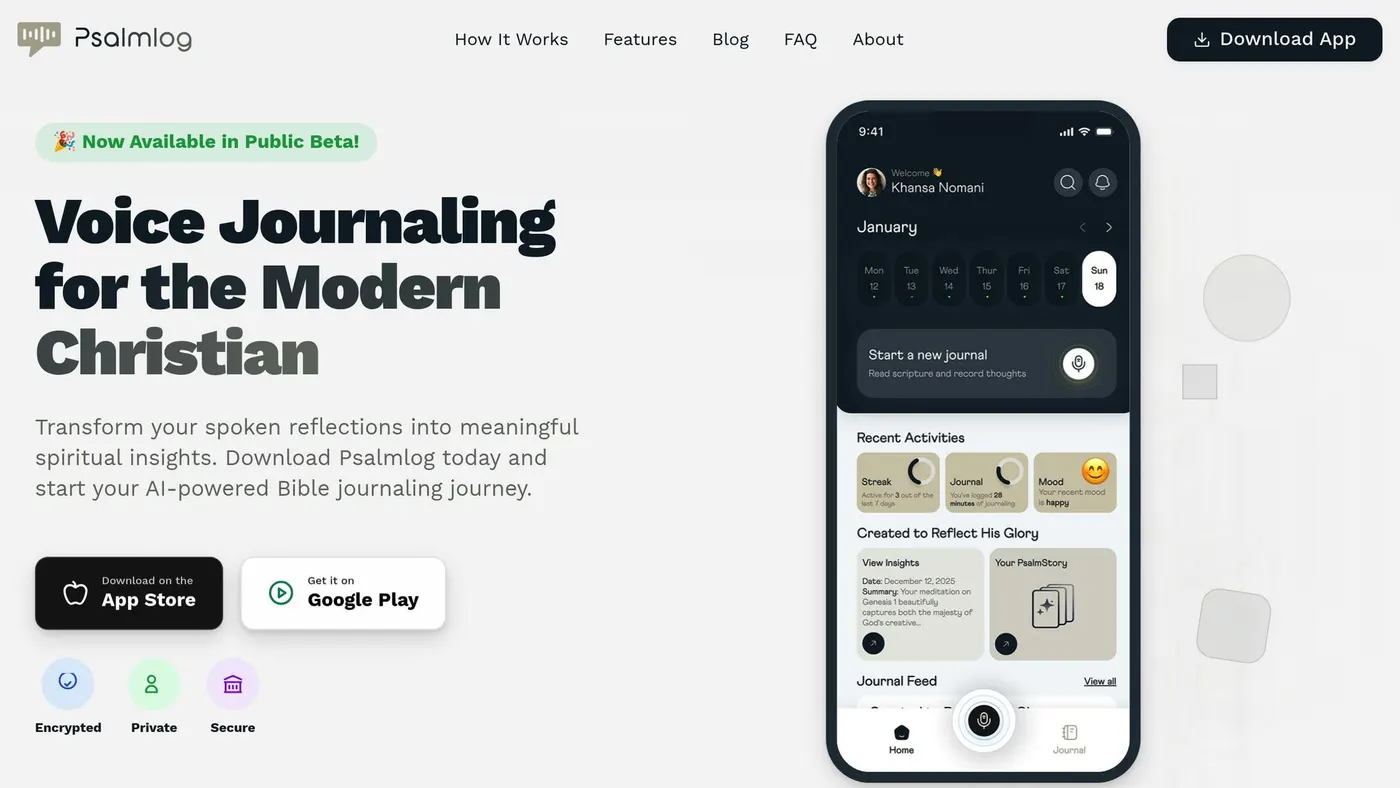
Psalmlog takes the convenience of digital journaling and tailors it specifically for Christians seeking a deeper spiritual connection. With features like 6-point AI biblical guidance, voice journaling, scripture integration, and personalized insights, it transforms how users reflect on their faith. Let’s break down what makes Psalmlog stand out.
6-Point AI Biblical Guidance and Voice Journaling
The core differentiator is Psalmlog’s 6-point AI biblical guidance – every entry becomes a Scripture-anchored reflection that walks you through interpretation, prayer, and a practical “Walking it out” application step. Instead of staring at a blank page, you write or speak what’s on your heart and receive pastoral-style guidance grounded in the Bible.
The voice journaling feature (included on Faith Builder and higher) makes it easy to capture prayers, reflections, and emotions in a natural, conversational way. Instead of typing, you can simply speak your thoughts into the app, allowing for a more fluid and heartfelt expression of your spiritual journey.
Psalmlog’s scripture tagging takes your reflections to the next level by automatically linking relevant Bible verses to your entries. This seamless connection between your personal experiences and biblical teachings saves time and enriches your journaling experience – and works across multi-lingual Bible translations.
Personal Insights and Security
Psalmlog’s Personal Insights Dashboard uses AI to analyze your journaling trends, offering a unique way to track your spiritual and emotional growth. By visualizing patterns in your reflections – such as recurring themes or emotional shifts – you can gain a clearer understanding of your spiritual journey and identify areas for growth. The full insights dashboard and weekly spiritual pulse unlock on the Shepherd plan.
"I use a journal to write in, but this would allow me to journal more on the go while getting insight I would never have otherwise. It’s exciting!" – Sarah K., Preview Tester
When it comes to privacy, your entries are stored securely on managed infrastructure, and the AI services Psalmlog uses are contractually prohibited from training on your data. Your reflections stay yours.
Plans and Features for Different Needs
Psalmlog offers four tiers to suit a range of users and budgets. Full plan details are on the pricing page.
- Free ($0): 3 lifetime journal entries, basic AI biblical guidance, web only, text input – great for trying the format.
- Seeker ($9.99/month or $99.99/year – save 17%): 30 sessions/month with the full 6-point AI biblical guidance, mobile app, basic templates, Psalmstory sharing, CSV backup. Includes a 7-day free trial.
- Faith Builder ($19.99/month or $179.99/year – $14.99/mo, save 25%): Unlimited sessions, contextual AI with 30-day memory, 300 minutes of voice journaling per month, Psalmcast (audio devotionals) 5 credits/mo, basic insights dashboard, 20+ premium templates, calendar sync, single-entry PDF.
- Shepherd ($34.99/month or $299.99/year – $24.99/mo, save 29%): Extended AI context (3-6 months), unlimited voice, full Psalmcast (50 credits/mo), full AI-powered insights dashboard, weekly spiritual pulse, premium + custom templates, devotional book PDF export.
All paid plans include a 7-day free trial, the mobile app, multi-lingual Bible translations, and export. Smart search makes it easy to revisit past prayers and insights using AI-powered text search, and date filtering lets you explore your spiritual journey across weeks, months, or years.
Side-by-Side Comparison: Digital vs Paper Spiritual Journals
When deciding between digital and paper spiritual journals, weighing the strengths of each format can help align your choice with your spiritual goals. Both options have their own advantages, catering to different needs and preferences.
Comparison Table
| Feature | Paper Spiritual Journals | Digital Spiritual Journals (Psalmlog) |
|---|---|---|
| Accessibility | Requires a physical journal; limited to one location | Accessible on any device with internet connectivity |
| Searchability | Manual page flipping; finding specific entries can be time-intensive | Instant keyword search; quickly spot patterns and themes |
| Organization | Chronological only; constrained by physical space | Automated tagging, date filtering, and unlimited digital storage |
| Scripture Integration | Requires manual Bible lookup and transcription | Automatic scripture tagging with contextual insights across multi-lingual translations |
| AI Guidance | Not available | 6-point AI biblical guidance on every entry, with contextual memory on Faith Builder+ |
| Voice Recording | Not available | 300 min/month on Faith Builder, unlimited on Shepherd |
| Privacy & Security | Relies on physical security; vulnerable to loss or damage | Stored securely; AI providers contractually prohibited from training on your data |
| Backup & Archiving | Requires physical storage; no automatic backup | Cloud-based automatic backups with CSV/PDF export |
| Creative Expression | Allows drawing, sketching, and decorating | Limited to text and voice; lacks visual creativity options |
| Cost | $10–50 upfront for quality journals and pens | Free plan (3 entries); paid plans from $9.99/month with 7-day free trial |
| Multimedia Support | Limited to text and drawings | Includes voice entries, text transcripts, Psalmcast audio devotionals, and AI-generated insights |
| Long-term Storage | Requires physical storage for multiple books | Digital storage eliminates physical clutter |
| Insights & Analytics | Manual effort to identify patterns | AI-powered Personal Insights Dashboard and weekly spiritual pulse (Shepherd) |
| Sharing Capabilities | Limited to physical sharing; no digital distribution | Psalmstory sharing for ministry or community use |
Each format offers distinct benefits that shape how you engage with your spiritual practice. Paper journals bring a tactile, hands-on experience that invites creativity. Writing by hand, decorating pages, and sketching prayers create a personal and intimate connection to your reflections.
Digital journals, on the other hand, streamline the process for long-term reflection. As Jenny Lee, Writer and Artist at Hello Brio, explained:
"Want to find all the entries where you wrote about a specific person or topic? Done. (I use this to look for patterns or to try to solve a problem.)"
This ability to search through entries is a game-changer for tracking spiritual growth over time.
Digital platforms also offer secure, automated backups, removing the need for physical storage. Features like scripture integration make it easier to connect biblical teachings with your personal reflections. Plus, voice journaling allows for spontaneous, natural expression, capturing thoughts and prayers without the need to pause and write.
While paper journals require recurring purchases for supplies, digital options provide predictable pricing. With a free plan available and paid plans starting at $9.99 per month, digital spiritual journal apps like Psalmlog ensure reliable storage without taking up any physical space. Lifestyle Writer Marichelle E. Urquico captured this sentiment perfectly:
"A digital journal is something I can keep for many years. And I don’t have to keep looking for a new journal every few months or so (which sometimes becomes my toxic habit)"
How to Choose the Right Format for Your Spiritual Practice
After comparing digital and paper journals, it’s time to decide which format best supports your spiritual practice. Let’s break it down.
Think About Your Journaling Style and Needs
Your journaling habits and spiritual goals should guide your decision. Start by reflecting on how you naturally express yourself and what you need to deepen your faith journey.
- Prefer speaking your prayers? Digital journaling might be your best bet since paper journals can’t capture voice recordings. Digital tools let you document thoughts and prayers anytime, anywhere.
- Looking for scripture integration? Digital platforms make it easy to link reflections with biblical passages. Features like Bible version switching, integrated commentaries, and smart tagging simplify the process. Paper journals, on the other hand, require manual note-taking and lack these dynamic features.
- Want AI-guided reflection? Apps like Psalmlog deliver 6-point biblical guidance on every entry – impossible to replicate with paper.
- Concerned about storage and privacy? Digital tools like Psalmlog offer secure storage and automatic backups, while paper journals rely on physical security, which can be less reliable.
- Need accessibility? Digital journals are available across devices, whereas paper journals stay in one place.
By identifying your priorities, you can choose the format that aligns with your spiritual goals.
Making the Right Choice
Here’s how you can decide:
- If voice recording, scripture searches, AI-powered insights, and the ability to journal on multiple devices matter to you, go digital.
- If you find handwriting calming, enjoy artistic expression, and prefer a tactile, offline experience, stick with paper.
Or try both! A hybrid approach can combine the strengths of each. For instance, use digital tools for voice journaling and AI biblical guidance, and keep a paper journal for handwritten prayers and creative expression. This way, you can enjoy the convenience of digital features while preserving the mindfulness of writing by hand.
For digital journaling, consider platforms like Psalmlog. The free plan gives you 3 lifetime entries with basic AI biblical guidance, the Seeker plan ($9.99/month) adds 30 sessions/month with full 6-point AI and mobile, and the Faith Builder plan ($19.99/month) unlocks unlimited sessions, 300 minutes of voice journaling, and contextual AI memory. All paid plans include a 7-day free trial. Ultimately, the best format is the one you’ll use consistently.
Conclusion: Finding What Works for Your Spiritual Journey
Choosing between digital and paper spiritual journals isn’t about picking a "better" option – it’s about discovering what deepens your connection with God. Each format has its own strengths, and when matched to your personal preferences, either can transform your spiritual practice.
Paper journals offer a calming, hands-on experience that encourages mindful reflection. The act of writing by hand can feel spiritual in itself, providing a peaceful escape from the constant buzz of screens. However, they do have their drawbacks: no voice recording, no built-in scripture references, no AI guidance, and the possibility of losing your precious notes to damage or misplacement.
On the other hand, digital journals overcome many of these hurdles. Features like 6-point AI biblical guidance, voice journaling, automatic scripture tagging, and AI-generated insights bring a new level of convenience and depth to your practice. Voice journaling captures those fleeting prayers and thoughts that might otherwise slip away. Scripture tagging ties your reflections directly to God’s word, while AI insights can help you uncover patterns in your spiritual journey that you might not notice on your own. These tools are designed to meet the needs of modern believers.
For example, Psalmlog offers a digital journaling platform tailored for Christian reflection. The free plan gives you 3 lifetime entries to try the format, the Seeker plan at $9.99/month unlocks the full 6-point AI biblical guidance, and the Faith Builder plan at $19.99/month adds voice journaling (300 min/mo), Psalmcast audio devotionals, and a 30-day contextual AI memory. Every paid plan includes a 7-day free trial.
You don’t have to choose one format over the other – many people find that combining both can enhance their practice. Digital voice journaling offers immediacy, while handwritten prayers bring a personal, reflective touch. The most important thing is consistency. Whether you prefer the comfort of pen and paper or the advanced tools of a digital platform, the goal is to create a habit that supports your spiritual growth.
FAQs
How do I decide between using a digital or paper spiritual journal?
Choosing between a digital or paper spiritual journal comes down to what feels right for you and your spiritual routine. Digital journals bring convenience to the table with features like search functions, AI biblical guidance, multimedia integration, and the ability to sync across devices. They’re also perfect if you enjoy options like voice journaling or highlighting scriptures directly within your entries.
On the flip side, paper journals provide a hands-on, distraction-free experience. There’s something grounding about putting pen to paper – it can encourage mindfulness and create a stronger sense of personal connection.
When making your choice, think about what matters most to you: portability, how much you want to personalize your journal, or even the impact on the environment. The best journal is the one that complements your spiritual practices and keeps you engaged and consistent on your journey.
What’s the best way to combine digital and paper journaling for spiritual growth?
To get the best out of both digital and paper journaling, consider using your paper journal for more personal touches like creative reflections, scripture notes, or insights where handwriting can add a deeper, meaningful connection. On the other hand, digital journaling works great for organizing your entries, syncing them across devices, AI-guided reflection, and quickly revisiting past entries.
By combining these methods, you can enjoy the personal and tactile experience of writing by hand while benefiting from the convenience and structure digital tools offer. Together, they form a well-rounded system to support your spiritual journey and scripture study.
How does Psalmlog protect the privacy and security of your digital spiritual journal?
Psalmlog prioritizes privacy and security, ensuring that your spiritual reflections stay personal and protected. Entries are stored securely on managed infrastructure, and the AI providers Psalmlog uses are contractually prohibited from training on your data. Mobile devices add an extra layer with built-in biometric locks (such as fingerprint or facial recognition).
For added peace of mind, consider setting a strong, unique password and enabling any extra privacy options offered within the app. Together, these tools create a safe and secure environment for your spiritual journaling and personal growth.