
AI in Ministry: Ethics & Best Practices
Ethical AI in church ministry: balancing tools with human care, protecting pastoral privacy, and ensuring theological accuracy.
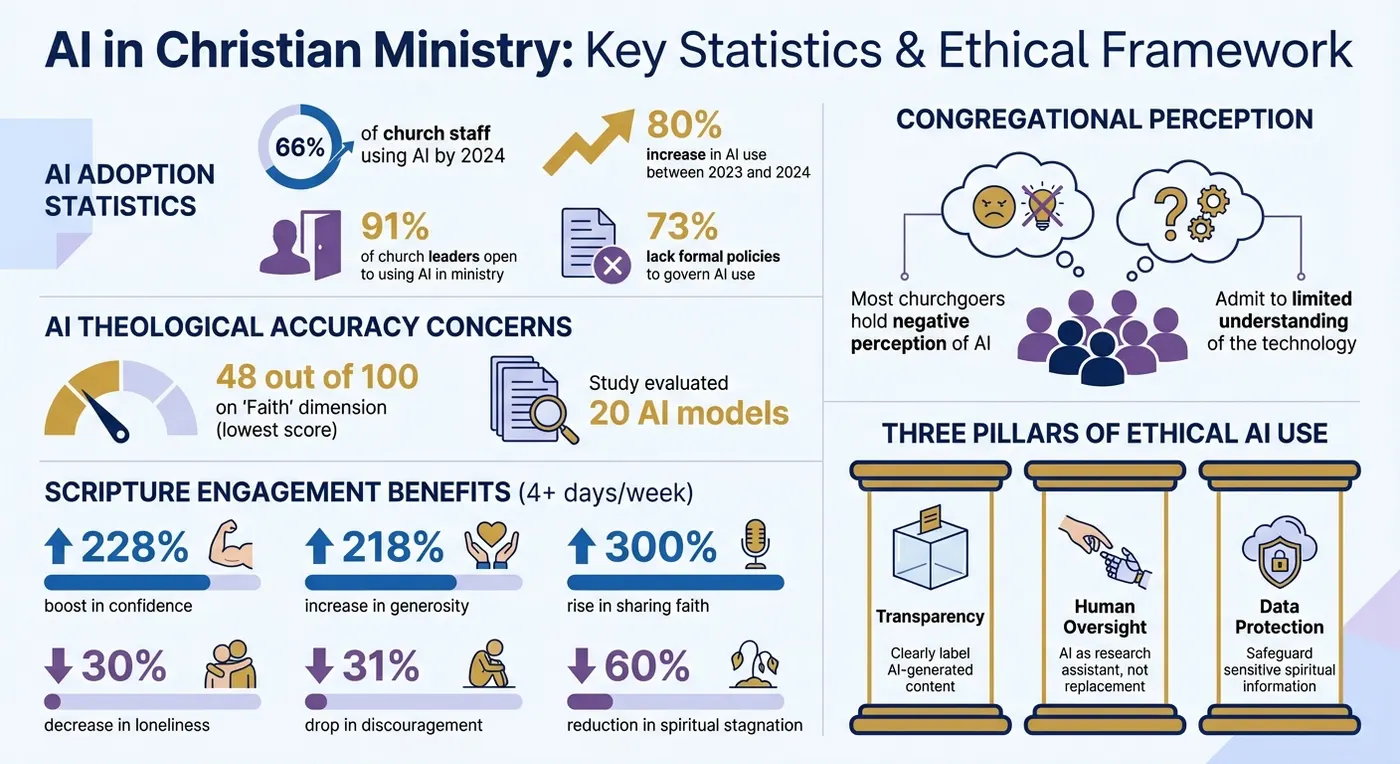
AI is becoming a common tool in Christian ministry, with 66% of church staff using it by 2024. Pastors leverage AI for tasks like sermon preparation and Bible study and graphics creation. While AI offers convenience, it raises ethical concerns about spiritual discernment and digital discipleship, personal connection, privacy, and theological accuracy. Key takeaways include:
- AI’s role: A "research assistant" for routine tasks, not a replacement for spiritual leadership.
- Concerns: Loss of human connection, potential misuse of sensitive data, and risks of theological errors.
- Ethical use: Transparency about AI involvement, safeguarding data, and ensuring human oversight.
- Biblical principles: Upholding human dignity, truth, and the importance of personal relationships.
AI can support ministry by handling practical tasks, but spiritual growth and care remain human responsibilities. Ministries must balance AI’s utility with Christ-centered values to maintain trust and integrity.
AI Adoption and Ethical Challenges in Christian Ministry Statistics
Ethical Challenges in AI for Christian Ministry
Loss of Personal Connection
AI has the potential to erode the relational foundation of Christian ministry. Kenny Jahng, Founder of AiForChurchLeaders.com, highlights the issue clearly:
"AI can analyze data, but it cannot shepherd hearts. It can draft a sermon, but it lacks the spiritual discernment to preach with authority".
Over-reliance on AI could strip sermons of the Spirit-led conviction that comes from personal prayer and study. A Barna study points out that most churchgoers hold a negative perception of AI and admit to limited understanding of the technology. Nathan Webb cautions that technology should serve as a tool, not a replacement for genuine human relationships.
The emergence of tools like "texting Jesus" apps and AI agents designed to mimic deceased loved ones illustrates a troubling trend. These technologies risk assigning spiritual roles to machines, undermining the human discipleship that is central to spiritual growth. This shift could replace the "flesh to flesh" interactions vital to Christian community with impersonal, automated content delivery.
In addition to these relational challenges, the handling of sensitive ministry data presents another critical concern.
Privacy and Data Security Concerns
Ministries often manage deeply personal information, such as prayer requests, counseling notes, and financial contributions. When this data is processed by AI systems, the risks of misuse or breaches increase significantly. One Hundred Nights underscores this issue:
"Religious organizations handle deeply personal information – spiritual struggles, prayer requests, pastoral counseling notes, financial giving. AI systems must protect this sensitive data with robust security measures and clear data governance policies".
Despite the potential benefits of AI, a significant gap exists in preparedness. While 91% of church leaders are open to using AI in ministry, 73% lack formal policies to govern its use. This leaves congregations exposed to the risks posed by third-party AI vendors, who might exploit sensitive spiritual data to train their systems without proper consent.
Additionally, the widespread availability of AI tools raises concerns about misuse, such as creating deepfakes or inappropriate images. Such actions not only violate biblical principles but could also breach civil laws. Ministries must prioritize respect and confidentiality in data handling to align with their values.
Preserving Theological Accuracy
AI also faces challenges in maintaining theological accuracy. Unlike human discernment, AI generates responses based on statistical patterns rather than spiritual truths. Dr. Joseph R. Miller, Assistant Professor at Grand Canyon University, explains the issue:
"AI gives us consensus answers. But Christian education is not about consensus – it’s about truth, wisdom and virtue".
A study evaluating 20 AI models revealed that the "Faith" dimension scored the lowest, with an average of only 48 out of 100. This highlights AI’s difficulty in addressing core Christian concepts like grace and biblical authority.
Because AI lacks spiritual discernment, it risks introducing theological errors. Elder Gerrit W. Gong of the Quorum of the Twelve Apostles emphasizes the importance of truth:
"The Holy Ghost only attests to truth. The Holy Ghost must always be able to attest to the truth and authenticity of all we say and share both in our form and in our content".
Without careful human oversight, AI-generated content could reflect the biases of its programmers rather than biblical wisdom. Ensuring theological accuracy requires a commitment to rigorous review and alignment with Scripture. This includes understanding how AI links theological motifs to ensure consistency with biblical themes.
A Biblical Framework for Ethical AI Use
Imago Dei and Human Dignity
The Bible teaches that humans are created in the image of God (Genesis 1:26-27), a truth that gives every person undeniable value. This concept, known as Imago Dei, is central to how Christians should think about integrating AI into ministry. Unlike machines, which are valued for what they can do, humans have worth simply because they reflect God’s image.
AI, as a product of human ingenuity, does not share this divine image. Genesis 1:26-28 describes the "dominion mandate", which calls humans to create and use tools responsibly, including AI. These tools should enhance human well-being, not replace meaningful human relationships or be treated as having human identity, value, or moral responsibility. FaithTech captures this idea well:
"Our worth is measured by being image-bearers, and representatives, not by processing power. No AI model no matter how capable will ever inherit the new heavens and earth".
This understanding of human dignity lays the groundwork for ethical and transparent AI practices.
Love Thy Neighbor: Transparency in AI
The command to love others (Matthew 22:39) challenges ministries to use AI with honesty and fairness. If congregations are unaware that AI is being used for tasks like sermon preparation or prayer suggestions, it can weaken trust and authenticity – two pillars of Christian community.
The Bible also calls believers to seek justice (Isaiah 1:17), which means ensuring AI systems do not perpetuate biases that harm vulnerable groups. Since God is Truth (John 14:6), Christians are obligated to be transparent about AI use and to fight against misinformation. The 2019 Evangelical Statement on AI echoes this responsibility:
"We affirm that the development of AI is a demonstration of the unique creative abilities of human beings… it is an example of man’s obedience to the divine command to steward creation".
Transparency in AI use is not just about honesty – it’s about preserving the integrity of ministry and respecting the freedom and agency God has given humans.
Freedom in Christ and Human Agency
Galatians 5:1 reminds believers, "it is for freedom that Christ has set us free." This freedom includes the ability to make ethical choices before God. AI, lacking a conscience, cannot take on the role of spiritual discernment or moral decision-making.
The Ethics and Religious Liberty Commission emphasizes:
"AI must never be assigned human identity, worth, or moral agency, nor should it undermine authentic human relationships or decision-making that requires spiritual discernment".
Only humans, as bearers of God’s image, carry the responsibility of moral agency. Ethical AI practices should support human decision-making, not replace it. This ensures that the spiritual journey remains a deeply human experience. Pope Francis highlights this responsibility:
"AI is above all else a tool that must respect human dignity".
How AI Can Support Ministry
Voice Journaling for Personal Reflection
In the context of a tech-driven ministry, AI tools such as voice journaling can deepen personal spiritual reflection. Psalmlog‘s voice journaling feature allows users to share their struggles naturally, capturing raw emotions during moments of stress, grief, or challenging decisions. The AI then analyzes the content and emotional tone of these entries, connecting users with Scripture passages that resonate deeply with their experiences.
For example, David R., who was dealing with ongoing conflicts with his teenage son, used the voice journaling feature to process his frustrations. Through the AI’s guidance, he was directed to Scripture about patience and godly parenting, which helped transform his approach to their relationship. Importantly, privacy is a top priority – audio is transcribed directly on the user’s device and is never uploaded to the cloud. Once transcribed, the audio is immediately discarded.
Personalized Scripture Insights
Traditional Bible study methods, like keyword searches, can sometimes overlook Scripture that speaks directly to the heart. Psalmlog’s AI acts as a personalized biblical life coach, analyzing users’ circumstances and uncovering verses that might otherwise be missed.
Take Sarah M., a marketing executive facing a tough decision about a new job offer. The AI provided her with Scripture emphasizing trust in God’s plans and the importance of seeking wise counsel. Reflecting on the experience, she shared, "The biblical insight helped me make the decision with confidence and peace". This tailored approach to Scripture has proven impactful – engaging with Scripture at least four days a week is associated with a 228% boost in confidence, a 218% increase in generosity, and a 300% rise in sharing one’s faith. Beyond personalized verses, the Spiritual Insights Dashboard offers users a broader view of their emotional and spiritual patterns over time.
Sentiment Analysis for Emotional Support
The Spiritual Insights Dashboard employs a 6-point system to track emotional trends, personal growth, and recurring themes in users’ journal entries. This creates a "weekly spiritual pulse", helping individuals identify areas where God is actively working in their lives and where additional support might be needed. Regular engagement with Scripture through this reflective process has been linked to a 30% decrease in loneliness, a 31% drop in feelings of discouragement, and a 60% reduction in spiritual stagnation.
Preston Zeller, the founder of Psalmlog, sums it up well:
"These innovations are simply tools, and Psalmlog will use them to help believers (and seekers) advance their faith journey".
Best Practices for Ethical AI Implementation
Being Transparent About AI Usage
Transparency is key to building trust. Ministries should clearly label any AI-generated content and inform individuals when they are engaging with an AI system. This distinction is crucial for maintaining pastoral integrity.
"Using AI ethically means allowing it to function as a research assistant, not the primary author" – Ed Stetzer, Dean of Talbot School of Theology.
Transparency also involves making the workings of AI understandable. Ministries should explain why a specific outcome was produced by an AI model in terms that are easy to grasp. Providing clear documentation about the AI’s purpose, parameters, and limitations ensures it is used appropriately and remains aligned with ministry goals and biblical principles.
This emphasis on clarity naturally guides ministries to integrate technology in a way that complements, rather than replaces, core Christ-centered practices.
Balancing Technology with Christ-Centered Practices
AI should enhance, not replace, the spiritual work that defines ministry. The heart of ministry lies in sharing a message shaped by personal study, prayer, and discernment. This process can be enriched by using tools to explore historical context in Bible study. Leaders must engage with Scripture directly, as relying on AI for this process could bypass critical moments of spiritual growth and formation.
"The Holy Spirit works beyond our interventions… we should never (and can’t) remove the human element from ministry, but neither should we avoid tools that could give us more time for caring for God’s people" – Rev. Bill Johnson.
A good starting point is to apply AI to small, specific tasks and expand its use gradually, evaluating its impact along the way. Let AI handle routine activities like recommending Bible verses, organizing research, or formatting notes, while human discernment ensures that biblical truths remain central to ministry efforts.
Regular oversight plays a vital role in maintaining this balance, ensuring that AI tools support rather than overshadow the spiritual mission.
Accountability and Oversight
Consistent evaluations are essential to keep AI aligned with biblical principles. Ministries should ensure that a human leader reviews AI-generated content to confirm its alignment with Scripture and the needs of the local church.
Establish clear processes for individuals to challenge or question decisions made by AI tools. Regular assessments of AI’s impact on ministry goals and the spiritual well-being of leaders are also important. Experts suggest re-certifying high-risk AI models every 6 to 12 months and medium-risk models every 12 to 18 months. This ongoing oversight ensures that technology remains a servant of the Spirit-led nature of ministry, rather than becoming a distraction from it.
Conclusion: Maintaining Integrity in a Tech-Driven Ministry
Key Takeaways for Ministries
Ethical boundaries and human oversight are non-negotiable when integrating AI into ministry work. AI can assist with tasks, but it cannot replace the spiritual depth and discernment required for shepherding souls.
The theological principle of Imago Dei – the belief that humans uniquely bear the image of God – underscores why these boundaries matter. While AI tools like Psalmlog can handle practical tasks such as organizing reflections, identifying emotional trends, or suggesting scripture, the responsibility for spiritual growth and formation rests solely with individuals. These tools are aids, not substitutes, for the deeply personal and human aspects of ministry.
Transparency about AI use is critical to maintaining trust and ministry integrity. For example, the spiritual wrestling and reflection that shape a leader’s message cannot be handed over to a machine without compromising the authenticity of that process. However, by automating routine tasks, AI can create space for ministry leaders to focus on what truly matters: building genuine relationships and offering pastoral care. In this tech-driven era, ministries must ensure that every technological choice aligns with Christ-centered values and prioritizes human connection.
The Future of AI in Ministry
Looking ahead, ministries are challenged to adopt AI with wisdom and intentionality. With 66% of church staff now using AI tools – an increase of 80% between 2023 and 2024 – the conversation has shifted. It’s no longer about whether to use AI, but about how to do so in a way that honors ethical principles and spiritual goals. As Rev. Bill Johnson puts it:
"Let the machines do the things machines excel at so the humans can be fully human with one another."
Psalmlog’s features, like sentiment analysis and structured reflection, showcase how AI can enrich personal spiritual practices without overshadowing the human element. When used thoughtfully, technology can support redemptive goals by enhancing our ability to care for others and live out God’s design. As ministries continue to explore AI’s potential, the focus must remain clear: every advancement should deepen human connection and draw people closer to Christ.
AI Goes to Church: Faith, Ethics, and the Future of Ministry | Todd Korpi
FAQs
When does AI cross the line in ministry?
AI in ministry steps out of bounds when it undermines key biblical principles such as authenticity, privacy, and theological integrity. It should always respect human dignity, uphold truth, and serve as a tool to support – not replace – real human connection. Misuse can occur when AI is employed for manipulation, deception, or when it substitutes relational ministry with technology. Using AI responsibly calls for careful discernment, a solid biblical foundation, and unwavering commitment to Christ-centered values, ensuring it complements rather than disrupts spiritual practices.
How can churches protect private pastoral data with AI?
Churches can protect sensitive pastoral data by implementing robust privacy practices. These include using encryption to secure data, setting up strict access controls to limit who can view or edit information, and conducting regular security audits to identify and fix vulnerabilities. Following ethical guidelines is also key to ensuring both confidentiality and data accuracy, which helps ministries build trust while safeguarding private information.
How do leaders verify AI content is theologically sound?
Leaders play a crucial role in ensuring AI-generated content aligns with biblical teachings and maintains theological integrity. This involves carefully reviewing outputs to confirm they reflect Christian values and uphold core beliefs. By applying ethical principles and established ministry guidelines, leaders can ensure the content remains authentic, Christ-centered, and faithful to Scripture.