
AI for Bible Study: A Theological Guide
Explores when and how to use AI in Bible study—benefits, spiritual limits, ethical concerns, and best practices to keep Christ central.
Yes, AI can be a helpful tool for Bible study – but only when used responsibly and with discernment. While AI can provide quick access to historical context, cross-references, and linguistic insights, it cannot replace the Holy Spirit’s role in guiding spiritual understanding or the importance of personal reflection and Christian community.
Here’s what you need to know:
- AI’s Role: AI can assist with tasks like finding cross-references, analyzing biblical languages, and summarizing theological concepts. Tools like Psalmlog offer features such as scripture matching and journaling to support faith journeys.
- Limitations: AI lacks the ability to provide divine insight or foster spiritual transformation. Over-reliance on AI risks creating a shallow understanding of Scripture.
- Key Concerns: Ethical and spiritual risks include replacing prayerful discernment with algorithms or relying on AI-generated content in place of personal engagement with God.
- Best Practices: Always begin Bible study with prayer, verify AI-generated insights against Scripture, and use AI as a supplement – not a substitute – for personal study and community discussions.
7 Unknown Benefits of Using AI for Bible Study
Common Concerns About Using AI for Bible Study
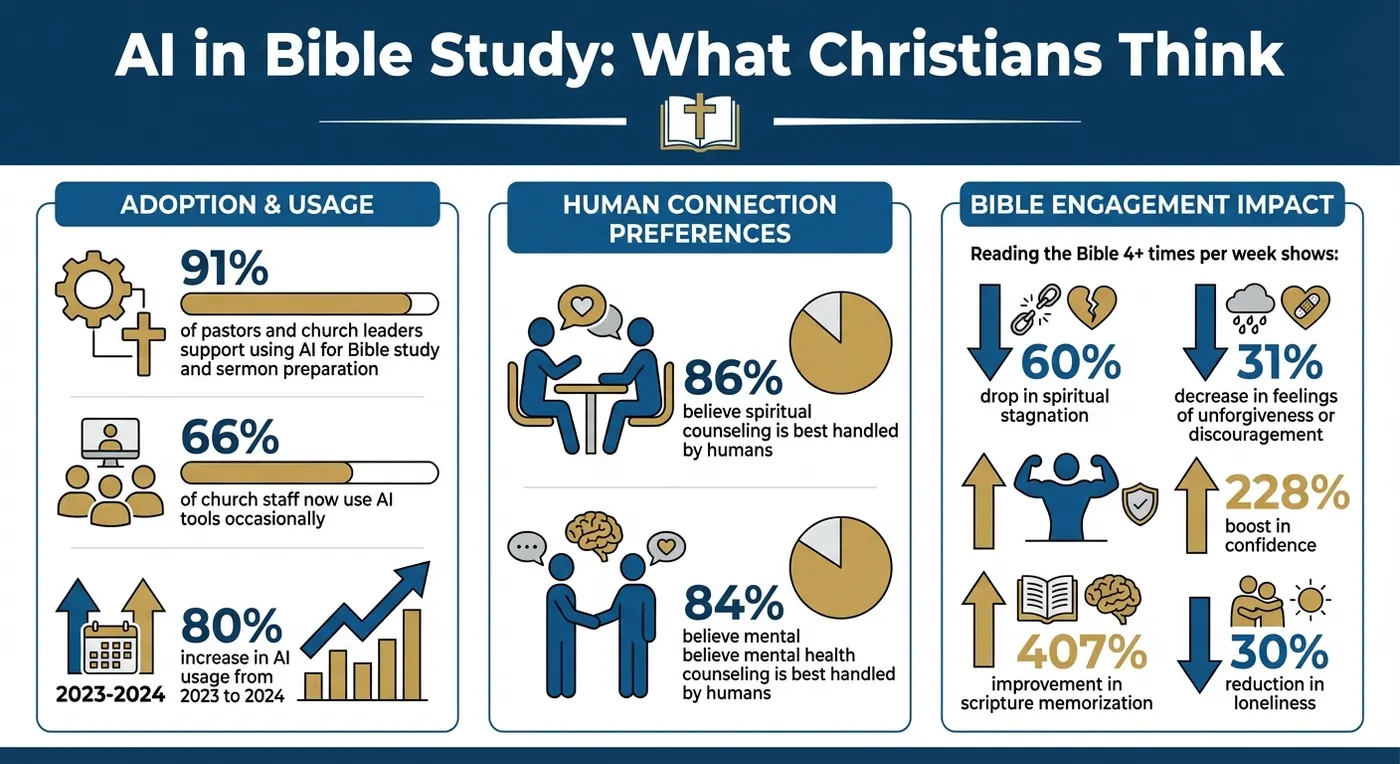
AI in Bible Study: Statistics on Christian Adoption and Attitudes Toward Technology in Faith
As AI becomes more integrated into ministry, many Christians are wrestling with important questions about how to use these tools responsibly. These concerns go beyond surface-level issues – they strike at the core of how believers engage with Scripture and deepen their relationship with Christ.
Can AI Replace the Holy Spirit’s Guidance?
Despite its ability to quickly locate cross-references or provide historical context, AI cannot replicate the transformative work of the Holy Spirit. While 91% of pastors and church leaders support using AI for Bible study and sermon preparation, they also acknowledge its clear limitations. As one ministry leader aptly noted:
Technology can help spread the message, but only God can change the heart.
AI works by analyzing patterns in data, not by revealing divine truth. It can assist with understanding context or finding connections in Scripture, but it cannot illuminate God’s Word in the way the Holy Spirit does. True spiritual insight is often born out of prayer, meditation, and life experiences – things that AI cannot replicate. Think of AI as a helpful tool, like a study guide or commentary, but never as a replacement for the Spirit’s work in your heart .
The Danger of Depending Too Much on Technology
Over-relying on AI can pose spiritual risks. Dr. Joseph R. Miller, an Assistant Professor at Grand Canyon University, offers this warning:
AI might help you pass a class, but it won’t help you become the man or woman God has called you to be.
When believers lean too heavily on algorithms for spiritual insight, they risk creating what some call "artificial theology" – a surface-level understanding that lacks the depth of a personal relationship with God. Spiritual growth often comes from wrestling with Scripture through prayer and reflection. This struggle isn’t just about gaining knowledge; it’s about heart transformation. Relying too much on AI for interpretation can dull the spiritual discernment that develops through these deeply personal processes.
Spiritual and Ethical Questions About AI
The use of AI in sacred practices raises deeper theological and ethical questions. Robert Maginnis, Senior Fellow for National Security at the Family Research Council, cautions:
When decisions that once required prayer are outsourced to an algorithm, something important changes. Conscience weakens. Responsibility erodes. Moral formation shifts from discipleship to data.
The concern isn’t that AI itself is inherently wrong, but that it could become an idol – a false authority for truth and guidance, taking a place that belongs to God alone. Biblical wisdom begins with the "fear of the Lord", something no machine can achieve. Additionally, using AI-generated prayers or reflections as if they were your own can lead to spiritual hypocrisy, creating an appearance of depth without genuine heart transformation. The challenge is to ensure AI remains a tool that serves your faith, rather than a force that shapes it.
These concerns remind us to approach technology with discernment, guided by Scripture, as we consider its role in our spiritual practices.
What the Bible Says About Evaluating AI Tools
While the Bible doesn’t mention artificial intelligence specifically, it provides timeless principles to help Christians assess any tool, including AI. These guidelines offer a way to determine whether technology supports or hinders your walk of faith.
Seeking Wisdom and Discernment in Technology
Scripture emphasizes the importance of wisdom and discernment in every aspect of life. Hebrews 5:14 reminds us that mature believers have "their powers of discernment trained by constant practice to distinguish good from evil." This wisdom is just as crucial when evaluating AI tools for Bible study.
AI, often described as a "stochastic parrot", predicts patterns without actual understanding. This can sometimes lead to inaccurate or even fabricated biblical references. In these moments, James 1:5 offers reassurance: "If any of you lacks wisdom, let him ask God, who gives generously to all without reproach." Before incorporating AI tools into your spiritual practices, take time to pray and seek God’s guidance to determine if these tools will genuinely aid your growth.
Church leaders are increasingly shifting the focus from whether Christians can use AI to how they can use it responsibly while staying aligned with theological principles. This reflects a broader commitment to using technology with wisdom and care, guided by Scripture.
Managing Resources and Time Faithfully
1 Corinthians 4:2 reminds us: "It is required that those who have been given a trust must prove faithful". Christians are called to manage their time, energy, and resources wisely, and this extends to how they use technology. AI, when used thoughtfully, can help streamline tasks, allowing more time for ministry, prayer, and fellowship.
The Dominion Mandate in Genesis 1:26-28 underscores the responsibility of stewardship, including the use of technology. For instance, AI can handle administrative work, freeing up time for more meaningful activities. Statistics show that 66% of church staff now use AI tools occasionally, a significant increase of 80% from 2023 to 2024.
The parable of the talents in Matthew 25:14-30 further illustrates the importance of using resources effectively. If AI helps you study Scripture more efficiently, giving you more time to apply what you’ve learned and serve others, it can be a responsible use of the tools God has provided. However, this efficiency should lead to deeper engagement with others, not isolation.
The Importance of Christian Community
Hebrews 10:24-25 reminds believers to "consider how to stir up one another to love and good works, not neglecting to meet together." This highlights a critical boundary: AI should never replace the essential role of Christian community in spiritual growth.
While AI can provide helpful context, it cannot replicate the empathy, accountability, or encouragement that comes from real human relationships. It also cannot perform sacraments or fulfill the "one another" commands of Scripture. For example, 86% of people believe spiritual counseling is best handled by humans, and 84% feel the same about mental health counseling – showing the irreplaceable value of human connection in spiritual matters.
As IBM Researcher Joanna Ng puts it:
You can’t build a life of faith based on information. You need transformation, formation from the people of God and from the Holy Spirit. And you can’t replace that.
How AI Can Help with Bible Study
While some may worry that technology could overshadow spiritual practices, AI can actually enrich your engagement with Scripture in practical ways.
Faster Access to Biblical Context and Meaning
AI tools make it easy to access information that once required hours of flipping through commentaries and concordances. Instead of manually searching for cross-references or word studies, you can now click a hyperlinked word and instantly see its occurrences throughout Scripture. A great example of this is Kenneth Reitz’s project, kjvstudy.org, which he developed in late 2025 using the AI assistant Claude. This platform generated detailed theological commentary for 12,321 verses, including Hebrew and Greek word analyses and historical context – a feat that would traditionally take years for a team of theologians and developers. Reitz summed it up well:
The human provides the judgment. The AI provides the throughput.
AI can also simulate conversations with biblical figures or analyze how specific terms appear across the Bible, acting like a "context compass" to guide deep research. Whether you’re diving into historical backgrounds or conducting word studies, AI delivers answers in seconds, making it a powerful tool for personalized and efficient Bible study.
Customized Reflection and Application
AI offers tailored reflections based on specific theological perspectives – be it Reformed theology, Gospel-centered teachings, or insights from trusted authors. It bridges ancient texts with modern-day applications. AI can also create bilingual study guides or simplify complex theological content, making Scripture accessible to a broader audience. For instance, in April 2025, Pastor Justin Weels utilized AI to analyze 40 "wilderness" metaphors in the Psalms. He then generated a bilingual study guide that provided historical context and materials for non–English speakers in his congregation. These tools don’t just deepen understanding – they make Bible study more inclusive and adaptable to individual needs.
Saving Time for Busy Christians
For Christians juggling work, family, and church responsibilities, AI can drastically cut down preparation time. Pastor Justin Weels, for example, reduced his weekly study time from 10 hours to just 6 by adopting an AI-driven "Scripture Sprint" method. He now spends 4 hours on research and 2 on prayer. Pastor Elena likens AI’s role to that of a digital concordance:
AI’s a tool – like a digital concordance. Let it dig the quarry; you carve the stones.
Psalmlog: An AI Tool Built for Christian Bible Study
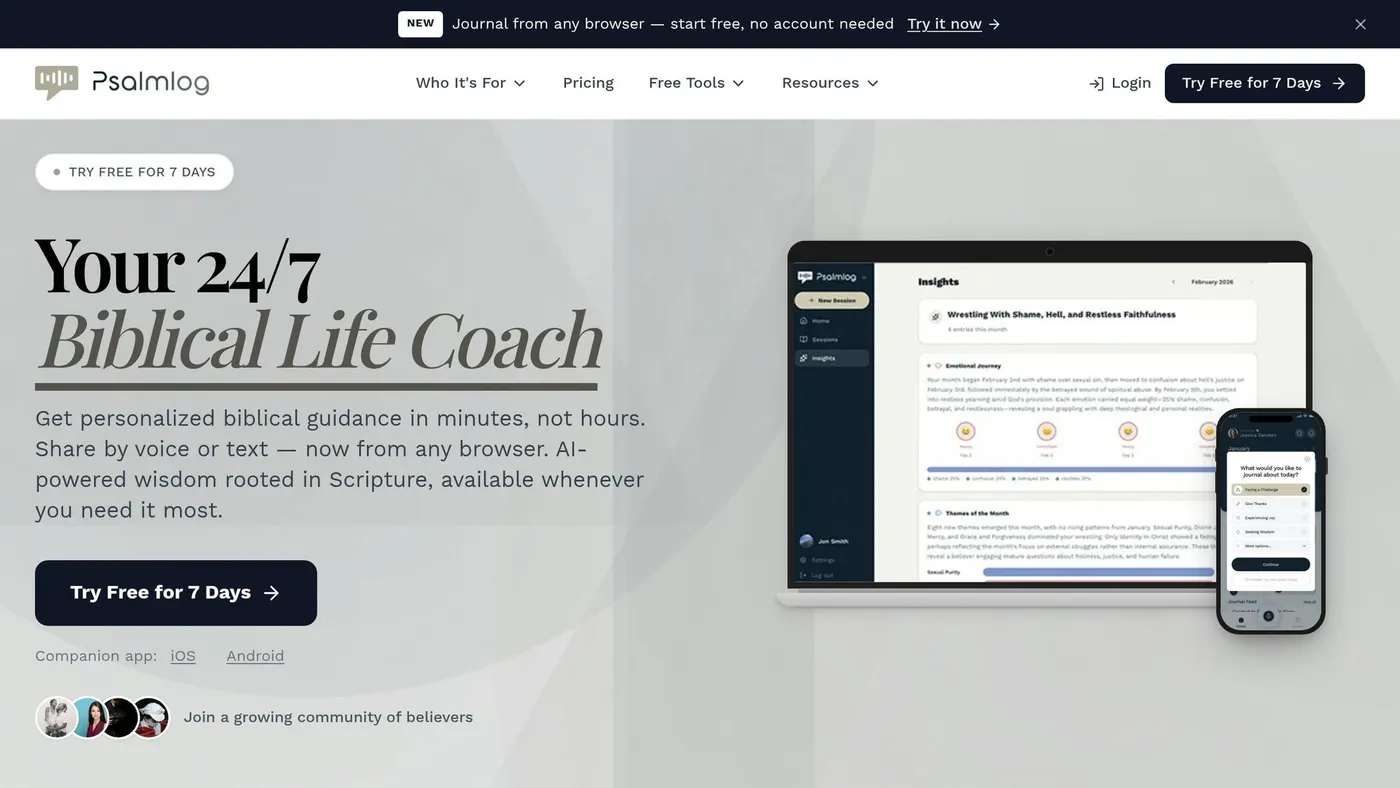
Psalmlog is a study companion powered by AI, created specifically to help Christians deepen their connection with Scripture, all while respecting the Holy Spirit’s role in guiding faith. Preston Zeller, the founder of Psalmlog, puts it this way:
These innovations are simply tools, and Psalmlog will use them to help believers (and seekers) advance their faith journey.
This tool shows how AI, when approached thoughtfully, can enhance Bible study while staying true to Christian traditions. Psalmlog offers a focused, privacy-conscious approach that integrates well with the broader conversation about AI’s role in spiritual practices.
What Psalmlog Offers
Psalmlog emphasizes voice and text journaling, allowing users to openly express their thoughts and struggles. Through AI-powered scripture matching, the platform analyzes the context and emotions behind your entries, presenting Bible verses that resonate with your situation – going far beyond basic keyword searches. To protect privacy, all voice transcriptions are processed locally, and audio files are immediately discarded.
The Spiritual Insights Dashboard is another standout feature. It tracks emotional trends and faith development, offering a clear picture of your spiritual journey. Personalized biblical guidance is delivered quickly, and for those who prefer structure, journaling templates are available for specific challenges like anxiety, grief, or major decisions. Alternatively, you can opt for free-form journaling for open-ended reflection.
Research from the Center for Bible Engagement highlights the impact of regular Scripture engagement. Reading the Bible at least four times a week is associated with a 60% drop in spiritual stagnation and a 31% decrease in feelings of unforgiveness or discouragement. Moreover, Christians who engage with Scripture this often experience a 228% boost in confidence, a 407% improvement in scripture memorization, and a 30% reduction in loneliness.
How Psalmlog Stays True to Biblical Principles
Psalmlog prioritizes a Christ-centered approach, ensuring that its features align with biblical values.
For example, the voice journaling and sentiment analysis tools reflect the biblical emphasis on heartfelt sincerity (Matthew 6:7). These tools encourage users to express their genuine emotions and thoughts to God, rather than relying on polished, pre-written prayers. The platform’s privacy-first design ensures that your entries are never shared or used to train third-party AI models, preserving the sacredness of your personal reflections.
Psalmlog also offers multiple Bible translations and bases its insights on Scripture, steering clear of generic self-help content. By focusing on spiritual insights grounded in God’s Word, the platform ensures that Christ – not AI – remains the ultimate source of wisdom.
Best Practices for Using Psalmlog
Start each session with prayer, asking for guidance and understanding. Use the voice feature to share your struggles naturally, then review the suggested Scripture and insights alongside trusted commentaries to verify their alignment with biblical teachings.
Make the most of the Spiritual Insights Dashboard by regularly reviewing your emotional and spiritual patterns. This can help you identify areas where you may feel stuck and take steps forward with the Holy Spirit’s guidance. Use Psalmlog as a supplement to your personal Bible study and as a tool to enhance discussions within your faith community.
Psalmlog offers a free plan that includes three journal entries on the web. For more features, the Faith Builder plan ($19.99/month or $14.99/month when billed annually) provides 30 sessions, access to the 6-point insights dashboard, voice input, and the Psalmstory feature. Additionally, there are free tools like the AI-powered Bible Verse Finder and a 15-question Spiritual Health Quiz to support your faith journey.
How to Use AI Responsibly in Bible Study
Using AI in Bible study calls for thoughtful and intentional use. The aim is not to replace spiritual practices but to complement them, ensuring Christ remains the focus. Here’s how you can let AI support your faith journey without becoming a distraction.
Start with Prayer
Begin every session with prayer before using any AI tool. Ask the Holy Spirit to guide your study and provide wisdom. This step helps ensure that your focus remains on seeking God’s truth. Pastor Andrew Conard highlights the role of AI in Bible study:
AI tools can enhance biblical study by providing linguistic insights, historical context, and interpretive perspectives… However, these tools supplement rather than replace the Spirit-guided work of interpretation.
Before turning to AI for additional insights, take time to read the Bible passage slowly – at least three times – and jot down your initial reflections and questions. This practice allows you to approach AI insights with a prayerful and discerning mindset.
Check AI Insights Against Scripture
AI-generated insights should never be taken at face value. Always verify them by cross-referencing with Scripture, trusted commentaries, and traditional church teachings. Pay close attention to whether the insights align with core Christian beliefs, such as the Trinity, the deity of Christ, and salvation by grace through faith.
A helpful approach is to use the Wesleyan Quadrilateral – Scripture, tradition, reason, and personal experience – as a framework for evaluation. This ensures that any AI input supports, rather than contradicts, biblical truth.
Combine AI with Community and Personal Study
Once you’ve verified AI insights through prayer and Scripture, bring them into your small group or personal discussions. AI should enhance fellowship, not replace it. Use the insights as conversation starters with your pastor, mentor, or community.
For instance, AI can handle labor-intensive tasks like exploring Greek or Hebrew word meanings, freeing you to focus on deeper discussions with others. Research even suggests that incorporating AI-assisted findings into group studies can enhance engagement and deepen understanding. However, it’s crucial to remember the warning from Dr. Joseph R. Miller, Assistant Professor at Grand Canyon University:
AI might help you pass a class, but it won’t help you become the man or woman God has called you to be.
Let AI serve as a tool, not a substitute, for genuine spiritual growth and connection with God.
Conclusion: Using AI Wisely in Bible Study
AI has the potential to be a helpful companion in Bible study when approached thoughtfully and with discernment. Tools like Psalmlog can offer historical background, linguistic insights, and useful cross-references. However, it’s important to remember that technology is just that – a tool. While AI can shed light on Scripture, it’s the Holy Spirit that truly transforms hearts. This distinction is significant, especially considering that 86% of people believe spiritual counseling is better left to humans than AI.
As we discussed earlier, AI can assist in navigating complex information, understanding Greek and Hebrew word meanings, and even creating discussion questions for small groups. Still, it cannot replace the personal journey of spiritual growth. Biblical interpretation is a shared responsibility within the body of Christ and cannot be handed off to a machine.
A wise approach is to always begin with prayer, placing God at the center of your study. Start by asking the Holy Spirit for guidance, read Scripture attentively and prayerfully, and take time to journal your thoughts before turning to any digital tools. This helps strengthen your own ability to interpret and ensures that God’s Word speaks directly to your heart.
Always cross-check AI-generated insights with Scripture and trusted sources. Share what you learn with your pastor, mentor, or small group, allowing AI to complement fellowship rather than replace it. Ultimately, spiritual growth depends on your active engagement with God and the community of believers.
When used responsibly, AI can save time, provide access to valuable resources, and support your faith journey. The key is to keep Christ at the center, maintain human oversight, and rely on the Holy Spirit as your ultimate guide. With this approach, AI becomes a helpful tool, firmly rooted in a commitment to Christ-focused study.