
Beatitudes Explained: Meaning & Application
The Beatitudes map kingdom life by describing hearts shaped by dependence, mercy, purity, peacemaking, and faithful endurance.
The Beatitudes show what life with God looks like from the inside out. In Matthew 5:3–12, Jesus names 8 marks of kingdom life: humility, sorrow over sin and pain, gentleness, a deep desire for righteousness, mercy, purity, peacemaking, and steady faith under pressure.
If I had to sum up the whole passage in one plain line, it would be this: God blesses people who depend on Him, want what is right, treat others with mercy, and stay faithful when it costs them.
Here’s the article in simple terms:
- Poor in spirit = I know I need God
- Those who mourn = I bring grief and sin to God
- The meek = I use strength with restraint
- Hunger and thirst for righteousness = I want holiness and justice like food and water
- The merciful = I show compassion and forgive
- Pure in heart = I live with one aim, not a split heart
- Peacemakers = I work to heal broken relationships
- The persecuted = I stay faithful when I face pushback for doing what is right
A key detail many readers miss: the first and last Beatitudes share the same promise – “the kingdom of heaven” – which frames the whole section. And across all 8, Jesus shifts the focus from outward image to inward life.
This means the Beatitudes are not steps to earn God’s favor. They are signs of a heart being shaped by Him, and they show up in daily choices, conflict, sorrow, prayer, mercy, and endurance.
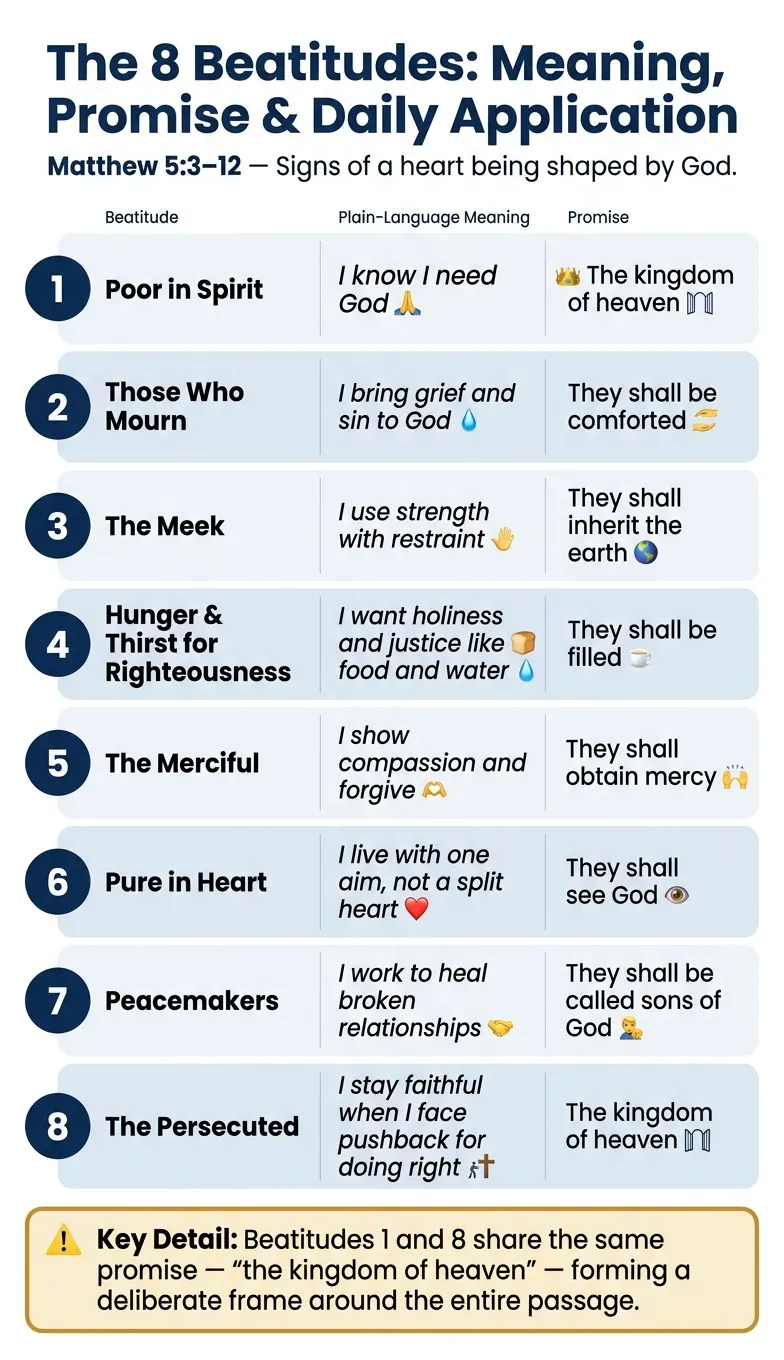
The 8 Beatitudes: Meaning, Promise & Daily Application
Beatitudes 1 and 2: Need for God and Grief Before God
Blessed Are the Poor in Spirit
Jesus starts here because this is the posture that opens the door to every other Beatitude: dependence on God.
"Blessed are the poor in spirit, for theirs is the kingdom of heaven." – Matthew 5:3
Poor in spirit means total spiritual dependence. It is the plain, honest admission that you bring nothing that can earn God’s favor and that you rely fully on His grace. This is a theological realization of where you stand before a holy God. And far from weakness, it is a kind of spiritual strength shaped by humility.
The promise is in the present tense: the kingdom of heaven already belongs to them.
In prayer, this looks like coming to God empty-handed. No pretending. No bargaining. Just the posture of kingdom life.
From that dependence, Jesus moves to sorrow brought into God’s presence.
Blessed Are Those Who Mourn
"Blessed are those who mourn, for they shall be comforted." – Matthew 5:4
Jesus uses a word for deep grief, the sort of sorrow tied to loss. That includes grief over sin, which leads to repentance, and grief over loss and brokenness, brought honestly before God.
Paul links godly sorrow with repentance that leads to salvation.
The comfort promised here is more than relief from pain. It is God’s own presence meeting the mourner.
In prayer and confession, bring grief to God as it is instead of hiding it. This kind of sorrow softens the heart and gets it ready for the next Beatitude.
The Beatitudes Explained Verse By Verse:: What Jesus Really Meant About the Good Life
Beatitudes 3 through 5: Gentle Strength and Right Desires
These next three Beatitudes show how inward humility starts to shape outward behavior. Jesus moves from the inner life to what people can actually see: how we handle conflict, what we long for, and how we treat people who have failed us.
Blessed Are the Meek
"Blessed are the meek, for they shall inherit the earth." – Matthew 5:5
Meekness is one of the most misunderstood words in the Beatitudes. In modern English, it can sound like being timid, passive, or easy to push around. But the Greek word praus meant something closer to strength under control – not weakness and not passivity.
You can see that kind of meekness in everyday life. It cools conflict instead of feeding it. It corrects without harshness. And it accepts correction without becoming defensive.
The promise here – they shall inherit the earth – turns normal human logic upside down. The people who don’t claw for power or try to dominate others are the ones Jesus calls blessed, and they are the ones who will inherit the earth.
Blessed Are Those Who Hunger and Thirst for Righteousness
"Blessed are those who hunger and thirst for righteousness, for they shall be filled." – Matthew 5:6
Here Jesus uses survival language. Hunger and thirst point to an urgent desire for God’s holiness and justice. This isn’t mild interest. It’s the kind of longing you feel in your body.
The Greek word dikaiosunē includes both personal holiness and a longing for social justice and responsibility to the poor. So this Beatitude isn’t only about private morality, and it isn’t only about public wrongs either. It reaches both.
A real hunger for righteousness shows up in places that cost something:
- private choices
- costly integrity
- good done without looking for applause
Blessed Are the Merciful
"Blessed are the merciful, for they shall obtain mercy." – Matthew 5:7
Mercy is loyal compassion in action. It tells the truth about wrong. It forgives actual offenses, not vague ideas. And it stays patient without pretending harm didn’t happen.
That kind of mercy does more than soften a person. It trains the heart for purity and peacemaking.
Beatitudes 6 through 8: Inner Purity, Peace, and Faithful Endurance
Mercy now turns inward. It shapes the heart, how we make peace, and how we respond when following Christ costs us something. These final Beatitudes show what daily life looks like when mercy, purity, and peace move from ideas into action. They shape how a person thinks, relates to others, and suffers for Christ.
Blessed Are the Pure in Heart
"Blessed are the pure in heart, for they shall see God." – Matthew 5:8
Purity of heart is not sinlessness. It is not flawless rule-keeping either. It points to sincerity, moral integrity, and a heart that is fully given to God. Katharos means clean, pure, and free from impurity. So purity of heart means one loyalty, one aim, and no divided allegiance.
You can see it in the motives behind giving. You can see it in what someone does when no one else is around. You can see it in whether worship is sincere or just for show.
The promise works on two levels. The pure in heart sense God’s presence with more clarity now, and one day they will see Him fully. An undivided heart is also what makes real peace possible.
Blessed Are the Peacemakers
"Blessed are the peacemakers, for they shall be called sons of God." – Matthew 5:9
Jesus does not say peace-lovers. He says peacemakers. That difference matters.
A pure heart does not stay hidden. It shows up in how you deal with broken relationships. Biblical peacemaking goes after reconciliation and restored relationships. It is rooted in shalom – wholeness, not just the absence of conflict.
That means a peacemaker in a strained marriage does not shut down just to avoid another argument. They move toward honest reconciliation, even when it is costly. In a divided church or a tense workplace, they stand for truth in love instead of stirring up division or picking a side just to belong.
Peacemakers are called children of God because they reflect their Father’s reconciling character.
But peacemaking does not always get applause. Many times, it brings resistance instead.
Blessed Are Those Who Are Persecuted for Righteousness’ Sake
"Blessed are those who are persecuted for righteousness’ sake, for theirs is the kingdom of heaven." – Matthew 5:10
This blessing is for suffering that comes from obeying Christ, not for suffering caused by bad behavior or avoidable conflict. A life shaped by the Beatitudes will clash with a world that rewards self-promotion and revenge.
Today, that friction may look like social exclusion, mockery, slander, or lost opportunities. The issue is not whether conflict happens. The issue is why. Is it coming from faithfulness to Christ, or from pride and poor judgment?
The promise here echoes the first Beatitude: theirs is the kingdom of heaven.
Conclusion: What the Beatitudes Mean for Christian Life Today
The Beatitudes sketch the shape of life in God’s kingdom: dependence, grief, meekness, hunger for righteousness, mercy, purity, peacemaking, and endurance. Put together, they form a clear path. It starts with dependence and keeps moving toward endurance.
These teachings feel hard because they cut against instinct. The world tends to reward self-sufficiency and comfort, not dependence on God. It tends to praise power and self-assertion, not meekness or peacemaking. To live the Beatitudes is to choose a different set of values, not once in a while, but day by day.
Spiritual growth rarely moves in a straight line. More often, it circles back. You return to mourning, meekness, and mercy again and again, but at deeper points as life changes.
One Simple Next Step for Personal Reflection
That movement makes the Beatitudes practical, not just ideas on a page. For personal reflection, start with one Beatitude and stay there for a bit.
Read Matthew 5:3–12 slowly. Notice which Beatitude brings conviction or stirs longing. Then write a short journal entry that connects that Beatitude to one actual situation in your life. Start with the one that presses on you the most.
FAQs
Are the Beatitudes commands or descriptions?
The Beatitudes are mainly descriptions, not commands. Jesus is declaring the blessedness of people who belong to God’s kingdom, not handing out a checklist for earning God’s favor.
They show the kind of character and deep flourishing God gives his followers. The invitation is into kingdom life shaped by a heart changed by grace, not just a list of rules.
How do the Beatitudes fit together?
The Beatitudes fit together as one picture of life in God’s kingdom. They aren’t a set of isolated rules or boxes to check. Instead, they show a life that starts with spiritual need and dependence on God, then grows into a way of living marked by His grace through mercy, purity, and peacemaking.
The first and eighth Beatitudes both point to the Kingdom of Heaven, which acts like a frame around the whole teaching. That matters because it shows the focus is less about a rigid step-by-step order and more about the kind of character Jesus forms in His people: Christlike character.
How can I practice one Beatitude this week?
Pick one Beatitude and act on it in a simple, concrete way:
- Poor in spirit: bring your worries to God in prayer and admit how much you need His grace.
- Meekness: meet conflict with patience instead of trying to force the result you want.
- Mercy: forgive someone who hurt you.
- Peacemaker: take one step to help move a conflict toward reconciliation.