
Spiritual Gifts of the Holy Spirit Guide
Spiritual gifts are God's tools to serve the church—identify yours biblically, grow them humbly, and use them to build others.
If you follow Christ, you were given a spiritual gift to serve others. The main point is simple: gifts come from the Holy Spirit, they differ from person to person, and they should be used with love, order, and humility.
Here’s the article in plain terms:
- Every believer has at least one gift for the good of the church
- No one has every gift, so Christians need each other
- Gifts are for service, not status
- Love matters more than public display
- Scripture names several gifts, including prophecy, teaching, mercy, giving, leadership, tongues, healing, and helps
- Public use of gifts should be tested and orderly
- You usually spot your gifts by serving, seeing fruit, and getting input from mature believers
The article pulls from 4 main New Testament sections: Romans 12, 1 Corinthians 12–14, Ephesians 4, and 1 Peter 4. Together, they show what gifts are, why God gives them, and how to use them well in church life.
A few facts stand out:
- In 1 Corinthians 12:7, gifts are given for “the common good”
- In 1 Corinthians 12:11, the Spirit gives gifts as He decides
- In 1 Corinthians 14, Paul puts limits on public speech so worship does not turn into confusion
- In Romans 12 and 1 Peter 4, gifts are tied to humble service and stewardship
One key distinction: spiritual gifts are not the same as natural skills, and they are not the same as the fruit of the Spirit. Gifts shape how I serve. Fruit shapes my character.
If I want to use this article well, here’s the short takeaway: serve where there is need, test what I think my gift is by Scripture, listen to wise feedback, and use whatever gift I have to build up other people.
That’s the heart of the guide below.
A Biblical Foundation for Spiritual Gifts
Why Gifts Are Given to the Body of Christ
Paul says spiritual gifts are given "for the common good" (1 Corinthians 12:7), and Peter calls believers "stewards of God’s varied grace" (1 Peter 4:10). That word steward matters. A steward handles something that belongs to someone else.
So the gift is not ours to keep, parade, or treat like a badge. It is God’s grace placed in our hands so we can serve other people. That changes the way believers should think about their own gifts and the gifts they see in others.
Every Believer Has a Gift, but Not the Same One
No believer has every gift, because God is the one who gives them. The Holy Spirit distributes gifts "just as he determines" (1 Corinthians 12:11). In plain terms, this is God’s decision, not a prize for talent, rank, or training.
God gives different gifts to different people so the church functions like a body, not a room full of self-made individuals. We need one another. That’s why spiritual gifts are judged by how they serve the body, not by how public they are or how much attention they draw. Every gift has a needed place in the body of Christ.
Love, Character, and Order as Biblical Guardrails
Gifts without love accomplish nothing. Paul does not treat that as a nice extra in 1 Corinthians 13. He makes it the point. If love is missing, the gift loses its worth. Gifts are temporary tools; Christlike character is the standard that lasts.
That same line of thought carries into 1 Corinthians 14. Paul sets limits on how many people should speak in a gathering, says tongues must be interpreted in public worship, and insists that worship be done decently and in order. These boundaries guard the church from confusion and keep the focus on building up others.
If a gift is used with pride, or without any accountability, it is already being used the wrong way no matter how dramatic it may seem. Those guardrails shape how the gifts in the next section should be understood and practiced.
Spiritual Gifts Made Simple: What Every Believer Must Know
The Major Gifts of the Holy Spirit in Scripture
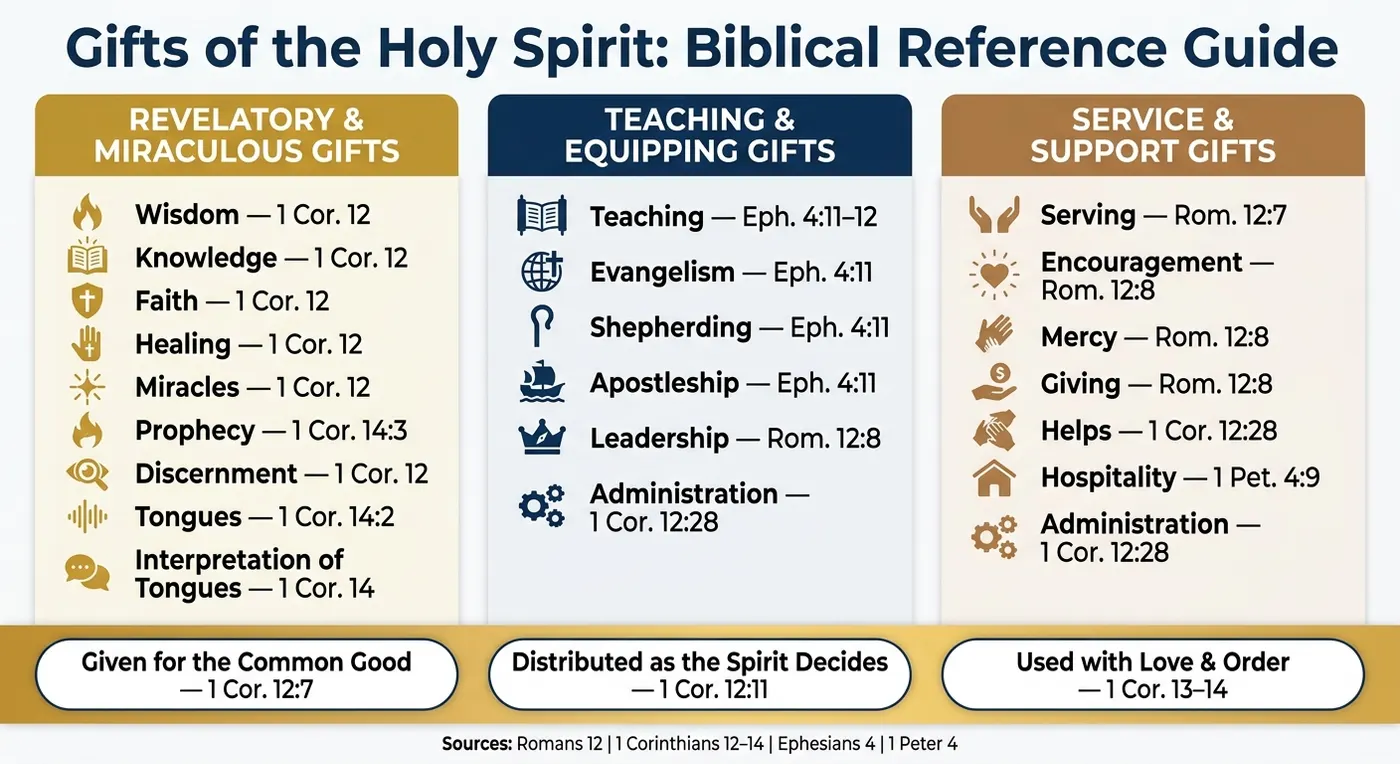
Gifts of the Holy Spirit: Biblical Reference Guide
With that groundwork in place, we can group Scripture’s gifts by the way they serve the church. In the New Testament, spiritual gifts often fall into three practical groupings: revelatory and miraculous gifts, teaching and equipping gifts, and service gifts.
Revelatory and Miraculous Gifts: Wisdom, Knowledge, Faith, Healing, Miracles, Prophecy, Discernment, Tongues, and Interpretation
These gifts come mainly from 1 Corinthians 12–14. They depend directly on the Holy Spirit for insight, power, or communication.
Wisdom applies biblical truth to a given situation. Knowledge understands that truth and explains it clearly.
Faith is a Spirit-given confidence that God will do something specific, even when the circumstances point the other way. Healing and miracles are closely connected. Healing refers to God working through a person to restore health. Miracles refer to broader acts of supernatural power that bear witness to God’s Word.
Prophecy is receiving and speaking a message from God to strengthen, encourage, or comfort others (1 Corinthians 14:3). Discernment – or distinguishing of spirits – is the ability to tell what comes from God and what does not, whether that involves a teaching, a spiritual claim, or a motive. Tongues is the ability to speak in a language not learned naturally, and interpretation of tongues is the matching gift that makes that message understandable to the congregation. In public worship, tongues must be interpreted so the church is built up.
Other gifts build up the church through teaching, direction, and oversight.
Teaching and Equipping Gifts: Teaching, Evangelism, Shepherding, Apostleship, and Leadership
These gifts appear across Ephesians 4 and Romans 12. Their focus is the church’s doctrinal health, stability, and direction.
Teaching is the ability to explain and apply the truths of Scripture so others learn and grow. Evangelism is the ability to be an unusually effective instrument in leading unbelievers to a saving knowledge of Christ.
Shepherding is the ability to personally lead, nourish, protect, and care for a group of believers over time. Someone may have the gift of shepherding without holding the formal office of pastor. Apostleship involves starting and overseeing new churches or ministries with recognized authority. Leadership is the ability to guide people toward a shared goal, while administration handles the practical steps that move that goal forward.
Scripture also names gifts that meet practical needs and support day-to-day ministry.
Service and Support Gifts: Serving, Encouragement, Mercy, Giving, Helps, Hospitality, and Administration
These gifts appear in Romans 12, 1 Peter 4, and 1 Corinthians 12.
Serving means seeing and meeting the practical, physical needs of the body. Encouragement is the ability to move others forward through counsel, comfort, and exhortation. Mercy goes beyond sympathy. It is the gift of deeply empathizing with people in distress and taking compassionate action. Giving is contributing material resources with generosity and cheerfulness, not from pressure or duty. Helps is closely tied to serving, but it is more people-focused: it supports and strengthens another person’s ministry. Hospitality means welcoming and caring for those who need food, shelter, or a sense of belonging. Administration is the ability to direct a church or ministry toward its goals by managing plans and people well.
Quick reference:
| Gift | Primary Biblical Text | Primary Purpose | Common Misuse | Biblical Safeguard |
|---|---|---|---|---|
| Prophecy | 1 Cor. 14:3 | Edification, encouragement, comfort | Failing to test prophetic messages | Must be "in proportion to faith" |
| Tongues | 1 Cor. 14:2 | Speaking to God; sign for unbelievers | Using tongues without interpretation | Must have an interpreter; limit to 2–3 speakers |
| Teaching | Eph. 4:11–12 | Doctrinal clarity and growth | Teaching without love | Speak truth in love (Eph. 4:15) |
| Leadership | Rom. 12:8 | Motivating the body toward God’s goals | Manipulation or coercion | Exercise with diligence and humility |
| Giving | Rom. 12:8 | Resourcing the body’s needs | Seeking recognition | Give with cheerfulness and liberality |
| Mercy | Rom. 12:8 | Caring for those in distress | Responding without compassion | Act with genuine empathy |
| Administration | 1 Cor. 12:28 | Steering ministry toward its goals | Focusing on process over people | Serve the vision with care |
Many believers show a gift mix, with two or more gifts working together.
How to Recognize and Use Your Spiritual Gifts Faithfully
Biblical Ways to Identify Your Gifts in Daily Life
After defining the gifts, the next step is learning how they show up in ordinary Christian life. Most people spot their gifts by serving. Three signs help here: desire, effectiveness, and confirmation from mature believers.
Pray for wisdom as you pay attention to those patterns. Maybe you keep feeling drawn to teaching Scripture, showing hospitality, or organizing ministry work. And maybe people are helped by it in plain, visible ways. That matters. Inner desire and outward fruit often line up.
Still, desire by itself isn’t enough. Test what you sense against Scripture, and talk it through with people who know you well. A pastor, church leader, or trusted mentor can often spot your effectiveness more clearly than you can. The Holy Spirit can use and shape natural abilities for ministry. The main question is simple: does it build up the church and point people to Christ?
Practicing Your Gifts in the Local Church with Humility and Accountability
Once you start to notice a gift, test it in the local church. Gifts grow through real service, correction, and time. Start where there’s a need: teaching, hospitality, administration, serving, nursery, or greeting. You don’t need a formal title to do any of that. You just need a willing heart.
Service is where a gift proves useful. Romans 12:3 calls believers to sober self-assessment. So stay open to feedback. Be willing to serve where help is needed. And don’t get pulled into comparing your gifts with someone else’s. Hidden, faithful service matters just as much as any public role.
Using Psalmlog for Prayer, Reflection, and Gift Discernment

Voice journaling can help you look back on these patterns with honesty over time. Regular prayer and reflection make recurring gift patterns easier to spot. It’s often hard to see what’s happening in the moment. Looking back tends to make things clearer.
That’s where Psalmlog fits well. You can record spoken reflections after prayer, Scripture reading, or ministry, then review Scripture tags and recurring patterns to notice what the Spirit may be developing in you.
Conclusion: Use Your Spiritual Gifts to Serve Others and Build Up the Church
After defining the gifts, the last question is how to use them with faithfulness. Spiritual gifts come from the Holy Spirit, and they are meant for the common good, not for personal status.
God gives gifts to the church in a way that keeps us dependent on one another. No believer carries everything the body needs, and no gift is given for self-exaltation. That means your gift isn’t a badge. It’s a tool for service. Use it with humility and accountability.
The takeaway is simple: steward your gifts, stay accountable to your local church, and let love shape how you use whatever gift you carry. The goal is to build up the church and glorify God. Serve faithfully where you are.
FAQs
How do I know which spiritual gift I have?
Start with prayer. Ask God to show you your spiritual gifts, then make space for quiet reflection. Pay attention to the places where you feel joy and where your service seems to help others most.
It also helps to ask trusted friends, family members, or church leaders what they notice in you. Sometimes other people can see patterns that are easy to miss on your own.
As you try different gifts through ministry and service, look back on those experiences. Notice where you seem to have the most impact and where your efforts bear the most fruit.
Are spiritual gifts different from talents and the fruit of the Spirit?
Yes. Spiritual gifts are different from both natural talents and the fruit of the Spirit.
Natural talents are abilities a person is born with and then sharpens through practice. Spiritual gifts, on the other hand, are given by the Holy Spirit at new birth for the purpose of building up the church.
The fruit of the Spirit is something else entirely. It points to Christlike character traits – such as love, joy, and patience – that the Spirit produces in believers.
Can spiritual gifts change or grow over time?
Yes. Spiritual gifts can grow and change in the way they show up over time. The Holy Spirit gives them at regeneration, and they are not lost. But they can stay dormant or go unnoticed for a long time.
Many believers discover their gifts little by little. As they use them in the church, they often grow in how well and how deeply they exercise them.
It’s a bit like learning to use a muscle. The gift is there, but practice shapes how it comes through. Someone may have the gift of teaching, for example, yet become clearer, wiser, and more helpful over the years as they serve others.