
Overcoming Fear: 12 Bible Verses That Will Make You Brave
12 Bible verses with short reflections and journaling tips to help Christians replace fear with trust, strength, and peace.
Fear can be overwhelming, but the Bible offers over 300 reminders to "fear not." Courage isn’t the absence of fear; it’s trusting God even when you’re afraid. Here are 12 Bible verses to help you find strength and peace in challenging moments:
- Joshua 1:9: Be strong and courageous because God is always with you.
- Deuteronomy 31:6: God’s presence ensures you’re never alone, even in uncertainty.
- Isaiah 41:10: God’s promises of strength and help silence fear.
- Psalm 23:4: God walks with you through life’s darkest valleys.
- 2 Timothy 1:7: God gives you power, love, and a sound mind, not fear.
- Psalm 27:1: Trust in God as your light, salvation, and stronghold.
- Isaiah 41:13: God holds your hand and reassures you, “Do not fear.”
- Psalm 56:3-4: Turn fear into trust in God’s promises.
- Proverbs 28:1: The righteous are bold like lions, free from guilt.
- Psalm 118:6: With God on your side, no one can truly harm you.
- 1 John 4:18: Perfect love from God casts out fear.
- Psalm 46:1: God is your refuge and strength, always ready to help.
These verses remind us that God’s presence transforms fear into faith. Speak them aloud, memorize them, or reflect on them in prayer to face challenges with confidence.
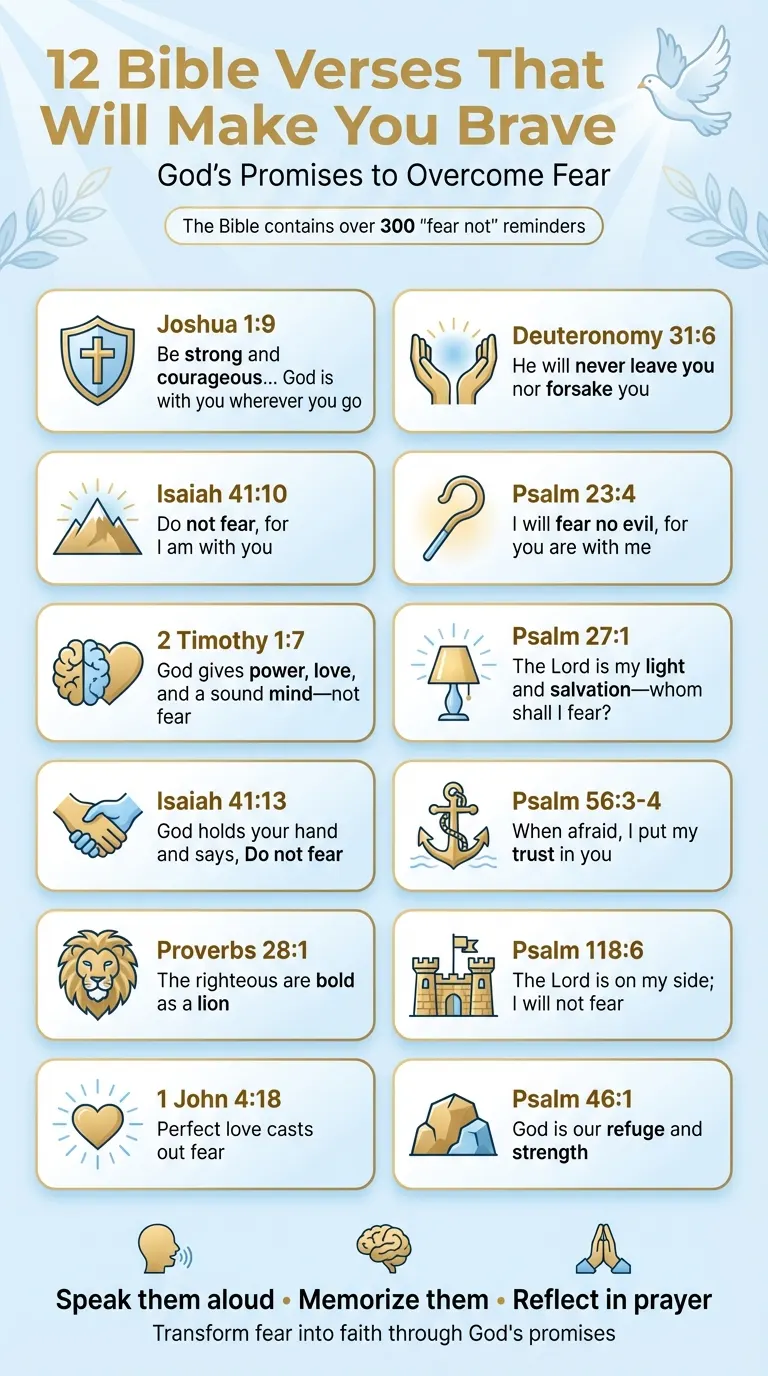
12 Bible Verses to Overcome Fear and Find Courage
Bible verses for overcoming fear (4 ways to deal with fear as a Christian)
1. Joshua 1:9
"Have I not commanded you? Be strong and courageous. Do not be afraid; do not be discouraged, for the LORD your God will be with you wherever you go." (Joshua 1:9, NIV)
This verse comes at a crucial turning point in Israel’s story. Joshua had just taken over as leader, tasked with guiding the Israelites into Canaan – a land filled with fortified cities and powerful armies. Facing such overwhelming odds, God repeatedly commands Joshua to be courageous, highlighting how essential courage is in the face of fear.
What stands out is how God frames courage – not as something tied to personality, but as an act of obedience. John Gill, in his Exposition of the Bible, puts it this way:
"Consider who it is that has given these orders and instructions, the great Jehovah, the everlasting I AM, who is faithful to his promises, and able to perform".
This means your courage doesn’t hinge on how naturally brave you feel. It’s rooted in the assurance of God’s constant presence.
The verse also offers a remedy for discouragement: the promise that God is always with you. As RethinkNow insightfully notes:
"Peace is found not in the absence of the storm but in the presence of God".
Even science backs up the calming effects of this verse. A 2021 Mayo Clinic study revealed that oncology patients who recited Joshua 1:9 daily had 22% lower cortisol levels – the hormone linked to stress – compared to those who didn’t.
To put this into practice, commit this verse to memory and reflect on your own "Jordan River" – a challenge where taking even one step of faith could lead to transformation. With God’s promise of unwavering presence, this verse serves as a powerful reminder to face life’s obstacles with boldness.
2. Deuteronomy 31:6
"Be strong and courageous. Do not be afraid or terrified because of them, for the LORD your God goes with you; he will never leave you nor forsake you." (Deuteronomy 31:6, NIV)
This verse, spoken by Moses during his final address to the Israelites, carries a powerful message of courage and reassurance. At 120 years old, Moses was preparing to pass the mantle of leadership to Joshua. The Israelites, after 40 long years in the wilderness, were on the verge of entering the Promised Land – a land filled with fortified cities and intimidating enemies. It was a moment of uncertainty and fear, but Moses reminded them of an essential truth: they were not alone.
God is described here not as a distant figure but as an active warrior, present in their battles. Pastor and author Matthew H. Patton captures this beautifully:
"Imagine the strength of entering battle with the mightiest ally by your side!"
The original Hebrew words in this verse add depth to its meaning. Khazaq refers to mental and spiritual strength, while amatz speaks to boldness and determination. Together, they paint a picture of unwavering inner resolve, even in the face of overwhelming odds. The phrase "will never leave you nor forsake you" is especially striking in its original language. It uses a double negative for emphasis, making it clear that God’s commitment is absolute – He will never loosen His hold or abandon His people.
This promise isn’t confined to the Old Testament. It’s echoed in Hebrews 13:5, offering Christians the same assurance of God’s constant presence. During moments of fear – whether it’s starting a new job, moving to a new place, or navigating personal loss – this verse invites believers to anchor themselves in God’s promise. As Senior Editor Jennifer Garcia of FreeBibleStudyHub explains:
"Fear is the opposite of faith and trust in God. This phrase encourages believers to reject fear as they step into God’s promises."
True courage comes from trusting that God is with you through every transition and challenge. This verse calls us to lean into that trust, no matter how daunting the road ahead may seem.
3. Isaiah 41:10
"So do not fear, for I am with you; do not be dismayed, for I am your God. I will strengthen you and help you; I will uphold you with my righteous right hand." (Isaiah 41:10, NIV)
This verse, written around 700 BC, brought hope to the Israelites as they faced the looming threat of Babylonian exile. In the midst of uncertainty and fear, when they felt powerless against foreign domination, God’s words reassured them that His presence was their ultimate source of strength and comfort.
The verse is structured around five promises: God’s presence (“I am with you”), His personal relationship with His people (“I am your God”), His power to strengthen, His willingness to help, and His commitment to sustain them. In the original Hebrew, the verbs for “strengthen,” “help,” and “uphold” are in the imperfect tense, highlighting that God’s support is ongoing and unceasing. The phrase “righteous right hand” further emphasizes His strength and honor in upholding those who trust Him.
As Matthew Henry once noted:
"The scope of these verses is to silence the fears, and encourage the faith, of the servants of God in their distresses."
A modern example of this verse in action comes from July 2019, when Anne Peterson leaned on Isaiah 41:10 for courage while testifying in a Chicago courtroom. By relying on this promise, she overcame her fears, presented critical evidence, and played a role in achieving justice.
To integrate this verse into your life, try speaking it aloud during prayer, tailoring it to your specific situation (e.g., “Lord, I will not fear this diagnosis, for You are with me”). Use a spiritual reflection planner to record moments when you’ve experienced God’s help and strength. This verse serves as a timeless reminder that biblical courage can inspire resilience in the challenges we face every day.
4. Psalm 23:4
"Even though I walk through the valley of the shadow of death, I will fear no evil, for you are with me; your rod and your staff, they comfort me." (Psalm 23:4, NIV)
This verse delivers a powerful reminder of God’s unwavering presence during life’s most challenging moments. The "valley of the shadow of death" (tsalmaveth in Hebrew) symbolizes those seasons where danger and fear feel overwhelming and unavoidable. Yet, the key word here is "walk through." It emphasizes that these dark valleys are temporary – they are not where we remain but something we pass through. This reflects the consistent Biblical theme of God as a Shepherd who guides us, even when the path feels perilous.
The verse doesn’t promise a life free from difficulty but highlights the transformative impact of God’s presence. As Bible teacher Olivia Clarke puts it:
"The presence of God changes everything. Not by removing the danger, but by changing your position relative to it".
Earlier in the psalm, the Shepherd leads the flock through green pastures and still waters. But in the dark valley, He is no longer ahead – He is among the sheep, providing immediate comfort and reassurance. This shift is mirrored in the psalm’s language. David transitions from speaking about God in the third person ("He leads me") to addressing Him directly ("You are with me"), reflecting a deepened sense of intimacy and reliance during trials.
The "rod" and "staff" mentioned here are rich with meaning. The rod represents God’s power to protect, while the staff signifies His guidance and care. Together, they paint a picture of a Shepherd who is both defender and guide, actively involved in our lives. These symbols encourage us to reflect on how God’s protection and guidance have shaped our responses to fear.
To make this verse personal, think back to times when God’s comfort or guidance carried you through difficult situations. These memories can strengthen your faith in current struggles. When fear threatens to take over, counter it with worship music for anxiety, focus on scriptural truths, or lean on the encouragement of fellow believers who can remind you of God’s promises. And above all, pray – not just for the removal of hardship but for a greater awareness of God’s presence in the midst of it.
5. 2 Timothy 1:7
"For God has not given us a spirit of fear, but of power and of love and of a sound mind." (2 Timothy 1:7, NKJV)
This verse cuts straight to the root of fear, distinguishing between a healthy reverence for God and the crippling fear that holds us back. Paul makes it clear that this paralyzing fear doesn’t come from God. Instead, God equips us with three essential tools: power, love, and a sound mind. These gifts counter fear and enable us to live boldly.
Similar to the promises in Joshua 1:9 and Deuteronomy 31:6, this verse reminds us that our courage comes not from our own abilities but from God’s provision. Written while Paul awaited execution in a Roman prison, these words encouraged Timothy to lead with confidence in his ministry. God provides power to face challenges, love to shift our focus away from self-preservation, and a sound mind to think clearly and act wisely.
Applying this promise can turn fear into action. A helpful approach is the "Cast, Fill, Trust" method: cast your fears onto Jesus, fill your heart with Scripture and the Holy Spirit, and trust in His promises. God doesn’t demand a life completely free of fear – He asks us to not let fear control us.
"Nothing will do more to inspire courage, to make a man fearless of danger, or ready to endure privation and persecution, than ‘love.’"
When fear threatens to take over, lean into the gifts of power, love, and a sound mind. Surrender your fears to God, and you’ll discover a courage that grows stronger rather than crumbling under pressure.
6. Psalm 27:1
"The Lord is my light and my salvation – whom shall I fear? The Lord is the stronghold of my life – of whom shall I be afraid?" (Psalm 27:1, NIV)
Psalm 27:1 offers a powerful reminder of God’s role as our guide, protector, and deliverer. Through three vivid metaphors – light, salvation, and stronghold – the verse paints a picture of unwavering divine support. God as "light" represents His ability to illuminate our path and dispel darkness. "Salvation" speaks to His power to rescue us from harm, while "stronghold" evokes the image of a fortified refuge, offering security against life’s crushing challenges. These metaphors assure us that no matter the circumstances, God’s presence is a shield against fear.
When David penned these words, he was no stranger to adversity, facing battles and betrayal. Yet, his confidence in God’s character remained unshaken. The unique mention of "light" in the Old Testament emphasizes God as a beacon of hope. The Hebrew term maôz, translated as "stronghold", refers to a secure fortress, reinforcing the idea of God as an unyielding protector. The repeated use of "my" makes this verse deeply personal, reminding us that God’s care is intimate and individual.
"The Lord, who is the believer’s light, is the strength of his life; not only by whom, but in whom he lives and moves."
The rhetorical questions – "Whom shall I fear?" and "Of whom shall I be afraid?" – are bold declarations that fear has no place when God stands with us. These questions challenge fear directly, proclaiming that no enemy, human or spiritual, can prevail against God’s protection. As Charles Spurgeon insightfully noted:
"The bold question looks into the future as well as the present. ‘If God be for us,’ who can be against us, either now or in time to come?"
This verse encourages us to shift our focus from the threats we face to the character of God. When fear begins to creep in, speak these questions aloud to confront your worries. True courage doesn’t stem from a life free of danger but from trusting the One who reigns over it all. This active trust in God’s power transforms fear into faith, paving the way for further reflections on biblical courage in the verses to come.
7. Isaiah 41:13
"For I am the Lord your God who takes hold of your right hand and says to you, Do not fear; I will help you." (Isaiah 41:13, NIV)
This verse paints a striking image of God’s deep and personal relationship with His people. The act of God holding your right hand isn’t just symbolic – it conveys closeness, strength, and reassurance. In ancient times, the right hand represented authority and power. So, when God takes hold of it, He not only offers comfort but also becomes a source of stability and strength. While originally spoken to the Israelites during their exile, this promise extends beyond their situation, showing how God can turn moments of weakness into opportunities for strength.
The verse carries both a command – "Do not fear" – and a promise – "I will help you." It encourages shifting focus away from personal limitations and onto God’s unwavering support. John Calvin highlighted the importance of fixing our attention on God during hardships:
"Whenever we are attacked by any severe contest, let us learn to look to Him; for if we hesitate and look hither and thither, we shall never enjoy peace of mind." – John Calvin
This imagery of God holding your hand is deeply comforting. Matthew Henry noted that God speaks "with tenderness", emphasizing His closeness: "not only within call, but present with thee." This is a God who walks beside us, much like a parent guiding a child through uncertain paths. John Gill elaborated that this divine grip teaches believers "to walk by faith, leading them into his presence… and keeps them from falling." It’s a vivid reminder of God’s protective presence in every step of life’s journey.
When fear begins to creep in, try visualizing this "hand-holding" moment. Picture God’s hand firmly gripping yours, providing the strength you need. Acknowledge your vulnerabilities – doing so creates space for God to work as your Redeemer. Lean into His strength instead of relying on your own, allowing this dependence to turn fear into faith-driven action.
8. Psalm 56:3-4
"When I am afraid, I put my trust in you. In God, whose word I praise – in God I trust and am not afraid. What can mere mortals do to me?" (Psalm 56:3-4, NIV)
David penned these words during a terrifying moment – he was held captive by the Philistines in Gath. This verse stands out because it doesn’t shy away from fear. David openly admits, "When I am afraid", showing that fear is a natural, human response. But here’s the key: David doesn’t stay in that fear. Instead, he uses it as a moment to turn toward trust.
This passage highlights a deliberate choice: moving from fear to trust. David doesn’t deny his fear; he acknowledges it and then consciously decides, "I put my trust in you." It’s a reminder that fear doesn’t have to paralyze us – it can become the very thing that drives us closer to God. As Bible Hub commentary beautifully explains:
"A fragile hand in a strong Savior is safer than a strong hand on a fragile branch."
In other words, it’s not about the strength of your faith but about the strength of the One you’re trusting. This verse encourages you to shift your focus from the size of your fear to the greatness of God.
David also points to the power of God’s "word" – His promises and truth. By the end of the psalm, he asks, "What can mere mortals do to me?" This isn’t blind optimism or denial of real danger. Instead, it’s a recognition that human threats pale in comparison to God’s sovereignty and authority.
When fear creeps in, don’t ignore it. Acknowledge it, and then let it push you toward trust. Speak God’s promises, remember His faithfulness, and let His truth steady your heart.
9. Proverbs 28:1
"The wicked flee when no one pursues, but the righteous are bold as a lion." (Proverbs 28:1)
This verse paints a vivid picture of two contrasting mindsets. The wicked, burdened by guilt, often run from threats that don’t even exist. As theologian Matthew Henry explained:
"Guilt in the conscience makes men a terror to themselves… Sin makes men cowards."
A guilty conscience can turn even the bravest into cowards. On the other hand, the righteous are compared to lions – fearless and steadfast. This boldness doesn’t come from an absence of fear but from a clear conscience and unwavering trust in God’s protection. When you live according to God’s truth, guilt no longer holds you back, allowing courage to replace fear.
True boldness stems from a deep reverence for God. When you fear God above all else, other fears lose their grip. You’re no longer tied down by the need for approval or the fear of rejection. A 2023 Barna Group study found that nearly 50% of practicing Christians feel pressured to compromise their beliefs at work or school. Yet, when rooted in Christ, you can stand firm, embodying that lion-like boldness described in Scripture.
To strengthen this boldness, consider adopting habits that nurture your faith. For instance, regular confession can be transformative. Unresolved guilt amplifies fear and tempts you to retreat. But by confessing openly and honestly, you break free from guilt’s hold, restoring the confidence to act with courage.
10. Psalm 118:6
"The LORD is on my side; I will not fear. What can man do to me?" (Psalm 118:6)
This verse reminds us that when God is with us, no human threat can truly harm us. The Hebrew word li, meaning "for me", emphasizes that God is actively protecting us, not merely watching from a distance. It’s a powerful declaration that faith in God surpasses any challenge posed by people.
The question, "What can man do to me?" highlights the temporary nature of human harm when compared to God’s eternal plans. Albert Barnes captured this beautifully when he wrote:
"They cannot destroy me when he means to save me; they cannot defeat his gracious designs toward me. I am safe if God is my Friend."
Psalm 118:6 is part of the "Egyptian Hallel" (Psalms 113–118), traditionally sung during Passover. In fact, Jesus and His disciples sang this very Psalm after the Last Supper and before heading to Gethsemane (Mark 14:26). The New Testament also echoes its message in Hebrews 13:6, reinforcing its timeless relevance.
To make this truth a daily reality, consider memorizing Psalm 118:6 and speaking it aloud whenever fear or anxiety creeps in. Saying it out loud can break negative thought patterns and refocus your mind on God’s constant presence. Ask yourself, "What’s the worst that someone can do to me?" Then, compare that to the limitless protection and care of God, and watch how human power fades in comparison.
11. 1 John 4:18
"There is no fear in love, but perfect love casts out fear. For fear has to do with punishment, and whoever fears has not been perfected in love." (1 John 4:18, ESV)
This verse delivers a profound message: love and fear cannot coexist. The word "perfect" here (from the Greek teleia) doesn’t imply a flawless or sinless state – it speaks to completeness or maturity. When God’s love is fully embraced, it pushes fear aside. As Alexander MacLaren beautifully explained:
"Fear is a shrinking apprehension of evil as befalling us… The entrance of the one [love] is for the other [fear] a notice to quit."
The fear mentioned isn’t the healthy reverence we should have for God. Instead, it’s the dread of punishment, the kind of fear that anticipates divine retribution. This fear can even make you feel a preview of the punishment you fear most. But when you grasp the truth that Jesus bore that judgment on the cross, fear dissolves into confidence.
To live out this verse, start by focusing on scriptures that reveal the depth of God’s love for you – passages like John 3:16, 1 John 3:1, and Romans 8:38-39. When fear creeps in, picture God’s love as a calming force that replaces panic. Go further by showing love to others, even those who are hard to love. Extending God’s love outward strengthens your own sense of security and shows that you truly know Him.
The more you remain in Christ’s love, the more your spiritual maturity develops – and fear loses its power. This truth sets the stage for understanding how God’s presence continues to build courage, as seen in the next verse.
12. Psalm 46:1
"God is our refuge and strength, a very present help in trouble." (Psalm 46:1, ESV)
This verse serves as a powerful reminder of God’s unwavering presence and protection during life’s most challenging moments. It portrays God as both a refuge – a safe haven to run to in times of danger – and a source of strength for those feeling weak or defenseless. The Hebrew word for "refuge" (machaseh) evokes the image of a fortress or high tower, a place of security when chaos surrounds. Meanwhile, "strength" (oz) highlights God’s active role in empowering and sustaining His people.
Douglas Sean O’Donnell, Senior Vice President at Crossway, explains it beautifully:
"God is the place (and person) we go to for safety (‘our refuge’) and strength that renews us."
The phrase "very present help", derived from the Hebrew word nimtsa (meaning "well proved"), underscores that God’s care has stood the test of time. Robert Jones, Professor of Biblical Counseling at The Southern Baptist Theological Seminary, further illustrates this by describing God as someone who is "near you – ever present, always available, and eager to receive your 911 call and respond immediately."
This verse has offered comfort and courage to countless individuals throughout history, including Martin Luther. In April 1521, as he faced the Diet of Worms and the possibility of execution for his beliefs, Psalm 46:1–3 became a source of strength for him. Inspired by this psalm, Luther later penned the hymn "A Mighty Fortress Is Our God," a lasting testament to God’s protective presence.
To bring this verse into your daily life, try turning to God as your first refuge when fear or trouble arises, rather than as a last resort. Whether you’re dealing with job loss, health issues, financial struggles, or relationship challenges, reciting this verse can help center your heart on God’s protection. Reflect on past experiences where you’ve seen God’s faithfulness, and write them down as reminders of His enduring care. Additionally, practicing the stillness encouraged in verse 10 – letting go of control and trusting in God’s sovereignty – can provide peace when circumstances feel overwhelming. This verse reinforces the courage found in earlier passages, encouraging you to lean into God’s presence no matter what comes your way.
Using Psalmlog Voice Journaling to Apply These Verses

To embrace the promise of enduring courage, try using voice journaling as a way to internalize these verses and face fear head-on. Psalmlog’s voice journaling tools help transform biblical truths into a personal source of strength you can rely on when anxiety takes hold.
Speaking verses aloud is a powerful practice that strengthens faith and calms anxiety. With Psalmlog’s voice journaling, you can record these promises of courage, creating a personal collection of affirmations to revisit during tough moments. As Ed Welch insightfully states:
"Fear and what we do with our fear are two different things. Fear is natural; our responses to fear can be more complicated, but they can be examined with one simple question: Did I turn toward the Lord or not?"
This recorded library becomes a vital spiritual tool, working seamlessly with other features to enrich your faith journey.
The scripture tagging feature allows you to organize verses by the specific fears they address – whether it’s concerns about health, finances, relationships, or the unknown. This makes it easy to find the exact spiritual encouragement you need in any given moment. Rachel Schlesinger highlights the importance of this practice:
"When you document… you can go back and see his evidence, and you can go back and see your growth."
By creating a personalized "go-to list" of meaningful verses, you’ll have quick access to truths that have resonated with you before, offering reassurance when you need it most.
Psalmlog also incorporates AI-powered insights to help you process the emotions tied to your fear. This feature uses sentiment analysis to identify when fear clouds your thoughts and pairs those feelings with relevant scripture. Rebecca Poe Hays, PhD, underscores the value of this emotional connection:
"The book of Psalms is particularly helpful here because it lets us hear from God’s people themselves as they reflect upon a whole range of human experiences and emotions."
The app’s six-point AI journal insights encourage you to slow down and reflect, which is key to managing overwhelming feelings like anxiety. This approach enriches your devotional time by connecting emotions to scripture in a meaningful way.
For deeper reflection, consider using the three-question framework while journaling: What emotions does this allow me to feel? How does this bring me closer to God and others? How does this reshape my story within God’s larger narrative? This structured method, combined with Psalmlog’s resources, creates a safe space to confront fears honestly while grounding your identity in God’s truth. These practices not only strengthen your faith but also equip you to face life’s challenges with confidence rooted in scripture.
Conclusion
Fear doesn’t have to control your life. The 12 Bible verses we’ve explored offer powerful tools to reshape how you respond when anxiety creeps in. As Pastor Duke Taber wisely puts it:
"Fear doesn’t have to have the final say – God’s presence and power are greater than anything we might face".
The real transformation happens when you move beyond simply reading these scriptures and start weaving them into your daily life.
Make these promises your own by actively engaging with them. Speak them out loud when fear tries to take hold. God’s Word is a powerful antidote – trusting in it replaces those overwhelming emotions with His steady truth. Whether it’s Joshua 1:9, 2 Timothy 1:7, or Psalm 23:4, declaring these verses helps you combat fear with God’s love and strength.
Meditate on these truths until they become your natural response to uncertainty. Turn them into personal prayers, asking for God’s peace when anxiety feels unbearable. This isn’t about never feeling afraid – it’s about choosing to trust God more than your fears. Each decision to lean on faith builds spiritual strength, grounded in real experiences of God’s faithfulness.
Step forward boldly, knowing that the same God who calmed the storm can bring peace to your heart. Cast your worries on Him, trusting that His strength will sustain you. These verses are more than words – they’re living truths that can equip you to face life’s challenges with confidence in God’s unchanging character. His promises remain steady, offering hope and peace as you rely on Him each day.
FAQs
How do I pick the right verse for my fear?
When picking a Bible verse to help with fear, look for ones that speak directly to your emotions or situation. For example, Isaiah 41:10 offers reassurance of God’s constant presence: “Fear not, for I am with you.” Similarly, 1 John 4:18 reminds us that “perfect love casts out fear.” Verses like Psalm 27:1 (“The Lord is my light and my salvation – whom shall I fear?”) or Psalm 56:3 (“When I am afraid, I put my trust in you”) focus on God’s strength and protection. Choose a verse that truly resonates with you, offering comfort and strengthening your faith.
How can I memorize these verses fast?
To memorize Bible verses efficiently, repetition and active engagement are key. Begin with well-known passages like 2 Timothy 1:7 or Isaiah 41:10. Say them out loud each day to reinforce your memory. Writing the verses down can also help solidify them in your mind. If a verse feels too long, break it into smaller, manageable parts to make it easier to learn. Regular practice in various settings will strengthen your recall over time.
What if I still feel afraid after praying?
Feeling uneasy or afraid after praying is something many people experience – it’s part of the journey of spiritual growth. The Bible offers comforting reminders, such as Isaiah 41:10, which assures us that God strengthens and upholds us, and 2 Timothy 1:7, which emphasizes the spirit of power, love, and self-discipline that God gives us. Spend time reflecting on these promises, meditating on His Word, and connecting with faith communities or trusted mentors to nurture your trust in God’s presence.