
A Christian's Guide to Overcoming Intrusive Thoughts
Biblical, practical steps to manage intrusive thoughts: label and release them, use Scripture, prayer, journaling, and breathing to renew your mind and find peace.
Intrusive thoughts can be distressing, but they don’t define who you are or your faith. Nearly 94% of people experience intrusive thoughts, and as a Christian, it’s important to understand that these thoughts are not sinful unless acted upon. The Bible provides guidance to help you manage these moments with grace and peace. Here’s how:
- Recognize the Source: Intrusive thoughts can stem from stress, spiritual attacks, or your mind’s natural responses – not your true intentions.
- Label and Release: Acknowledge the thought without judgment. Say, “This is not my will,” and avoid dwelling on it.
- Turn to Scripture: Replace lies with biblical truths like Philippians 4:8 and Romans 12:2 to renew your mind.
- Daily Surrender: Use prayer, breath prayers, and meditation on God’s Word to refocus your mind on Christ.
Practical tools like journaling, breath prayers, and Scripture memorization can help you find peace. Remember, God’s love for you is unchanging, and your identity in Christ remains secure.
What the Bible Says About Intrusive Thoughts
Defining Intrusive Thoughts
Intrusive thoughts are those involuntary, unwelcome images, phrases, or impulses that seem to pop into your mind out of nowhere. They often feel completely out of sync with who you are – like a violent image during a moment of prayer or a blasphemous thought while reading Scripture. These thoughts can be persistent and hard to shake. Interestingly, studies reveal that over 90% of people experience intrusive thoughts at some point, though they’re more common in individuals dealing with anxiety or OCD. The key thing to understand is that these thoughts are ego-dystonic – meaning they don’t align with your true beliefs or values.
The Mind as a Spiritual Battleground
The Bible describes the mind as a place where spiritual battles take place. In 2 Corinthians 10:5, Paul encourages believers to "take every thought captive to obey Christ", making it clear that not every thought reflects our true selves. Similarly, Ephesians 6:12 reminds us that our struggle isn’t just against earthly challenges but against spiritual forces that aim to manipulate our thoughts with lies, fear, and doubt. Recognizing this spiritual aspect can help us avoid falling into self-condemnation. Intrusive thoughts are often more about external spiritual influences or biological "misfires" than any intentional wrongdoing on our part. The Bible also frames this struggle as involving three key elements: our physical nature, our sin nature, and our renewed identity in Christ.
"The battle for our minds, after all, isn’t merely neurological – it’s spiritual. So we need spiritual tools for the fight." – John Beeson, Co-lead Pastor at New Life Bible Fellowship
This perspective helps us understand how to separate God’s truth from deceptive thoughts.
Discerning God’s Voice from the Enemy’s Lies
One of the most important steps in overcoming intrusive thoughts is learning to tell the difference between God’s voice and the enemy’s lies. God’s voice will always align with Scripture. It brings peace, even when correcting us, and focuses on truth, honor, and purity – qualities highlighted in verses like John 17:17 and Philippians 4:8. On the other hand, the enemy’s voice is marked by accusation and fear. Satan, often referred to as "the accuser", uses intrusive thoughts to make us feel condemned or unforgiven.
Sometimes, these thoughts are just random "brain noise", triggered by stress, lack of sleep, or past trauma. They’re morally neutral and don’t reflect deliberate choices. It’s important to remember that having an intrusive thought isn’t sinful. Sin comes into play only when we dwell on or act upon these thoughts, as explained in James 1:14-15.
"The difference between a carefree passer-by and a tormented believer is not the thought itself but the meaning assigned to it." – Craig Chamberlin
When evaluating troubling thoughts, ask yourself: Is it true? Is it helpful? Is it appropriate? Is it complete? Thoughts from God will pass all four of these tests. The enemy’s lies, however, will fail at least one – often by twisting a half-truth to make it seem like the full truth.
Bible Verses for Renewing Your Mind
Scripture to Anchor Your Thoughts
When intrusive thoughts feel overwhelming, grounding yourself in Scripture can provide clarity and peace. Philippians 4:8 encourages focusing on what is true, honorable, and pure. Similarly, Romans 12:2 calls for transformation through the renewal of your mind, emphasizing that change comes by embracing God’s truth. Isaiah 26:3 offers reassurance, promising that God will "keep in perfect peace those whose minds are steadfast, because they trust in Him."
Passages like Philippians 4:6-7 remind us to replace anxiety with prayer and gratitude, so God’s peace can guard our hearts and minds. 1 Peter 5:7 and Psalm 55:22 invite us to cast our worries on the Lord, trusting in His care. James 4:7-8 provides further guidance, urging us to submit to God, resist the devil, and draw near to Him.
These Scriptures serve as a foundation, showing how God’s Word can calm your thoughts and lead to genuine transformation.
How God’s Word Transforms Your Thinking
Beyond steadying your thoughts, Scripture has the power to reshape them. Hebrews 4:12 describes God’s Word as "alive and active, sharper than any double-edged sword", able to penetrate deep into our hearts and discern our thoughts and attitudes. It helps identify and align your thinking with truth.
Intrusive thoughts don’t define who you are. Instead, Scripture reclaims your mind and reshapes it in Christ. Regular meditation on God’s Word can uproot the harmful patterns where intrusive thoughts thrive. John Beeson, Co-lead Pastor at New Life Bible Fellowship, explains that these thoughts often stem from trauma or stress. Meditating on Scripture replaces obsessive, false narratives with affirming truths grounded in God’s promises.
One practical method is crafting truth statements that counter specific fears. For example, if you fear rejection, declare Romans 8:38-39, affirming that "Nothing can separate me from the love of God." Breath prayers can also be helpful: inhale while meditating on "The LORD is my shepherd" and exhale with "I shall not want" (Psalm 23:1). Studies indicate that combining slow, deep breathing with prayer can reduce obsessive anxiety by up to 43%.
The goal isn’t about achieving flawless thinking but shifting your focus from self-criticism to celebrating Christ’s completed work. Licensed Counselor Esther Smith explains:
"We find peace when we set our minds on Christ and trust the work He has done within us… We find peace when our minds are captured by the gospel".
How To Stop Intrusive, Negative Thoughts From Satan, Biblically | #008 | Unlearned Wisdom
4 Steps to Overcome Intrusive Thoughts
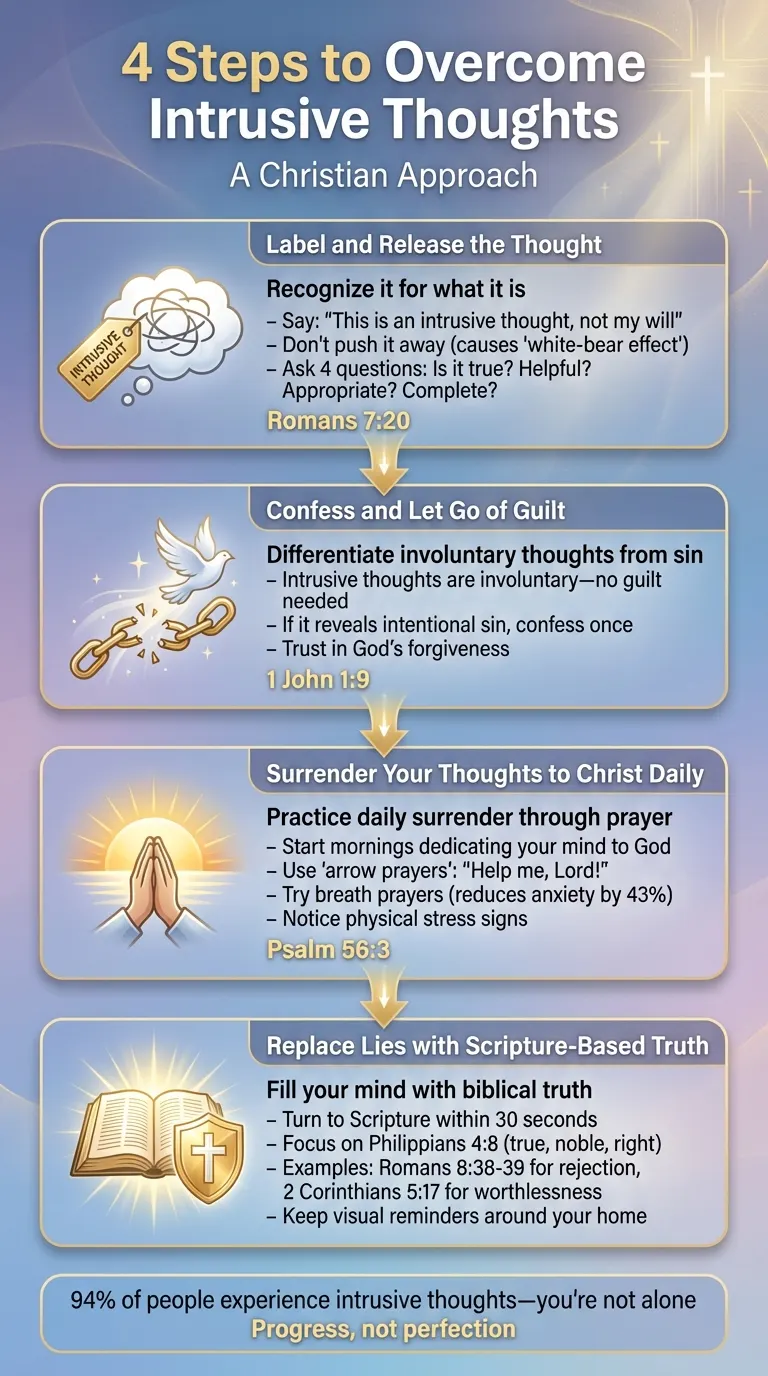
4 Biblical Steps to Overcome Intrusive Thoughts
Breaking free from intrusive thoughts involves both spiritual understanding and practical steps. These four steps can help you move past unwanted ideas and align your thinking with Christ. They build on the earlier discussion about how Scripture renews the mind and provide actionable habits for daily life.
Step 1: Label and Release the Thought
When an intrusive thought pops into your mind, recognize it for what it is. Label it by saying, "This is an intrusive thought, not my will". This simple acknowledgment helps create some distance between you and the thought. As the Apostle Paul said, "Now if I do what I do not want to do, it is no longer I who do it, but it is sin living in me that does it".
Avoid trying to push the thought away – it often backfires and makes the thought come back stronger (a phenomenon known as the "white-bear effect"). Instead, acknowledge its presence without reacting emotionally.
To determine where a thought comes from, ask yourself these four questions:
- Is it true and consistent with Scripture?
- Is it helpful – does it promote holiness or cause harm?
- Is it appropriate – does it reflect reality or come from fear?
- Is it complete – could it be a partial truth that ignores the whole picture?
As counselor Esther Smith puts it, "A half-truth masquerading as the whole truth becomes a complete untruth".
Step 2: Confess and Let Go of Guilt
It’s important to differentiate between intrusive thoughts and intentional sin. Intrusive thoughts are involuntary and not something to feel guilty about. Rusty Entrekin, a biblical counselor, explains:
"God will not condemn someone with OCD for thinking something that they do not want to think, any more than He would condemn someone with schizophrenia for hearing voices. There is no need to confess an intrusive thought."
However, if a thought reveals an intentional sinful desire, like harboring bitterness, confess it once to God and trust in His forgiveness, as promised in 1 John 1:9. Mark Ballenger, founder of AGW Ministries, advises, "Confess a sin once, and then move on. Anything more than that is unbiblical".
Through Christ, you are already made whole and forgiven.
Step 3: Surrender Your Thoughts to Christ Daily
Surrendering your thoughts to Christ is something you practice every day. Start your mornings by dedicating your mind to God in prayer. While you can’t control every thought that comes to mind, you can choose where to focus.
When intrusive thoughts arise, use quick "arrow prayers" like "Help me, Lord!". For deeper moments, try breath prayers: as you inhale, think, "When I am afraid…" and as you exhale, "…I put my trust in You". Research suggests that combining deep breathing with prayer can reduce obsessive-anxiety scores by as much as 43%.
Also, pay attention to physical signs of stress, like tension in your neck or shoulders. Simple actions like rolling your shoulders or stretching can help release this tension and interrupt the anxiety cycle.
Once you’ve surrendered your thoughts, actively replace any lingering lies with Scripture-based truth.
Step 4: Replace Lies with Scripture-Based Truth
To counter intrusive thoughts, fill your mind with truth. Within 30 seconds of a troubling thought, turn to Scripture for grounding. Instead of wrestling with the thought, focus on what is "true… noble… right" (Philippians 4:8).
For example, if you fear rejection, remind yourself of Romans 8:38-39: "Nothing can separate me from the love of God." If you struggle with feelings of worthlessness, declare 2 Corinthians 5:17: "I am a new creation in Christ." Keep visual reminders of these truths around your home to reinforce them.
Some people find it helpful to speak to themselves in the second person, saying, "You are having a thought about X", to create emotional distance and reduce the intensity of the thought.
The goal isn’t perfection but steady progress. By consistently replacing lies with Scripture, you train your mind to rest on God’s promises rather than on deceptive thoughts.
Spiritual Practices for a Renewed Mind
Building on the earlier steps, these daily spiritual practices can strengthen your mind against intrusive thoughts. They create a solid base for mental and spiritual well-being, helping your mind become more resilient to unwanted ideas.
Daily Prayer for Mental Strength
Prayer does more than nourish your spirit – it also soothes your nervous system. When paired with slow, deep breathing, prayer triggers your body’s natural calming mechanisms, easing the anxiety that intrusive thoughts often provoke.
Short, repeated breath prayers can break negative thought patterns. For instance, you might inhale while focusing on, "The Lord is my shepherd," and exhale with, "I shall not want" (Psalm 23:1). Or, when fear arises, breathe in, "When I am afraid," and breathe out, "I put my trust in You" (Psalm 56:3).
John Beeson, Co-lead Pastor at New Life Bible Fellowship, highlights the spiritual aspect of this practice:
"The battle for our minds, after all, isn’t merely neurological – it’s spiritual. So we need spiritual tools for the fight."
When a negative thought like "I am a failure" surfaces, counter it with a spoken prayer:
"Loving Father, thank you for adopting me and making me a saint in Christ."
Adding moments of deep Scripture meditation alongside prayer can further reinforce this sense of peace.
Meditating on Scripture
Biblical meditation takes a different approach than secular mindfulness. Instead of emptying your mind, you fill it with God’s Word, realigning your thoughts with the Bible’s call to renew your mind. The Hebrew word hagah, meaning "to resound", underscores the deep engagement of both mind and heart.
Ken Puls, Director of Publications for Founders Ministries, describes this practice:
"Meditation is pondering the Word in our hearts, preaching it to our own souls, and personally applying it to our own lives and circumstances."
To keep Scripture front and center, try placing notecards with Bible verses in areas you frequent, like your bathroom mirror or kitchen sink. You could also set a meaningful verse as your phone’s lock screen. During commutes, listening to an audio Bible playlist can turn idle time into moments of spiritual reflection.
Voice Journaling for Spiritual Growth
Voice journaling offers a hands-on way to process and release intrusive thoughts. Speaking your thoughts aloud creates a sense of separation from them. Addressing yourself in the second person – saying, "You are experiencing a random thought" rather than "I am thinking this" – can ease the emotional weight of those thoughts.
The K-LOVE Pastoral Care Team explains:
"Just by voicing these burdens, the weight of them already feels easier to bear."
This practice allows you to process stress in real time and replace negativity with truths rooted in Scripture. When an intrusive thought arises, speak it out loud, then counter it immediately with a Bible verse. This method of externalizing and examining your thoughts can interrupt the negative cycles that keep intrusive ideas lingering in your mind.
Using Psalmlog to Overcome Intrusive Thoughts

Building on the advantages of voice journaling for spiritual growth, Psalmlog offers tools that help address intrusive thoughts through a biblical perspective. By combining voice journaling with AI-driven insights, Psalmlog turns these challenges into opportunities for deeper reflection and spiritual renewal.
Capture and Reflect on Your Thoughts
Speaking your thoughts aloud can create a sense of separation from them. When an intrusive thought arises, you can use Psalmlog to record what you’re experiencing. This act of externalizing your emotions helps transform overwhelming feelings into something tangible and manageable for reflection.
As you record, you can also label the thought using Psalmlog’s built-in feature. This simple step of naming the thought reinforces the cognitive distancing process and reduces its emotional intensity. Additionally, Psalmlog’s scripture tagging feature connects your entries with relevant Bible verses, empowering you to "take every thought captive", as instructed in 2 Corinthians 10:5.
"Journaling helps externalize your inner experiences. When we keep emotions or thoughts in our minds, it can feel overwhelming and disorganized. Writing them down can create the space needed to really see what is happening and reflect more effectively".
Dr. Aerial Cetnar, PhD, Licensed Professional Counselor, highlights how this process can bring clarity and relief.
Beyond recording and labeling, Psalmlog provides personalized insights to guide your spiritual growth.
Get Personalized Biblical Guidance
After capturing your thoughts, Psalmlog’s AI analyzes your entries and delivers scripture-based insights tailored to your specific struggles. The app identifies recurring thought patterns and highlights situations that tend to trigger anxiety or intrusive ideas. It then offers Scripture-based truth statements to counteract these negative thoughts, equipping you with practical, biblical tools to combat them.
By consistently applying these insights, you can develop a habit of aligning your thoughts with God’s truth.
Build a Daily Mind Renewal Habit
Integrating Psalmlog into your daily routine strengthens your ability to align your thoughts with Scripture. The app’s Faith Builder plan (starting at $19.99/month) provides 300 minutes of recording time each month, ensuring you have ample space for daily journaling.
Features like the calendar view and personal insights dashboard allow you to track your progress over time. By consistently replacing intrusive thoughts with biblical truth, you take advantage of your brain’s neuroplasticity. Research shows that practices like labeling and refocusing – central to Psalmlog’s approach – can help up to 75% of committed users. Over time, this consistent effort helps intrusive thoughts fade, making room for healthier, more constructive patterns.
Conclusion
Intrusive thoughts don’t have to dominate your spiritual life or steal your peace. As mentioned earlier, most people experience these thoughts, so you’re far from alone in this challenge. The struggle involves both biological and spiritual aspects, which means addressing both is key.
Your daily habits can reshape not only your thought patterns but also your spiritual well-being. Moving forward, focus on three key principles: grounding yourself in Scripture, maintaining consistent spiritual practices, and relying on God’s strength instead of your own. When you recognize intrusive thoughts as just that – thoughts, not your true desires – and replace them with biblical truths like those in 2 Corinthians 10:5 and Philippians 4:8, you begin to rewire your brain in ways that align with God’s design. Studies even show that combining prayer with deep breathing can significantly reduce anxiety, proving how spiritual disciplines can lead to real, measurable change.
Consistency is essential for transformation. Craig Chamberlin explains:
"Peace grows as you practice the small, consistent habits… Every time you label, allow, breathe, and refocus, you carve a new neurological pathway".
Tools like Psalmlog can support this journey by helping you track your thoughts, find personalized biblical guidance, and monitor your progress over time.
Above all, trust in God’s control over your mind. Your identity isn’t shaped by fleeting thoughts but by your place as a child of God. Romans 8:1 reminds us:
"Therefore, there is now no condemnation for those who are in Christ Jesus".
When you feel overwhelmed, hold onto this promise: “The Lord is close to the brokenhearted and saves those who are crushed in spirit” (Psalm 34:18).
Your mind can shift from being a battleground of fear to a place of God-honoring creativity. Take the first step today: capture one thought, say a simple breath prayer, or jot down a journal entry. Use Psalmlog to guide and support you in this renewal process. With God’s help and steady practice, peace is closer than you think.
FAQs
Are intrusive thoughts a sin?
Intrusive thoughts, by their very nature, are not sins. They often arise involuntarily, outside of our control. What truly matters is how we choose to respond to them. Acting on these thoughts or dwelling on them in ways that lead to harmful actions or attitudes can lead us astray. But remember, God understands these struggles and does not hold us accountable for what we cannot control. Instead, center your mind on His truth through prayer and reflection on scripture, finding strength and guidance in His word.
How do I tell God’s voice from fear?
Recognizing God’s voice amidst fear starts with understanding His character. God speaks with peace, love, and truth, always in harmony with Scripture. On the other hand, fear tends to stir up anxiety or bring feelings of condemnation. To discern the source of an impression, measure it against Scripture: if it promotes faith, love, and obedience, it’s likely from God. Consistent prayer, immersing yourself in Scripture, and depending on the Holy Spirit are key practices that help believers sense God’s gentle, uplifting voice and separate it from fear’s overpowering negativity.
When should I seek professional help?
If intrusive thoughts are causing overwhelming distress, triggering panic attacks, or interfering with your daily life, it’s important to seek professional help. This becomes even more crucial if these thoughts persist or result in compulsive behaviors. A mental health professional can assist in addressing conditions such as OCD and offer support that aligns with your values and beliefs.